#SpaceCoast

A representative Starlink liftoff from SLC-40 at CCSFS.
Photo: Charles Boyer / Talk of Titusville.

About forty-five minutes before today’s scheduled liftoff, SpaceX announced that they were scrubbing for the day and would try to launch Falcon 9 tomorrow morning:

SpaceX added on their website later that, “Liftoff is targeted for 7:30 a.m. ET, with opportunities available until 11:28 a.m. ET.”

Updated added 3pm May 27, 2024

SpaceX has set the launch of another 23 Starlink satellites to low-Earth orbit aboard a Falcon 9 Monday morning from Space Launch Complex 40 at Cape Canaveral Space Force Station. According to the company, “Liftoff is targeted for 7:30 a.m. ET, with backup opportunities available until 11:30 a.m. ET. If needed, additional opportunities are also available on Tuesday, May 28 starting at 7:30 a.m. ET.”

The booster used for the mission will land downrange on the droneship Automated Spaceport Drone Ship ‘Just Read The Instructions’, which will be on station northeast of The Bahamas. Since the mission is not a Return To Launch Site mission, there won’t be any sonic boom on the Space Coast.

Payload

23 Starlink satellites, to be used in SpaceX’s orbital-based Internet service.

They are manufactured at SpaceX’s Starlink manufacturing facility in Redmond, Washington, are estimated to weigh 750-800 kg apiece and are about 3.0 meters (9.84 feet) long and 1.3 meters (3.94 feet) wide at liftoff. When a Starlink Mini V2 extends its solar panels, it is an estimated 98.5 feet in diameter.

Starlink Satellites.
Photo: SpaceX

Weather

Weather for the launch is again highly favorable, with 95% chances of acceptable weather in the start of the launch window, and slightly degrading to “only” 90% acceptable later in the day. If for some reason the launch doesn’t happen on Monday, the planned backup window is also good, but night quite as good as Monday: opening at a 90% chance of favorable range conditions, as Tuesday morning progresses, cumulus clouds drop the chances of acceptable weather at 85%.

In short, chances are very good that weather will not be a limiting factor for this mission.

Via 45th Weather Squadron, May 26, 2024

Sky Cover

The National Weather Center forecasts that roughly 10% of the sky will be covered by clouds during the launch window.

These estimates are hit-or-miss and in any case are highly local, but are interesting if you are planning to view the launch in person.

Graphic: National Weather Service

Trajectory

Falcon 9 will take a southeasterly direction tonight towards The Bahamas, as is customary for all Group 6 Starlink missions. Spectators looking toward the Atlantic Ocean from shore will see the rocket flying left to right.

Given that the flight is immediately offshore with no return to launch site, there will be no sonic boom from the launch on the Space Coast.

Booster

According to SpaceX’s Starlink 6-60 Mission page, “This is the 10th flight for the first stage booster supporting this mission, which previously launched Crew-6, SES O3b mPOWER, USSF-124, and six Starlink missions.”

That’s Booster B078, which last flew late last month on the Starlink 6-53 mission.

Booster B1078
Flight NumberPayloadDate
1Crew-6March 2, 2023
2O3b mPOWER 3 & 4April 28, 2023
3Starlink 6-4June 4, 2023
4Starlink 6-8August 7, 2023
5Starlink 6-16September 16, 2023
6Starlink 6-31December 3, 2023
7USSF-124February 14, 2024
8Starlink 6-46March 25, 2024
9Starlink 6-53April 23, 2024
Booster B1078 as of April 23, 2024

Countdown Timeline

There are key events in the countdown that you may hear called out in launch coverage.

Remember that once Propellant Loading (T-minus thirty-eight minutes) starts, Falcon 9 is committed to the launch attempt. Because of the nature of the cryogenic fuels used to power the rockets, any hold precludes a later launch attempt the same day. While it only rarely happens, there have been occasions where that has happened, and a launch scrub is called for the day’s attempt.

SpaceX provides the following countdown milestones on their mission information page:

Hours:Minutes:SecondsEvent
00:38:00SpaceX Launch Director verifies go for propellant load
00:35:00RP-1 (rocket grade kerosene) loading begins
00:35:001st stage LOX (liquid oxygen) loading begins
00:16:002nd stage LOX loading begins
00:07:00Falcon 9 begins engine chill prior to launch
00:01:00Command flight computer to begin final prelaunch checks
00:01:00Propellant tank pressurization to flight pressure begins
00:00:45SpaceX Launch Director verifies go for launch
00:00:03Engine controller commands engine ignition sequence to start
00:00:00Falcon 9 liftoff
Typical SpaceX countdown timeline is presented for information purposes only.

Timeline of Falcon 9 Flight

SpaceX has published a timeline of expected events during the mission:

Hours:Minutes:SecondsEvent
00:00:00Liftoff
00:01:11Max-Q (Moment of peak mechanical stress on the rocket)
00:02:261st stage main engine cutoff (MECO)
00:02:301st and 2nd stages separate
00:02:362nd stage engine starts (SES-1)
00:02:56Fairing deployment
00:06:091st stage entry burn begins
00:06:331st stage entry burn ends
00:07:591st stage landing burn begins
00:08:221st stage landing
00:08:412nd stage engine cutoff (SECO-1)
00:54:082nd stage engine starts (SES-2)
00:54:102nd stage engine cutoff (SECO-2)
01:05:17Starlink satellites deploy
via: SpaceX

All events up to the end of the 1st stage entry burn should be visible for launch spectators watching the launch in person, so long as clouds are not blocking the viewer’s line of sight. Fairing separation is generally only visible during daytime launches and then only using advanced optics like high-powered binoculars or a super-telephoto lens (500mm+).

Watching Online

SpaceCoastLaunchCalendar.com will have a livestream of the launch if you’re not able to watch the launch in person: Livestream

SpaceX will have a livestream of the launch on their website: Starlink 6-60 This will also be available on the X platform. Coverage starts about five minutes before liftoff.

Spaceflight Now will have coverage of the launch starting about one hour before liftoff on Youtube: link

For official updates regarding launch times, SpaceX.com is the best source of information. Starlink launch times change from time to time, and the company generally updates their website within minutes of the decision to change the launch time. This is very handy if none of the streaming options on YouTube have started their broadcasts.

Remember that there is a delay between a launch stream and the actual countdown clock. That is simply because of physics: it takes time for the signal to travel from the launch site, through the Internet, and back down to your phone, resulting in a five to fifteen-second delay.

Space Launch Schedule, an app for iOS and Android phones, has a real-time countdown clock that is accurate to a second, give or take. The app is free. Search the App Store or Google Play.

Launch Viewing: In Person

This morning’s planned launch is from SLC-40, on the south side of the Eastern Range (KSC and Cape Canaveral Space Force Station combined.) The southern parks in Titusville on Washington Avenue and FL-528/A1A in Cape Canaveral are the best spots to watch liftoff directly.

Restaurants With Good Launch Views

Given the early hours of the launch window (7:30AM – 11:30AM EDT) these restaurants may not be open for launch viewing. Later in the day, all three may well be, so if you are interested, be sure to call ahead to make sure they’ll be ready to serve you.

  • The Space Bar ($$$) – atop the Courtyard Marriott near Kennedy Parkway
  • New York New York ($$) – on the Indian River with an outdoor seating area. Is family-friendly.
  • Shiloh’s ($$$) — located on the Indian River with an outdoor deck overlooking KSC/CCSFS

Indirect Views

There are several excellent viewing spots for SLC-40 launches that offer indirect views — meaning you won’t see the rocket until it clears obstructions such as trees, buildings, even a storm berm in one case.

  • Jetty Park, Port Canaveral
    • Fee required, much be purchased in advance: Port Canaveral Store
    • It’s very possible to see a cruise ship coming or going.
    • The pier especially has great views
  • Cocoa Beach
    • Parking fees (probably). Pay with your smartphone on the parking app. There are signs everywhere telling you how.
    • Further away, but still good views.
  • Northern Titusville Parks
    • Further away, but really nice views.

Playalinda Beach

View From Playalinda Beach
Photo: Charles Boyer / ToT

Playalinda Beach out on the Cape Canaveral National Seashore will be open to spectators, that is, if KSC Security and the National Park Service allow viewers for the launch. It opens to visitors at 6 AM.

This varies from launch to launch, but as a general rule, they have allowed spectators to watch Starlink launches from the beach. A now-dwindling brush fire near Beach Road may affect Playalinda plans, so call ahead to be sure.

Cape Canaveral National Seashore Playalinda Beach
Phone: (386) 428-3384 x0
Current operating hours: 6:00 AM–8:00 PM

If you are going to Playalinda, and if it is open, remember these general tips. Some may not apply to this particular launch.

  • Get there at least two hours early, or better, earlier than that. Lines are long at the entry gate and they will only allow as many spectator vehicles as there are parking space available.
  • If the launch L-0 time is moved to after 8PM, you must leave Playalinda, as the National Park Service is very strict about closing hours.
  • Cape Canaveral National Seashore has a fee to get in and cash is not accepted. Debit and credit cards are okay, or if you have one of the National Park Service’s passes for the Seashore or the National Parks, that will work as well.
  • Cellphone service is spotty at best and often non-existent at Playalinda. Don’t count on your cellphone to keep up with the launch; you might get a signal, or you might not.
  • You are not allowed to view from the pullouts on Beach Road. Stanchions will block them. You’ll have to park and go to the beach.
  • Refreshments are not available. There are no stores at Cape Canaveral National Seashore, so you’ll need to bring drinks and food if you want any while you’re there.
  • Rangers will keep you back a certain distance from the launch area on the beach. Even if the beach is open, you’ll still be unable to go down to the fence that demarcates the normal security zone. There’s a line that spectators can’t go past somewhat north of the fence. That’s for safety and security.

Be prepared for potential changes or pushbacks in the launch schedule, and keep up by monitoring the live stream links mentioned above.

Keep up with launch news and other space events that affect the local area by subscribing to alerts when we publish a new article by entering your email at the link at the bottom of this page, or by visiting Space Talk here on the website. It’s free, and you can cancel at any time.

Read more

The smoldering aftermath of a wildfire in Merritt Island National Wildlife Refuge.
Photo: Charles Boyer / Talk of Titusville

A lightning strike from a severe thunderstorm started a conflagration in Merritt Island Wildlife Refuge this afternoon. It is north of Kennedy Space Center, and is currently no threat to property or human endeavor — in other words, the facilities at Kennedy Space Center.

1PM EDT Update: Beach Road to Cape Canaveral National Seashore and Playalinda Beach has reopened to traffic. Only lingering wildfire smoke is in the area of the road, and any smoldering fire remaining active appears to be located well south of the road.

Previous Updates

Merritt Island National Wildlife Released this statement on social media at 10:25 AM Sunday: “Update on the current wildfire in the Peacocks Pocket marsh. Fire crews will be flying over the area this morning to better assess the size and scope of the fire. A plan of action will be formed after this flight and will depend greatly on the expected weather conditions. This area last burned a little over 3 years ago which is the natural cycle for refuge.”

MINWR official statement at around 11PM EDT May 25: “A lightning caused fire is currently burning in the Peacocks Pocket impoundment. The fire is estimated to be 150-200 acres. Fish & Wildlife firefighters are onsite and will monitor the blaze throughout the night. Expect all access roads to Peacocks Pocket to be closed tomorrow until fire crews determine they are safe, including: West Gator Creek, Gator Creek East Gator Creek, and Catfish Creek roads.”

11PM MAY 25: KSC Police are currently turning unbadged cars away Gate 4TT, at the end of Max Brewer Bridge. They have also cleared the Refuge of spectators. (see above: the road has reopened to traffic headed towards CCNS/Playlinda Beach and Gate 4 for KSC)

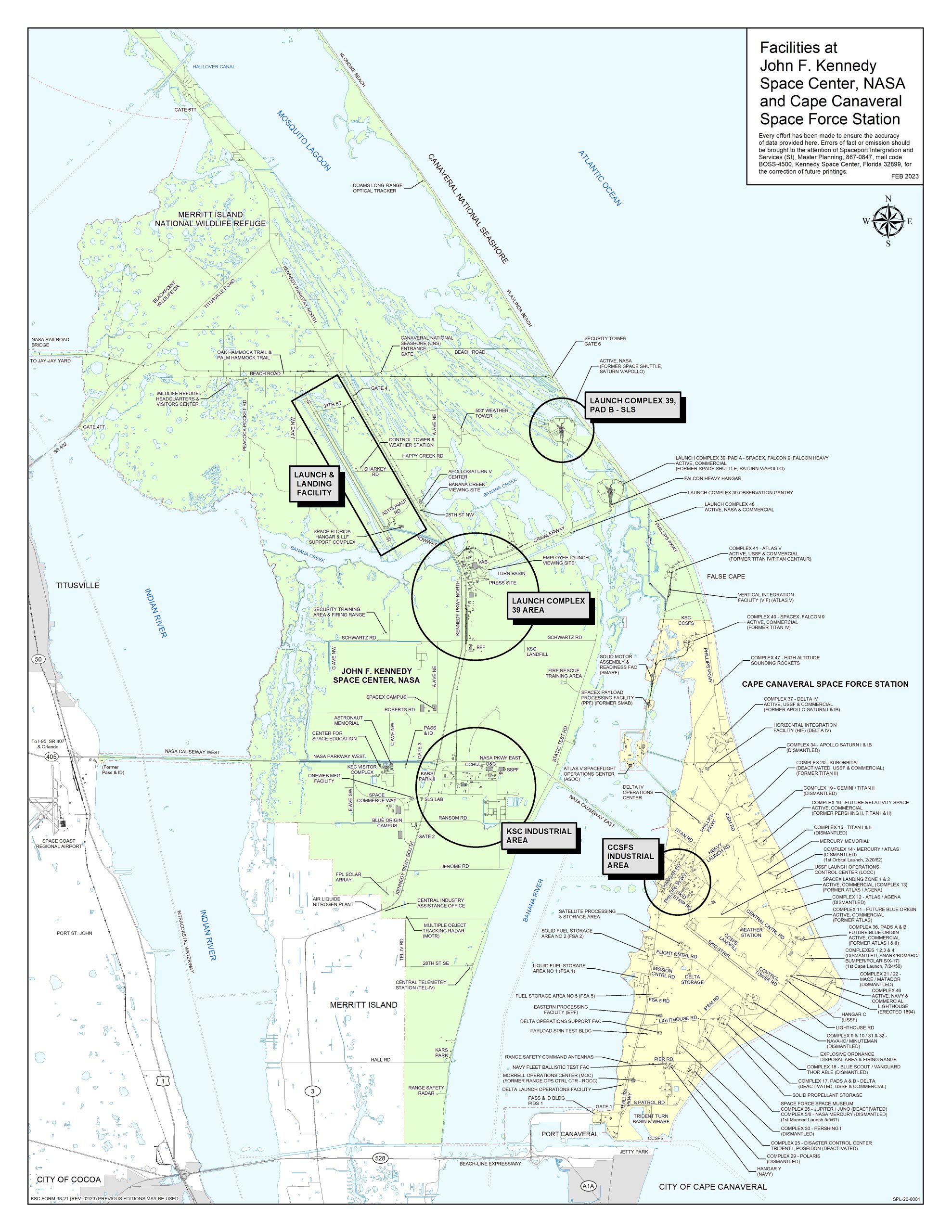
The general location of the wildfire in Merritt Island National Wildlife Refuge.
Graphic: original map is from the 2021 KSC Facilities Map, NASA

12 PM EDT, Sunday: Beach Road Open, Fire Seems To Be Dwindling

From a distance and to the uneducated naked eye, the wildfire is now starting to burn itself out, especially on its northern edges. Still far away from operational KSC facilities and buildings, no flames could be seen from Beach Road or US-1 in Titusville, which is very different than twelve hours earlier.

That does not mean that the fire is no longer any danger — a change in weather conditions or wind direction and speeds could fan the flames. Stay tuned to local authorities for official status updates. We will pass them along as soon as we receive them.

1 PM Sunday, May 26: As seen from US-1 in Titusville, a perspective of the wildfire in MINWR: it is far away from any launch pad or KSC buildings, with the closest operational area of the space center being the Shuttle Landing Facility, but even that is at least two miles east. Click to enlarge
Photo: Charles Boyer / Talk of Titusville
12PM Sunday, May 26: a fire hotspot as seen across the Indian River from Titusville.
Photo: Charles Boyer / ToT


11 PM EDT, Saturday: KSC Closes Beach Road

Around 11 PM EDT, KSC Police were emptying MINWR and were stopping people at the end of Max Brewer Bridge. KSC Police asked me to leave, and that’s exactly what I immediately did: I skedaddled.

Closeup of the fire line near Beach Road Saturday night.
Photo: Charles Boyer / Talk of Titusville
A waning moon rises over Beach Road through the smoke from wildfire in Merritt Island National Wildlife Refuge Saturday night.
Photo: Charles Boyer / Talk of Titusville
Closeup of the blaze.
Photo: Charles Boyer / ToT

7 PM EDT, Saturday: Fire Is Spreading

Late afternoon wildfire scene in Merritt Island Wildlife Refuge.
Photo: Charles Boyer / Talk of Titusville
Read more

The flight path of Falcon 9 carrying the Starlink 6-63 mission to orbit this evening, as seen from the Mid Course Radar Site on Kennedy Parkway inside the Merritt Island Wildlife Refuge near Allenhurst, Florida. This radar system tracks rockets as they launch. A full moon is in the background.
Photo: Charles Boyer / Talk of Titusville

SpaceX launched another 23 Starlink V2 Mini satellites to orbit tonight from Kennedy Space Center, right at the end of the planned launch window. Liftoff was at 10:45 PM EDT from Pad LC-39A.

Booster B1077 completed its 13th mission successfully after it touched down on the droneship ASDS ‘Just Read The Instructions’ northeast of The Bahamas about 8.25 minutes after liftoff. JRTI will return to Port Canaveral after a few days, and the booster will be returned to SpaceX’s Hangar X at Kennedy Space Center for inspection, refurbishment and preparation for its next flight.

At 11:52 PM EDT, SpaceX announced that the payload had been successfully deployed, marking another 100% successful launch by the company.

Booster B1077.13 Record

SpaceX Booster B1077
FlightMissionDate
1Crew-510/15/2023
2GPS III SV0601/18/2023
3 Inmarsat-6 F202/18/2023
4Starlink Group 5-1003/29/2023
5Dragon CRS-2 SpX-2806/05/2023
6Galaxy 3708/03/2023
7Starlink Group 6-1309/01/2023
8Starlink Group 6-2510/30/2023
9Starlink Group 6-3312/07/2023
10Northrup Grumman NG-2001/30/2024
11Starlink Group 6-4303/10/2024
12Starlink Group 6-5104/17/2024
13Starlink Group 6-6305/23/2024
Booster B1077 flights as of May 23, 2024

Launch Replay

Next Launch

Memorial Day, SpaceX plans to launch another set of satellites for Starlink Group 6. This launch is planned for the morning hours, one where Falcon 9 will travel the well-flown path to the southeast as it delivers more members of its low-Earth orbit constellation that provides Internet access to underserved markets.

Mission: Starlink 6-60
Date: NET May 27, 2024
Organization: SpaceX
Rocket: Falcon 9
Launch Site: SLC-40, Cape Canaveral Space Force Station
Launch Window: 07:30 AM – 11:30 AM EDT
Payload: 23 communications satellites
As of May 17, 2024. Subject to change without notice.

Keep up with launch news and other space events that affect the local area by subscribing to alerts when we publish a new article by entering your email at the link at the bottom of this page, or by visiting Space Talk here on the website. It’s free and you can unsubscribe at any time.

Read more

Falcon 9 Liftoff From LC-39A
Photo: Charles Boyer / ToT

Lather, rinse, repeat: SpaceX plans to launch another Starlink Group 6 mission early this evening from Pad LC-39A at Kennedy Space Center. The launch window opens at 6:45 PM EDT and extends until10:45 PM EDT the same day.

Update: SpaceX now has “Liftoff targeted for 10:13 p.m. ET. If needed, additional opportunities are also available on Friday, May 24, starting at 6:26 p.m. ET.”

The booster used for the mission will land downrange on the droneship ASDS ‘Just Read The Instructions’, which is stationed northeast of The Bahamas, so there won’t be any sonic boom on the Space Coast tonight.

Payload

23 Starlink satellites, to be used in SpaceX’s orbital-based Internet service. They are manufactured at SpaceX’s Starlink manufacturing facility in Redmond, Washington, are estimated to weigh 750-800 kg apiece and are about 3.0 meters (9.84 feet) long and 1.3 meters (3.94 feet) wide at liftoff. When a Starlink Mini V2 extends its solar panels, it is an estimated 98.5 feet in diameter.

Each Starlink satellite is equipped with a Argon-fueled Hall-effect thruster (HET) for maneuverability. Once the satellite’s useful lifetime concludes, SpaceX commands it to re-enter the Earth’s atmosphere, where it burns up safely and leaves no space junk behind.

According to SpaceX each HET has the following specifications:

  • 70 mN thrust
  • 2500 s specific impulse – 50% total efficiency
  • 4.2 kW power –
  • 2.1 kg mass
  • Center mounted cathode

There are now around 6.000 Starlink satellites in orbit, with as many as 30,000 planned when SpaceX completes the Starlink network.

SpaceX recently announced that it has three million subscribers worldwide in nearly one hundred countries. This follows its announcement of 2.7 million subscribers in April, clearly showing that the service is growing rapidly.

Weather

 Just like last night’s forecast for Starlink 6-62, weather is about as good as it gets this time of year on the Space Coast: the 45th Weather Squadron of the US Space Force has forecast only a 5% chance of a weather-related range violation (POV), meaning that they expect a 95% chance for acceptable weather through the launch window. In the event of a scrub or launch delay, tomorrow, conditions are slightly less favorable, with a 90% percent chance of favorable conditions and a 10% Probability of Violation.

Via USSF 45th Weather Squadron

Sky Cover

The National Weather Center forecasts that roughly 5-15% of the sky will be covered by clouds during the launch window. These estimates are often somewhat pessimistic, can be hit-or-miss and in any case are highly local, but are interesting if you are planning to view the launch in person.

The bottom line is that this evening’s launch should not have many clouds interrupting a spectator’s view of the rocket as it flies to space.

Via National Weather Service

Trajectory

The Bimini Highway. Falcon 9 will take a southeasterly direction tonight towards The Bahamas, as has been customary for all Group 6 Starlink missions. Spectators looking in the direction of the Atlantic Ocean will see the rocket flying left to right.

Given that the flight is immediately offshore with no return to launch site, there will be no sonic boom from the launch on the Space Coast.

Booster

According to SpaceX’s Starlink 6-63 Mission page, “This is the 13th flight for the first stage booster supporting this mission, which previously launched Crew-5, GPS III Space Vehicle 06, Inmarsat I6-F2, CRS-28, Intelsat G-37, NG-20, and six Starlink missions.”

That’s Booster B1077. This booster flew 36 days ago when it lofted the Starlink Group 6-51 mission.

SpaceX Booster B1077
FlightMissionDate
1Crew-510/15/2023
2GPS III SV0601/18/2023
3 Inmarsat-6 F202/18/2023
4Starlink Group 5-1003/29/2023
5Dragon CRS-2 SpX-2806/05/2023
6Galaxy 3708/03/2023
7Starlink Group 6-1309/01/2023
8Starlink Group 6-2510/30/2023
9Starlink Group 6-3312/07/2023
10Northrup Grumman NG-2001/30/2024
11Starlink Group 6-4303/10/2024
12Starlink Group 6-5104/17/2024
Booster 1077 flight record as of April 17, 2024

Countdown Timeline

There are key events in the countdown that you may hear called out in launch coverage.

Remember that once Propellant Loading (T-minus thirty-eight minutes) starts, Falcon 9 is committed to the launch attempt. Because of the nature of the cryogenic fuels used to power the rockets, any hold precludes a later launch attempt the same day. While it only rarely happens, there have been occasions where that has happened, and a launch scrub is called for the day’s attempt.

SpaceX provides the following countdown milestones on their mission information page:

Hours:Minutes:SecondsEvent
00:38:00SpaceX Launch Director verifies go for propellant load
00:35:00RP-1 (rocket grade kerosene) loading begins
00:35:001st stage LOX (liquid oxygen) loading begins
00:16:002nd stage LOX loading begins
00:07:00Falcon 9 begins engine chill prior to launch
00:01:00Command flight computer to begin final prelaunch checks
00:01:00Propellant tank pressurization to flight pressure begins
00:00:45SpaceX Launch Director verifies go for launch
00:00:03Engine controller commands engine ignition sequence to start
00:00:00Falcon 9 liftoff
Typical SpaceX countdown timeline is presented for information purposes only.

Timeline of Falcon 9 Flight

SpaceX has published a timeline of expected events during the mission:

Hours:Minutes:SecondsEvent
00:00:00Liftoff
00:01:11Max-Q (Moment of peak mechanical stress on the rocket)
00:02:261st stage main engine cutoff (MECO)
00:02:301st and 2nd stages separate
00:02:362nd stage engine starts (SES-1)
00:02:56Fairing deployment
00:06:091st stage entry burn begins
00:06:331st stage entry burn ends
00:07:591st stage landing burn begins
00:08:221st stage landing
00:08:412nd stage engine cutoff (SECO-1)
00:54:082nd stage engine starts (SES-2)
00:54:102nd stage engine cutoff (SECO-2)
01:05:17Starlink satellites deploy
via: SpaceX

All events up to the end of the 1st stage entry burn should be visible for launch spectators watching the launch in person, so long as clouds are not blocking the viewer’s line of sight. Fairing separation is generally only visible during daytime launches and then only using advanced optics like high-powered binoculars or a super-telephoto lens (500mm+).

Watching Online

SpaceCoastLaunchCalendar.com will have a livestream of the launch if you’re not able to watch the launch in person: Livestream

SpaceX will have a livestream of the launch on their website: Starlink 6-63 This will also be available on the X platform. Coverage starts about five minutes before liftoff.

Spaceflight Now will have coverage of the launch starting about one hour before liftoff on Youtube: link

For official updates regarding launch times, SpaceX.com is the best source of information. Starlink launch times change from time to time, and the company generally updates their website within minutes of the decision to change the launch time. This is very handy if none of the streaming options on YouTube have started their broadcasts.

Remember that there is a delay between a launch stream and the actual countdown clock. That is simply because of physics: it takes time for the signal to travel from the launch site, through the Internet, and back down to your phone, resulting in a five to fifteen-second delay.

Space Launch Schedule, an app for iOS and Android phones, has a real-time countdown clock that is accurate to a second, give or take. The app is free. Search the App Store or Google Play.

Launch Viewing: In Person

This evening’s planned launch is from LC-39A at Cape Canaveral, which means that the best direct views of liftoff are the northern Titusville riverfront parks, one of the local businesses or Playalinda Beach: 

Restaurants With Good Launch Views

The following restaurants will be open for the beginning of the launch window.

  • The Space Bar ($$$) – atop the Courtyard Marriott near Kennedy Parkway
  • New York New York ($$) – on the Indian River with an outdoor seating area. Is family-friendly.
  • Shiloh’s ($$$) — located on the Indian River with an outdoor deck overlooking KSC/CCSFS

Playalinda Beach

View From Playalinda Beach
Photo: Charles Boyer / ToT

Playalinda Beach out on the Cape Canaveral National Seashore will be open to spectators, that is, if KSC Security and the National Park Service allow viewers for the launch. This varies from launch to launch, but as a general rule, they have allowed spectators to watch Starlink launches from the beach. You could be as close as 4.25 miles from the launch pad at liftoff.

Generally speaking, spectators have been allowed at Playalinda if the mission is not a national-security mission (for example, a National Reconnaissance Office payload) or a NASA mission. That’s not a certainty, however, and it would be wise to call ahead before making the trip out.

Cape Canaveral National Seashore Phone: 386 428-3384 x0

If you are going to Playalinda, and if it is open, remember:

  • Get there at least two hours early, or better, earlier than that. Lines are long at the entry gate and they will only allow as many spectator vehicles as there are parking space available.
  • If the launch L-0 time is moved to after 8PM, you must leave Playalinda, as the National Park Service is very strict about closing hours.
  • Cape Canaveral National Seashore has a fee to get in and cash is not accepted. Debit and credit cards are okay, or if you have one of the National Park Service’s passes for the Seashore or the National Parks, that will work as well.
  • Cellphone service is spotty at best and often non-existent at Playalinda. Don’t count on your cellphone to keep up with the launch; you might get a signal, or you might not.
  • You are not allowed to view from the pullouts on Beach Road. Stanchions will block them. You’ll have to park and go to the beach.
  • Refreshments are not available. There are no stores at Cape Canaveral National Seashore, so you’ll need to bring drinks and food if you want any while you’re there.
  • Rangers will keep you back a certain distance from the launch area. If the beach is open, you’ll still be unable to go down to the fence that demarcates the normal security zone. There’s a line that spectators can’t go past somewhat north of the fence. That’s for safety and security.

Other Viewing Locations

Cocoa Beach, Cocoa Beach PierJetty Park Pier will have indirect views, meaning that liftoff will not be visible, but after the rocket clears the pad and any ground obstructions, you will be able to see Falcon 9 ascending clearly assuming there are no clouds between you and the rocket.

Be prepared for potential changes or pushbacks in the launch schedule, and keep up by monitoring the live stream links mentioned above.

Keep up with launch news and other space events that affect the local area by subscribing to alerts when we publish a new article by entering your email at the link at the bottom of this page, or by visiting Space Talk here on th

Read more

-starlink-6-62_DSC1538
SpaceX Starlink 6-62, as seen just south of the Cocoa Beach Pier.
Photo: Charles Boyer / ToT

Beneath a full moon this evening, SpaceX launched another twenty-three Starlink Mini V2 satellites to orbit after successfully launching the Starlink 6-62 mission from Space Launch Complex 40 from Cape Canaveral Space Force Station this evening.

Liftoff was at 10:35 PM EDT. Around 8.3 minutes after liftoff, the first-stage booster used for the mission, tail number B1080, touched down safely on ASDS ‘A Shortfall of Gravitas’, stationed downrange in the Atlantic Ocean. After landing, B1080 has now flown eight times.

After a few days, the droneship will return to Port Canaveral, and B1080 will be transported to SpaceX’s Hangar X facility at Kennedy Space Center. There, it will be inspected, refurbished, and prepared for its next mission.

Payload

23 Starlink satellites, to be used in SpaceX’s orbital-based Internet service. They are manufactured at SpaceX’s Starlink manufacturing facility in Redmond, Washington.

Booster B1080.8

As of tonight, SpaceX’s Booster B1080.8 has flown the following missions successfully:

Booster B1080
Flight NumberMissionDate
1Axiom-2May 21, 2023
2EuclidJuly 1, 2023
3Starlink 6-11August 27 2023
4Starlink 6-24October 22, 2023
5Axiom-3January 18, 2024
6CRS-30March 21, 2024
7Starlink 6-52April 18, 2024
8Starlink 6-62May 22, 2024
Booster B1080 Flight Record as of May 22, 2024

Launch Replay

If you missed the launch (or were watching in-person) here’s a replay of the SpaceX coverage of the launch.

Interesting Stats

  • 54th launch by SpaceX this year
  • 25th launch from SLC-40 this year
  • 5 days, 22:13:00 turnaround for this pad
  • 365th SpaceX launch all time
  • 311th Falcon Family Booster landing
  • 82nd landing on JRTI
  • 266th consecutive successful Falcon 9 launch (excluding Amos-6) (if successful)

Next Launch

SpaceX plans to launch another set of Starlink satellites down the Bimini Highway to join Group 6. Launch will be in late afternoon or early evening. Check back at Talk of Titusville for a launch preview on Thursday May 23.

Mission: Starlink 6-63
Date: NET May 23, 2024
Organization: SpaceX
Rocket: Falcon 9
Launch Site: LC-39A, Kennedy Space Center
Launch Window: 06:45 PM – 10:45 PM EDT
Payload: 23 communications satellites
As of May 22, 2024. Subject to change without notice.

Keep up with launch news and other space events that affect the local area by subscribing to alerts when we publish a new article by entering your email at the link at the bottom of this page, or by visiting Space Talk here on the website. It’s free and you can unsubscribe at any time.

Read more

SpaceX will launch another 23 Starlink Mini V2 satellites in the later evening hours tonight from Space Launch Complex 40 at Cape Canaveral Space Force Station in Florida. The launch window opens at 10:33 PM EDT and extends to 2:33 AM EDT Thursday. The booster used for the mission will land downrange on the droneship ASDS ‘A Shortfall of Gravitas’, so there will not be a sonic boom on the Space Coast tonight.

Payload

23 Starlink satellites, to be used in SpaceX’s orbital-based Internet service. They are manufactured at SpaceX’s Starlink manufacturing facility in Redmond, Washington.

SpaceX recently announced that it has three million subscribers worldwide in nearly one hundred countries. This follows its announcement of 2.7 million subscribers in April and clearly shows that the service is growing rapidly.

Weather

 Tonight’s forecast is as good as it gets this time of year on the Space Coast: the 45th Weather Squadron of the US Space Force has forecast only a 5% chance of a weather-related range violation (POV), meaning that they expect a 95% chance for acceptable weather through the launch window. The same forecast remains effectively the same should technical reasons delay tonight’s launch: a 5% POV with a 95% chance of acceptable conditions on the range.

The 45th provides a good description of conditions in their forecast discussion: “East-northeasterly winds are expected today around an area of low pressure to the east of Florida that will continue to drift farther east through the day. With the onshore flow, a few showers or a storm may move across the Spaceport at times, with the highest chances midday with the development of the east coast sea breeze. As this feature moves farther out to sea on Wednesday, it will pull in drier air that will limit shower and storm chances along the coast for mid-week.”

Sky Cover

The National Weather Center forecasts that roughly 15% of the sky will be covered by clouds during the launch window. These estimates are often hit-or-miss and are highly local, but are interesting if you are planning to view the launch in person.

Trajectory

Falcon 9 will take a southeasterly direction tonight, as is customary for Group 6 Starlink missions.

Given that the flight is immediately offshore with no return to launch site, there will be no sonic boom from the launch on the Space Coast.

Booster: B-1080

According to SpaceX on the official mission page, the booster used tonight will be on its eighth mission: “This is the eighth flight for the first stage booster supporting this mission, which previously launched ESA Euclid, Ax-2, Ax-3, CRS-30, and three Starlink missions.”

That’s B-1080, which last flew on April 18th.

Booster B-1080, launching Starlink 6-52 on April 18th.
Photo: Charles Boyer / ToT
Booster B1080
Flight NumberMissionDate
1Axiom-2May 21, 2023
2EuclidJuly 1, 2023
3Starlink 6-11August 27 2023
4Starlink 6-24October 22, 2023
5Axiom-3January 18, 2024
6CRS-30March 21, 2024
7Starlink 6-52April 18, 2024
Booster B1080 Flight Record as of April 18, 2024

Countdown Timeline

There are key events in the countdown that you may hear called out in launch coverage.

Remember that once Propellant Loading (T-minus thirty-eight minutes) starts, Falcon 9 is committed to the launch attempt. Because of the nature of the cryogenic fuels used to power the rockets, any hold precludes a later launch attempt the same day. While it only rarely happens, there have been occasions where that has happened, and a launch scrub is called for the day’s attempt.

SpaceX provides the following countdown milestones on their mission information page:

Hours:Minutes:SecondsEvent
00:38:00SpaceX Launch Director verifies go for propellant load
00:35:00RP-1 (rocket grade kerosene) loading begins
00:35:001st stage LOX (liquid oxygen) loading begins
00:16:002nd stage LOX loading begins
00:07:00Falcon 9 begins engine chill prior to launch
00:01:00Command flight computer to begin final prelaunch checks
00:01:00Propellant tank pressurization to flight pressure begins
00:00:45SpaceX Launch Director verifies go for launch
00:00:03Engine controller commands engine ignition sequence to start
00:00:00Falcon 9 liftoff
Typical SpaceX countdown timeline is presented for information purposes only.

Timeline of Falcon 9 Flight

SpaceX has published a timeline of expected events during the mission:

Hours:Minutes:SecondsEvent
00:00:00Liftoff
00:01:11Max-Q (Moment of peak mechanical stress on the rocket)
00:02:261st stage main engine cutoff (MECO)
00:02:301st and 2nd stages separate
00:02:362nd stage engine starts (SES-1)
00:02:56Fairing deployment
00:06:091st stage entry burn begins
00:06:331st stage entry burn ends
00:07:591st stage landing burn begins
00:08:221st stage landing
00:08:412nd stage engine cutoff (SECO-1)
00:54:082nd stage engine starts (SES-2)
00:54:102nd stage engine cutoff (SECO-2)
01:05:17Starlink satellites deploy
via: SpaceX

All events up to the end of the 1st stage entry burn should be visible for launch spectators watching the launch in person, so long as clouds are not blocking the viewer’s line of sight. Fairing separation is generally only visible during daytime launches and then only using advanced optics like high-powered binoculars or a super-telephoto lens (500mm+).

Watching Online

SpaceCoastLaunchCalendar.com will have a livestream of the launch if you’re not able to watch the launch in person: Livestream

SpaceX will have a livestream of the launch on their website: Starlink 6-62 This will also be available on the X platform. Coverage starts about five minutes before liftoff.

Spaceflight Now will have coverage of the launch starting about one hour before liftoff on Youtube: link

For official updates regarding launch times, SpaceX.com is the best source of information. Starlink launch times change from time to time, and the company generally updates their website within minutes of the decision to change the launch time. This is very handy if none of the streaming options on YouTube have started their broadcasts.

Remember that there is a delay between a launch stream and the actual countdown clock. That is simply because of physics: it takes time for the signal to travel from the launch site, through the Internet, and back down to your phone, resulting in a five to fifteen-second delay.

Space Launch Schedule, an app for iOS and Android phones, has a real-time countdown clock that is accurate to a second, give or take. The app is free. Search the App Store or Google Play.

Launch Viewing: In Person

This evening’s planned launch is from SLC-40 at Cape Canaveral, which means that the best direct views of liftoff are: 

Restaurants With Good Launch Views

Given the late hour of the launch, most local businesses will be closed for the night. Space Bar may still be open for the beginning of the launch window. Call ahead if you are interested in viewing from there to be sure.

  • The Space Bar ($$$) – atop the Courtyard Marriott near Kennedy Parkway
  • New York New York ($$) – on the Indian River with an outdoor seating area. Is family-friendly.
  • Shiloh’s ($$$) — located on the Indian River with an outdoor deck overlooking KSC/CCSFS

Other Viewing Locations

Cocoa Beach, Cocoa Beach PierJetty Park Pier will have indirect views, meaning that liftoff will not be visible, but after the rocket clears the pad and any ground obstructions, you will be able to see Falcon 9 ascending clearly assuming there are no clouds between you and the rocket.

Be prepared for potential changes or pushbacks in the launch schedule, and keep up by monitoring the live stream links mentioned above.

Jetty Park will be closed at the time of the launch, but viewers can walk up the beach to the area.

Interesting Stats

  • 54th launch by SpaceX this year
  • 25th launch from SLC-40 this year
  • 5 days, 22:13:00 turnaround for this pad
  • 365th SpaceX launch all time
  • 311th Falcon Family Booster landing
  • 82nd landing on JRTI
  • 266th consecutive successful Falcon 9 launch (excluding Amos-6) (if successful)

Keep up with launch news and other space events that affect the local area by subscribing to alerts when we publish a new article by entering your email at the link at the bottom of this page, or by visiting Space Talk here on the website. It’s free and you can unsubscribe at any time

Read more

Falcon 9 lifts from the Eastern Range’s Cape Canaveral Space Force Station in 2024.
Photo: Charles Boyer / ToT

One does not have to work in the space industry to know that the Eastern Range is a very busy place these days. Less than ten years ago, the gaps between rocket launches were often measured in weeks or months. For example, in 2016, there were 23 launches from the Space Coast, and only 16 in 2017.

Today, in 2024, there are often two or more orbital launches per week and sometimes as many as two in one day from the combined facilities of Kennedy Space Center and Cape Canaveral Space Force Station. There were 73 launches from here in 2023, and as many as 111 could happen this year. As such, bottlenecks and competing priorities for launch times and resources are rising, leading Congress to possibly instruct the US Space Force to consider offloading some national security launches to other sites.

The House Armed Services Committee’s draft fiscal 2025 defense policy bill has an interesting requirement: to study the possibility of launching NSSL (national security) payloads from other ranges than Vandenberg SFB and Cape Canaveral SFS as soon as 2025. Remember that this is a draft of the bill in committee and that it has a long way to go before it becomes law if, indeed, Congress and the current Administration can agree on a budget in the first place.

Spaceports in the United States

There are some twenty spaceport-designated facilities in the US today. Only five of them are capable of supporting vertical rocket launches: the Eastern (Cape Canaveral / KSC) and Western (Vandenberg SFB) Ranges, Alaska’s Pacific Spaceport Complex, Spaceport America near southeast of Truth or Consequences, New Mexico, and the combined areas of Wallops Island — Mid-Atlantic Regional Spaceport and Wallops Flight Facility in Virginia. That in mind, the House committee’s draft bill says those sites must be considered for additional NSSL launches.

Western Range / Vandenberg SFB

SpaceX launch from Vandenberg
Photo: SpaceX

SpaceX and United Launch Alliance already use this facility for many launches, with the frequency of those launches expected to rise drastically over the next few years. SpaceX plans to launch 90 rockets into space from the Western Range by 2026, while ULA is working towards certification of the once-launched Vulcan for national security payloads that would include the Western Range as a launch point.

According to many reports, those plans—especially the SpaceX plans—are running into local opposition. The California Coastal Commission, a powerful agency in the State of California, and other environmental groups have questioned whether the planned increase should be allowed. This is an ongoing issue with no resolution in the foreseeable future.

Wallops Island

Rocket Lab Electron launching from Wallops Island
Photo: Charles Boyer / ToT

Wallops Island is an active spaceport where Rocket Lab and Northrup Grumman have conducted orbital launches in recent years. Rocket Lab is building a new launch pad for its future Neutron reusable rocket. NG is working with Firefly Aerospace to create a new variant of the Antares rocket it inherited from its acquisition of Orbital Sciences in 2018. That rocket is set to fly as soon as 2025.

Wallops makes logical sense for additional NSSL work, especially when Neutron and Antares enter service. They also have the land to develop new launch pads for new customers, giving that site great growth potential.

Pacific Spaceport Complex, Alaska

Despite PSCA having the largest launch azimuth range of any spaceport in the US that can access high-inclination, polar, and sun-synchronous orbits between 59° and 110° inclination, the Pacific Spaceport Complex has been mainly a development site for startups — ABL and Astra have been its main users the past few years, to mixed results. Previous users have included Northrup Grumman, but the aerospace giant has not launched from the facility since 2011.

The site opened in 1998 and has hosted 31 launches. It has hosted Athena I, Minotaur IV, Astra Rocket, and the RS1 rockets, with one successfully orbiting: on 19 November 2021, Astra’s LV0007 rocket achieved orbit.

That may be partly due to the facility being in Alaska and the cool local climate: located near the Bering Sea, Kodiak summers are short and mostly cloudy, and winters are long, very cold, wet, windy, and partly cloudy. Rocket launches depend on calm weather with no rain or high winds at launch time, and there, PCSA may struggle even compared to the infamously capricious weather on the Eastern Range.

Adding to PCSA’s difficulties is its remote nature with little infrastructure in the region. No rail service connected to the mainland or interstate highways leaves air shipment and the seaport at Kodiak as the major shipping options available to PCSA.

Nevertheless, Kodiak could easily become an area that supports NSSL launches during seasons when the weather allows for them. The Alaska Aerospace Corporation, a corporation owned by the state Government of Alaska, has been working diligently to attract new clients to its facilities, and in many ways, PCSA ticks many boxes for becoming a larger player in the launch business.

Spaceport America

With cities like Amarillo, Lubbock and even Dallas / Ft. Worth to the east and Albequerque to the north, orbital launches from Spaceport America seem to be a long way away.

Spaceport America is interesting because it has not been the launch site for any orbital attempts since its inception in 2011. The site in southern New Mexico is landlocked, meaning that early flight would be over land and possibly people and populated areas, leaving persons and property potentially exposed to the aftermath of a launch failure—namely, components from the rocket crashing down on them or potentially unburned toxic propellants descending from a failed rocket.

Virgin Galactic is a tenant at Spaceport America.
Photo: Virgin Galactic

“I’m disappointed in is that the Space Force and others are very focused on the Cape and Vandenberg and Wallops,” said Scott McLaughlin, executive director of Spaceport America, in an interview published in February 24th by spacenews.com. “There’s no emphasis on making launches safe enough to fly over humans. I think that’s a natural progression and it just doesn’t seem to be on anybody’s radar right now.”

Currently, SpaceX’s Falcon 9 has 99.4% success rate, with 343 full successes out of 345 launches over 14 years of service. One failure was during static fire testing, and probably should not be counted, given the rocket never left the launch pad. The one in-flight failure Falcon 9 did have was explosive, meaning that shrapnel and uncombusted fuel from the second stage and payload were not contained and fell into the sea after the launch failure.

That would naturally be a major concern for everyone downrange, and while the chances of another failure happening are quite remote, clearing Falcon 9 for overland flight would be a major political sticking point with an uncertain path to approval — especially when safer areas like the Eastern Range, Western Range, Kodiak and Wallops do not have those worries.

Other rockets, like the soon-to-be-retired Atlas V and the once-flown Vulcan (both United Launch Alliance products), also do not have any contingencies for launch failures over populated areas other than to self-destruct before such an event occurs. The same is true for Firefly Aerospace’s Alpha rocket. Nor does New Glenn, Blue Origin’s long-awaited orbital rocket.

In short, no modern rocket in the West is designed to have the capability to fly over populated areas safely, meaning that barring a political sea change or technological advances not yet on the drawing boards, Spaceport America is likely to be many years, if not a decade or more, away from supporting orbital flight.

RIP Spaceport Camden

Camden, Georgia, was an area considered by NASA in the late 1950s and early 1960s when it sought to build the facility that eventually became the Kennedy Space Center, and civic boosters and entrepreneurs have worked to make Camden a working launch site since that time.

After it accepted an Environmental Impact Statement, the Federal Aviation Administration issued a launch site operator license for Spaceport Camden with a flight trajectory limited to a 100-degree azimuth. It was planned to be a vertical launch facility, but voters scuttled the idea in 2022 in a spending referendum, effectively ending the current efforts to bring the area only as a potential orbital rocket spaceport. For now, Spaceport Camden as an option is dead.

The “800 Lb. Gorilla” Not Mentioned

Interestingly, the House committee did not mention another active spaceport as a potential site for NSSL launches: SpaceX’s facility at Boca Chica, Texas, where it is currently building and testing its huge Starship Heavy rocket.

SpaceX has conducted suborbital test launches from Boca Chica, and will continue to do so for the foreseeable future. Once Starship becomes operational, it could easily support NSSL launches from Boca Chica, so long as the supported azimuths from the facility match the mission profile of the payload. SpaceX could even add a Falcon 9 / Falcon Heavy launch pad to the site if it had the mind to and enough land to work with. This does not appear to be the case at this time, and perhaps that is the reason the House committee did not mention Boca Chica.

Azimith Limited: Two paths from Boca Chica would would avoid overflight of most far downrange landmasses, though they may also require performance reducing “dogleg” maneuvers to avoid other landmasses and achieve proper orbit. The red areas show previous Falcon 9 drop zones. Cape Canaveral can accommodate a much more diverse set of launch inclinations without overflying populated areas.

* Challenges For A South Texas Spaceport.pdf – Embry Riddle Aeronautical University


Read more

Photo: Charles Boyer / ToT

The Space Coast could see up to three launches this week: two Starlink launches from SpaceX, and if mission managers accept the current state of Boeing’s Starliner, at long last, the first crewed launch of the vehicle. Here’s a look at the schedule as it currently stands on Monday, May 20, 2024:

Wednesday, May 22: Starlink 6-62

  • Organization: SpaceX
  • Rocket: Falcon 9, Block 5
  • Launch Site: Space Launch Complex 40, Cape Canaveral Space Force Station
  • Launch Window: 10:33 PM – 02:33 AM EDT
  • Payload: 23 Starlink Satellites
  • Booster Return To Launch Site: No

There has been a steady stream of Starlink Group 6 launches over the past several months, and this is another one of them. While the mission may be similar to many other recent launches, every rocket launch is slightly different and worth viewing, so despite the apparent lather-rinse-repeat nature of a Starlink launch by SpaceX, it will be worth viewing.

Photo: Ed Cordero / Florida Media Now

Thursday, May 23: Starlink 6-63

  • Organization: SpaceX
  • Rocket: Falcon 9, Block 5
  • Launch Site: LC-39A, Kennedy Space Center
  • Launch Window: 06:45 PM – 10:45 PM EDT
  • Payload: 23 Starlink Satellites
  • Booster Return To Launch Site: No

This launch may be interesting, especially if it launches at the beginning of the window or if it is pushed back into the twilight hours of early evening.

If it launches close to the beginning of the planned launch window in the golden light of late afternoon, it will be a gorgeous sight to see, with the rocket illuminated by the yellowish light of the last part of daytime. Playalinda Beach should be open to viewers during that time. Remember that Playalinda has a hard closing time of 8 PM, so if the launch is delayed past then, you will have to leave and find another spot to watch.

If the T-0 for launch is pushed to around 8:30 PM EDT and if skies are clear enough to see the rocket at MECO/Staging, we could see a repeat of the jellyfish phenomenon that wowed launch spectators late last week.

No launch provider plans liftoff based on spectators, however, so if either of those things happens, it will be because SpaceX mission managers have decided that Falcon 9 is ready for flight. That’s as it should be, as spaceflight is not an entertainment business.

Photo: NASA, via livestream

Saturday, May 25: Boeing Starliner Crewed Flight Test

  • Organization: United Launch Alliance, Boeing, NASA
  • Rocket: ULA Atlas V
  • Launch Site: Space Launch Complex 41, Kennedy Space Center
  • Launch Window: 3:09 PM EDT. Instantaneous window
  • Payload: Boeing CST-100 Starliner capsule with NASA astronauts Butch Wilmore and Suni Williams
  • Booster Return To Launch Site: No

This is the most tenuous launch planned for the week. This mission has been delayed several times after the first launch attempt was scrubbed on May 6, 2024 due to a faulty valve on the second stage of Atlas V. The rocket was taken off its launch pad and moved back to ULA’s Vertical Integration Facility at SLC-41 where repairs were effected.

A Helium leak was discovered in the Starliner service module during that repair period, and at the time of this writing, mission managers are evaluating the leak (it is within tolerances) to decide if it is acceptable for flight. Sometime during the week, the results of the analysis will be announced by NASA and Boeing, and the launch schedule for Starliner will become clearer.

If the launch proceeds as scheduled, northern viewpoints in Titusville will be best for spectators if they are not on-site at Kennedy Space Center Visitors Center. Playalinda will be closed to spectators as this is a northeastward launch with crew.

Schedule Shifts Possible

Several factors affect launch dates and times: weather, technical readiness and range availability.

There is an old saying in the spaceflight industry: “Hundreds of thousands of things have to go right for their to be a launch, but only one has to go wrong for there to be a scrub.” That and “It’s better to be on the ground fixing a problem rather than wishing you were on the ground fixing a problem.”

In other words, no one launches unless they are certain they are ready. That means scrubs and schedule shifts are very possible, and anyone planning to watch a launch, either in person or online, should be prepared for launch times and shifts. It’s the nature of the business.

You can keep up with the general launch schedule here at Talk of Titusville, as we pass along schedule changes as soon as we know them. On launch day, the launch company’s website is the official source of information and there are several YouTube and X.com streams available that will give you the latest information.

Keep up with launch news and other space events that affect the local area by subscribing to alerts when we publish a new article by entering your email at the link at the bottom of this page, or by visiting Space Talk here on the website. It’s free and you can unsubscribe at any time.

Read more

Starlink 6-59 after staging. From L-R: Booster B1062, the two fairings used to shield the payload and the second stage.
Photo: Charles Boyer / ToT

In perhaps the most vivid launch for spectators so far in 2024, SpaceX launched another twenty-three Starlink Mini V2 satellites to orbit after successfully launching the Starlink 6-59 mission from Space Launch Complex 40 from Cape Canaveral Space Force Station this evening.

Liftoff was at 08:32 PM EDT. Around 8.3 minutes after liftoff, the first-stage booster used for the mission, tail number B1062, touched down safely on ASDS ‘A Shortfall of Gravitas’, stationed downrange in the Atlantic Ocean. After landing, B1062 has now flown to space for a record-setting twenty-one times.

Tonight’s launch came one minute after the official end of civil twilight, meaning that when Falcon 9 gained enough altitude, it left Earth’s shadow and was brightly lit by the sun while it was nearly dark on the ground.

This effect is often referred to as a “jellyfish,” and for launch spectators, it is a spectacular yet rare sight to see. “This was probably the best “jellyfish” effect I’ve seen since Inspiration4,” said accomplished launch photographer and Polaris Program Content Director John Kraus on X.com this evening. Kraus is not one to exaggerate, and in any case, he was exactly right: this was a spectacular launch that wowed everyone who saw it in person.

What’s A “Jellyfish?”

There is a period of time when the sun has just set where conditions are perfect to illuminate a rocket high in Earth’s atmosphere as it ascends while it is nearly dark down on the ground where people are watching.

Conditions have to be perfect for this to happen: skies need to be relatively clear between you and the rocket, the Sun can’t be blocked by clouds between it and the rocket and it has to happen at just the right time of day. All that came together tonight here on the Space Coast, giving spectators a spectacular “jellyfish” that was the best in about two years. Rare indeed.

If you’ve ever been outside in the gloaming and seen a plane fly overheard still brightly lit by the Sun, you’ve seen the same thing. Some nights, the plane is leacing a contrail and it too is brightly lit. The sun is still above the the horizon from the plane’s perspective, but down below it has already set.

If that happens during a rocket launch, you get to see the rocket brightly lit as it climbs, and you also get to see a gaseous plume from the rocket’s engines brightly illuminated. The higher a rocket is, the lower the pressure of the atmosphere, so the exhaust plume expands to enormous proportions that can appear larger than your extended hand (or even two!) as you look up.

This diagram can help one understand the timing of a launch jellyfish,

Booster B1062.20

Booster 1062 completed its twenty-first mission today after it landed on ‘A Shortfall of Gravitas.’ The drone-ship and booster stage will return to Port Canaveral after several days, where it will be offloaded, transported to Hangar X at Kennedy Space Center and refurbished for its next flight.

Falcon 9’s flight path as seen from Cocoa Village
Photo: Charles Boyer / ToT
FlightMissionDate
1GPS III SV04
Sacagawea
November 05, 2020
2GPS III SV05
Neil Armstrong
June 17, 2021
3Inspiration 4September 16, 2021
4Starlink 4-5January 06, 2022
5Axiom-1April 08, 2022
6Starlink 4-16April 29, 2022
7Nilesat-301June 08, 2022
8Starlink 4-25July 24, 2022
9Starlink 4-27August 19, 2022
10Starlink 4-36October 20, 2022
11Starlink 5-1December 28, 2022
12Starlink 5-4February12, 2023
13OneWeb 17March 9, 2023
14ArabSat 7BMay 27, 2023
15Starlink 6-7July 28, 2023
16Starlink 6-23October 18. 2023
17Starlink 6-30November 28, 2023
18Starlink 6-38January 29, 2024
19Starlink 6-44March 15, 2024
20Starlink 6-49April 13, 2024
21Starlink 6-59May 17, 2024
Booster 1062 flight record as of May 17, 2024

Launch Replay

Interesting Stats

  • 52nd SpaceX launch this year
  • 24th launch from SLC-40 this year
  • 4 days, 23:39:00 turnaround for this pad
  • 363rd SpaceX launch all time
  • 309th Falcon Family Booster landing
  • 265th consecutive successful Falcon 9 launch (excluding Amos-6)
  • 1st booster to fly 21 successful missions
  • 71st landing on ASOG

Next Launch

Next Thursday, SpaceX plans to launch another set of satellites for Starlink Group 6. This will essentially repeat tonight’s mission, and Falcon 9 will travel on a well-flown path to the southeast as it delivers more members of its low-Earth orbit constellation that provides Internet access to underserved markets.

Mission: Starlink 6-62
Date: NET May 23, 2024
Organization: SpaceX
Rocket: Falcon 9
Launch Site: SLC-40, Cape Canaveral Space Force Station
Launch Window: 06:45 PM – 10:45 PM EDT
Payload: 23 communications satellites
As of May 17, 2024. Subject to change without notice.

Keep up with launch news and other space events that affect the local area by subscribing to alerts when we publish a new article by entering your email at the link at the bottom of this page, or by visiting Space Talk here on the website. It’s free and you can unsubscribe at any time.

Read more

SpaceX plans to launch a Falcon 9 carrying the Starlink 6-59 mission to orbit from Space Launch Complex 40 at Cape Canaveral on Friday night. The launch window is planned for 08:32 PM EDT and extends to 11:30 PM EDT. If the mission does not take place tomorrow, SpaceX says that the backup launch window is “Saturday, May 18 starting at 8:06 PM EDT.”

The first stage booster will land downrange around 8.5 minutes after liftoff, so there won’t be a sonic boom on the Space Coast.

Payload

23 Starlink satellites, to be used in SpaceX’s orbital-based Internet service. They are manufactured at SpaceX’s Starlink manufacturing facility in Redmond, Washington.

Deployment of Starlink satellites. Photo: SpaceX

Each Starlink V2 Mini weighs an estimated 800 kilograms, and is estimated to be 4.1 meters (13 ft) by 2.7 meters (8 ft 10 in) in size with a total array of 120 m2 (1,300 sq ft). Those numbers are estimates only, and SpaceX has not released the exact dimensions of the Starlink family of satellites.

According to Dr. Jonathon McDowell of Harvard’s Center for Astrophysics, roughly 6,000 Starlink satellites are in orbit. Starlink serves about 2.7 million customers in 75 countries worldwide.

Weather

 As summer begins on the Space Coast, the chance for weather complications to affect launches starts to rise and that is reflected in the 45th Weather Squadron’s forecast: “For Friday, models now suggest the boundary will return to the north with enough moisture for a few more showers and storms during the afternoon hours on the inland moving sea breeze. Though best chances will be inland of the Spaceport by the late afternoon, west-northwest steering flow will push some of this back towards the coast along with any associated anvil clouds.”

In other words, as Talk of Titusville publisher Michael Lynch says about launch forecasts, “It’s complicated.” That said, don’t be surprised if there are shifts in the L-0 time Friday evening, or in the event of a scrub, Saturday evening as well.

Sky Cover

The National Weather Center forecasts that roughly 45% of the sky will be covered by clouds at the beginning of tomorrow evening’s launch window. These estimates are often hit-or-miss and are highly local, but are interesting if you are planning to view the launch in person.

Via: NOAA

Trajectory

Falcon 9 will take a southeasterly direction tonight, as is customary for Group 6 Starlink missions.

Given that the flight is immediately offshore with no return to launch site, there will be no sonic boom from the launch on the Space Coast.

Booster: B1062

FlightMissionDate
1GPS III SV04
Sacagawea
November 05, 2020
2GPS III SV05
Neil Armstrong
June 17, 2021
3Inspiration 4September 16, 2021
4Starlink 4-5January 06, 2022
5Axiom-1April 08, 2022
6Starlink 4-16April 29, 2022
7Nilesat-301June 08, 2022
8Starlink 4-25July 24, 2022
9Starlink 4-27August 19, 2022
10Starlink 4-36October 20, 2022
11Starlink 5-1December 28, 2022
12Starlink 5-4February12, 2023
13OneWeb 17March 9, 2023
14ArabSat 7BMay 27, 2023
15Starlink 6-7July 28, 2023
16Starlink 6-23October 18. 2023
17Starlink 6-30November 28, 2023
18Starlink 6-38January 29, 2024
19Starlink 6-44March 15, 2024
20Starlink 6-49April 13, 2024
Booster 1062 flight record as of April 13, 2024

Countdown Timeline

There are key events in the countdown that you may hear called out.

SpaceX provides the following countdown milestones on their mission information page:

Hours:Minutes:SecondsEvent
00:38:00SpaceX Launch Director verifies go for propellant load
00:35:00RP-1 (rocket grade kerosene) loading begins
00:35:001st stage LOX (liquid oxygen) loading begins
00:16:002nd stage LOX loading begins
00:07:00Falcon 9 begins engine chill prior to launch
00:01:00Command flight computer to begin final prelaunch checks
00:01:00Propellant tank pressurization to flight pressure begins
00:00:45SpaceX Launch Director verifies go for launch
00:00:03Engine controller commands engine ignition sequence to start
00:00:00Falcon 9 liftoff
Typical SpaceX countdown timeline is presented for information purposes only.
A nighttime Falcon 9 liftoff from Space Launch Complex 40
Photo: Charles Boyer / ToT

Timeline of Falcon 9 Flight

SpaceX has published a timeline of expected events during the mission:

Hours:Minutes:SecondsEvent
00:00:00Liftoff
00:01:11Max-Q (Moment of peak mechanical stress on the rocket)
00:02:261st stage main engine cutoff (MECO)
00:02:301st and 2nd stages separate
00:02:362nd stage engine starts (SES-1)
00:02:56Fairing deployment
00:06:091st stage entry burn begins
00:06:331st stage entry burn ends
00:07:591st stage landing burn begins
00:08:221st stage landing
00:08:412nd stage engine cutoff (SECO-1)
00:54:082nd stage engine starts (SES-2)
00:54:102nd stage engine cutoff (SECO-2)
01:05:17Starlink satellites deploy
via: SpaceX

All events up to the end of the 1st stage entry burn should be visible for launch spectators watching the launch in person, so long as clouds are not blocking the viewer’s line of sight. Fairing separation is generally only visible during daytime launches and then only using advanced optics like high-powered binoculars or a super-telephoto lens (500mm+).

Launch Viewing: In Person

This evening’s planned launch is from SLC-40 at Cape Canaveral, which means that the best direct views of liftoff are: 

You can also view from these locations, as long as they are open. Call ahead to be sure:

  • The Space Bar (6245 Riverfront Center Boulevard, Titusville, FL 32780)
    • On top of the Courtyard by Marriott just off of Kennedy Parkway, the Space Bar has an elevated view of the launch pad as well as food and drinks available. TSB is run by the same company that operates the Kennedy Space Center Visitors Center and is across the bridge from KSCVC.
  • Shiloh’s Steak and Seafood (3665 S Washington Ave, Titusville, FL 32780)
    • Casual fine dining, with an outdoor deck overlooking the Indian River and launch pads beyond that.
  • New York New York (5401 Riveredge Dr, Titusville, FL 32780)
    • A local’s go-to for a casual tiki bar on the riverfront without a lot of fuss, but with a very friendly staff. Their kitchen closes at 6:30 PM EDT, so if you’d like to have dinner, get there before 6 PM or so.

Other Viewing Locations

Cocoa Beach, Cocoa Beach PierJetty Park Pier will have indirect views, meaning that liftoff will not be visible, but after the rocket clears the pad and any ground obstructions, you will be able to see Falcon 9 ascending clearly assuming there are no clouds between you and the rocket.

Be prepared for potential changes or pushbacks in the launch schedule, and keep up by monitoring the live stream links mentioned above.

Read more