Bowing CST-100 Starliner ‘Calypso’ capsule on May 31, 2024 Photo: Charles Boyer, Talk of Titusville
“We’ll fly when we’re ready.”
Those words by the manager of NASA’s Commercial Crew Program, Steve Stich, earlier this spring have hovered over the launch campaign of Boeing’s Crewed Flight Test for several weeks now.
They’ve been a guiding principle for the launch and spacecraft teams, and NASA and astronauts Butch Wilmore and Suni Williams, and now, all parties agree that they’re ready to fly.
With that, the launch of Atlas V carrying Starliner to low-Earth orbit and eventually the International Space Station with Wilmore and Williams aboard is set for 12:26 PM EDT on Saturday June 1st.
The faulty valve in the second stage Centuar II of Atlas V has been replaced, and that problem closed out.
Engineers, scientists, and mission managers have analyzed the helium leak in Starliner discovered after the Centaur valve issue; the rate of loss was calculated and deemed safe for flight, and it will be monitored throughout the mission in case further intervention is required.
The panel for today’s press briefing at Kennedy Space Center, L-R: NASA Host and Moderator Derroll Nail NASA Associate Administrator Jim Free Steve Stich, manager, NASA’s Commercial Crew Program Dana Weigel, manager, NASA’s International Space Station Program NASA astronaut Mike Fincke Mark Nappi, vice president and program manager, Commercial Crew Program, Boeing Gary Wentz, vice president, Government and Commercial Programs, ULA Mark Burger, launch weather officer, 45th Weather Squadron, Cape Canaveral Space Force Station photo: Charles Boyer, Talk of Titusville
Mark Nappi, Mark Nappi, Boeing’s vice president and program manager for the company’s commercial crew program said earlier today that, “The teams are on station and they’re monitoring the spacecraft as we sit here and talk to you.”
“They reported this morning at 03:30 [AM EDT], powered up the vehicle, and have been a continuous monitoring mode and will continue to work the launch preps and the launch countdown leading up until tomorrow morning at 04:00 AM when the launch team will come in and start supporting the mission. So far, there’s been no issues that we’ve been working with the spacecraft, so all is going well,” Nappi added.
Atlas V and Starliner on the launch pad, May 31, 2024 Photo: Charles Boyer / ToT
Regarding the Helium issue that caused the lengthy May delay, Nappi was unequivocal: “It’s really just a matter of safety. When we looked at this problem, it didn’t come down to making trades; it came down to whether it was safe or not. And it is safe. That’s why we determined that we could go fly with what we have.”
Steve Stich added insight behind the determination. “There’s about 50 pounds of helium on board,” he said. “And this leak, if it was left open to vent, all the time, it would lose about a half a pound a day. So there’s plenty of margin left over.”
Weather Is A Slight Concern
Weather may be a concern for tomorrow. Mark Burger, launch weather officer, 45th Weather Squadron located at Cape Canaveral Space Force Station gave a 90% probability of acceptable weather, with a caveat. There is one watch item,” he said, “And that is the local winds. It’s already turning breezy out of there with sort of a stiff onshore flow, and that’s what we’ll be monitoring for tomorrow as well.”
Burger added, “Again, [we’re] not considering any rain or thunderstorms, maybe a few clouds, bu not anything concerning for us. The winds will be a little feisty tomorrow not only in terms of the magnitude of the winds, but also the direction of the winds. [There will be] a pretty good onshore component, nearly perpendicular to the coast. That tightens or restricts us just a little bit in terms of favorability. But again, now, winds, as you know, are a highly variable factor both in time and space. So hopefully we’ll be able to to get off without a hitch.”
The 45th Weather Squadron’s official forecast on May 31, 2024Railway view of the Atlas V with Starliner on May 31, 2024 Photo by Charles Boyer / Talk of Titusville
Keep up with launch news and other space events that affect the local area by subscribing to alerts when we publish a new article by entering your email at the link at the bottom of this page, or by visiting Space Talk here on the website. It’s free, and you can cancel at any time.
Falcon 9 lifting off from Space Launch Complex 40, as seen from the Banana River Bridge
SpaceX plans to add another 23 members to its ever-burgeoning constellation of Starlink satellites on Friday night from Space Launch Complex 40 at Cape Canaveral Space Force Station. The launch window opens at 6:43 PM EDT and extends to 10:43 PM the same night.
The launch will be SpaceX’s 57th of the year and the company’s 11th launch in May, numbers that far outpace any other organization globally.
The booster used for the mission will land downrange on the droneship Automated Spaceport Drone Ship ‘A Shortfall of Gravitas’, which will be stationed in the Atlantic Ocean just east of The Bahamas. Since the mission is not a Return To Launch Site mission, there won’t be any sonic boom on the Space Coast.
Payload
23 Starlink satellites, to be used in SpaceX’s orbital-based Internet service.
They are manufactured at SpaceX’s Starlink manufacturing facility in Redmond, Washington, are estimated to weigh 750-800 kg apiece and are about 3.0 meters (9.84 feet) long and 1.3 meters (3.94 feet) wide at liftoff. When a Starlink Mini V2 extends its solar panels, it is an estimated 98.5 feet in diameter.
Weather
According to the 45th Weather Squadron of the US Space Force, the forecast for the launch is highly favorable, with a 90% chance of acceptable weather during the launch window. If, for some reason, the launch doesn’t happen on Friday evening, the planned backup window is effectively the same: a 90% chance of favorable range conditions on Saturday.
In their forecast discussion, the 45th says that, “Onshore flow will strengthen tomorrow, with breezy conditions developing along the coast Friday and Saturday. The strong onshore flow will result in an early westward translation of the seabreeze, with the focus for any shower and storm development likely shifted to the west side of the Florida peninsula Friday and into the weekend.”
In short, a dry pair of days for the Space Coast — good for rocket launches, but perhaps not as good for an area experiencing a mild drought.
These estimates are hit-or-miss and in any case are highly local, but are interesting if you are planning to view the launch in person.
via National Weather Service
Trajectory
Falcon 9 will take a southeasterly direction tonight towards The Bahamas, as is customary for all Group 6 Starlink missions. Spectators looking toward the Atlantic Ocean from shore will see the rocket flying left to right.
Given that the flight is immediately offshore with no return to launch site, there will be no sonic boom from the launch on the Space Coast.
map: Google Maps
Booster: Unknown
SpaceX has not announced which booster it will deploy for this mission at the time of this writing.
Countdown Timeline
There are key events in the countdown that you may hear called out in launch coverage.
Remember that once Propellant Loading (T-minus thirty-eight minutes) starts, Falcon 9 is committed to the launch attempt. Because of the nature of the cryogenic fuels used to power the rockets, any hold precludes a later launch attempt the same day. While it only rarely happens, there have been occasions where that has happened, and a launch scrub is called for the day’s attempt.
SpaceX provides the following countdown milestones on their mission information page:
Hours:Minutes:Seconds
Event
00:38:00
SpaceX Launch Director verifies go for propellant load
00:35:00
RP-1 (rocket grade kerosene) loading begins
00:35:00
1st stage LOX (liquid oxygen) loading begins
00:16:00
2nd stage LOX loading begins
00:07:00
Falcon 9 begins engine chill prior to launch
00:01:00
Command flight computer to begin final prelaunch checks
00:01:00
Propellant tank pressurization to flight pressure begins
00:00:45
SpaceX Launch Director verifies go for launch
00:00:03
Engine controller commands engine ignition sequence to start
00:00:00
Falcon 9 liftoff
Typical SpaceX countdown timeline is presented for information purposes only.
Timeline of Falcon 9 Flight
SpaceX has published a timeline of expected events during the mission:
Hours:Minutes:Seconds
Event
00:00:00
Liftoff
00:01:11
Max-Q (Moment of peak mechanical stress on the rocket)
00:02:26
1st stage main engine cutoff (MECO)
00:02:30
1st and 2nd stages separate
00:02:36
2nd stage engine starts (SES-1)
00:02:56
Fairing deployment
00:06:09
1st stage entry burn begins
00:06:33
1st stage entry burn ends
00:07:59
1st stage landing burn begins
00:08:22
1st stage landing
00:08:41
2nd stage engine cutoff (SECO-1)
00:54:08
2nd stage engine starts (SES-2)
00:54:10
2nd stage engine cutoff (SECO-2)
01:05:17
Starlink satellites deploy
via: SpaceX. Unofficial. For information purposes only
All events up to the end of the 1st stage entry burn should be visible for launch spectators watching the launch in person, so long as clouds are not blocking the viewer’s line of sight. Fairing separation is generally only visible during daytime launches and then only using advanced optics like high-powered binoculars or a super-telephoto lens (500mm+).
SpaceX will have a livestream of the launch on their website: Starlink 6-64 This will also be available on the X platform. Coverage starts about five minutes before liftoff.
Spaceflight Now will have coverage of the launch starting about one hour before liftoff on Youtube: link
For official updates regarding launch times, SpaceX.com is the best source of information. Starlink launch times change from time to time, and the company generally updates their website within minutes of the decision to change the launch time. This is very handy if none of the streaming options on YouTube have started their broadcasts.
Remember that there is a delay between a launch stream and the actual countdown clock. That is simply because of physics: it takes time for the signal to travel from the launch site, through the Internet, and back down to your phone, resulting in a five to fifteen-second delay.
Next Spaceflight, an app for iOS and Android phones, has a real-time countdown clock that is accurate to a second, give or take. The app is free. Search the App Store or Google Play.
Launch Viewing: In Person
This morning’s planned launch is from SLC-40, on the south side of the Eastern Range (KSC and Cape Canaveral Space Force Station combined.) The southern parks in Titusville on Washington Avenue and FL-528/A1A in Cape Canaveral are the best spots to watch liftoff directly.
Given the early hours of the launch window (7:30AM – 11:30AM EDT) these restaurants may not be open for launch viewing. Later in the day, all three may well be, so if you are interested, be sure to call ahead to make sure they’ll be ready to serve you.
The Space Bar ($$$) – atop the Courtyard Marriott near Kennedy Parkway
New York New York ($$) – on the Indian River with an outdoor seating area. Is family-friendly.
Shiloh’s ($$$) — located on the Indian River with an outdoor deck overlooking KSC/CCSFS
Indirect Views
There are several excellent viewing spots for SLC-40 launches that offer indirect views — meaning you won’t see the rocket until it clears obstructions such as trees, buildings, even a storm berm in one case.
Parking fees (probably). Pay with your smartphone on the parking app. There are signs everywhere telling you how.
Further away, but still good views.
Northern Titusville Parks
Further away, but really nice views.
Be prepared for potential changes or pushbacks in the launch schedule, and keep up by monitoring the live stream links mentioned above.
Keep up with launch news and other space events that affect the local area by subscribing to alerts when we publish a new article by entering your email at the link at the bottom of this page, or by visiting Space Talk here on the website. It’s free, and you can cancel at any time.
Starliner and Atlas V at the launch pad in early May. Photo: Charles Boyer / Talk of Titusville
After three weeks of analysis and discussion between Boeing, NASA, and United Launch Alliance following the May 8, 2024 scrub, Boeing’s long road to lofting crew aboard Starliner to low-Earth orbit will take a step towards launching. Liftoff of Atlas V and Starliner is scheduled for 12:25 PM EDT, Saturday, June 1st, from Space Launch Complex 41.
On May 22, Steve Stich, manager, NASA Commercial Crew Program said, “There has been a great deal of exceptional analysis and testing over the last two weeks by the joint NASA, Boeing, and ULA teams to replace the Centaur Self Regulating Valve and troubleshoot the Starliner Service Module helium manifold leak.”
He added, “It has been important that we take our time to understand all the complexities of each issue including the redundant capabilities of the Starliner propulsion system and any implications to our Interim Human Rating Certification. We will launch Butch and Suni on this test mission after the entire community has reviewed the teams’ progress and flight rationale at the upcoming Delta Agency Flight Test Readiness Review.”
That Flight Readiness Review was completed today, and all parties agreed that Starliner is “go” for liftoff.
Should weather or technical issues cause a scrub on Saturday, backup launch opportunities are available on Sunday, June 2, Wednesday, June 5, and Thursday, June 6.
Butch Wilmore and Suni Williams during their crew walkout prior to departing for the launch pad on May 8, 2024. The launch attempt was later scrubbed
Starliner CFT astronauts Butch Wilmore and Suni Williams returned to Kennedy Space Center yesterday, and will be completing their final preparations in anticipation of Saturday’s liftoff while they remain in quarantine at the Neil Armstrong Operations and Checkout Building.
According to a NASA press release issued today, “During a Delta-Agency Flight Test Readiness Review Wednesday at NASA’s Kennedy Space Center in Florida, leaders from NASA, Boeing, and ULA (United Launch Alliance) verified launch readiness, including all systems, facilities, and teams supporting the test flight.”
The first step in the final phases of the launch campaign is to move the Atlas V launch vehicle with Starliner back to the launch pad from ULA’s Vertical Integration Facility, located about 1,800′ south of the pad. The journey is slated to about ninety minutes and is scheduled to start at 10 AM EDT, Thursday, May 30.
Atlas V in fight with Starliner in 2022 during the Starliner OFT-2 mission. Photo: Charles Boyer, Talk of Titusville
Liftoff as seen from SpaceX’s livestream of Starlink 6-60 Courtesy: SpaceX
After a delay of one day for reasons that SpaceX did not disclose, the company launched Falcon 9 and the Starlink 6-60 mission from Cape Canaveral’s Space Launch Complex 40 this morning. Liftoff was at 10:24 into hazy skies.
Spectators reported that the haze — lingering smoke from the weekend’s nearby scrub fire and also the ambient humidity typical of Florida in late may — was so heavy that it was difficult to see the rocket lifting off from the usual spectator spots. Once above the thick air, Falcon 9 was visible to most observers on the Space Coast all the way to first stage Main Engine Cutoff and staging.
Through the ground-haze, Falcon 9’s vapor cone was visible as the rocket ascended today. Photo: Tom McCool (@Cygnusx112) via X.com. Photo republished with author’s permission.
Around 8.25 minutes after liftoff, the first-stage booster used for the mission, tail number B1078, touched down safely on ASDS ‘A Shortfall of Gravitas’, stationed downrange in the Atlantic Ocean near the Bahamas. After landing, B1078 has now flown ten successful missions. ‘A Shortfall of Gravitas’ will now return to Port Canaveral, where the booster will be unloaded, transported to SpaceX’s Hangar X facility at Kennedy Space Center and prepared for its next flight after inspection and refurbishment.
Launch Replay
SpaceX coverage of the Starlink 6-60 launch, streamed on May 28, 2024
Payload
Today’s payload was another 23 Starlink satellites, which will join the ever-growing constellation of low-Earth-based devices in SpaceX’s orbital-based Starlink Internet service. They are manufactured at SpaceX’s Starlink manufacturing facility in Redmond, Washington. There are over 6,000 Starlink satellites in orbit with roughly 3.0 million subscribers in about 100 countries world-wide.
Booster B1078.10 Record
After today’s flight, Booster B1078 has flown ten missions.
Booster B1078
Flight Number
Payload
Date
1
Crew-6
March 2, 2023
2
O3b mPOWER 3 & 4
April 28, 2023
3
Starlink 6-4
June 4, 2023
4
Starlink 6-8
August 7, 2023
5
Starlink 6-16
September 16, 2023
6
Starlink 6-31
December 3, 2023
7
USSF-124
February 14, 2024
8
Starlink 6-46
March 25, 2024
9
Starlink 6-53
April 23, 2024
10
Starlink 6-60
May 28, 2024
Booster B1078 as of May 28, 2024
Interesting Stats
56th SpaceX launch this year
26th launch from SLC-40 this year
28th launch from Cape Canaveral Space Force Station in 2024
Lather, rinse, repeat: another Starlink Group 6 launch is planned for Thursday, May 30, 2024.
Mission: Starlink 6-64
Date: NET May 30, 2024
Organization: SpaceX
Rocket: Falcon 9
Launch Site: TBD
Launch Window: 07:09 PM EDT – 12:03 AM EDT
Payload: 23 communications satellites
As of May 28, 2024
Keep in mind that launch dates and times can change without notice at any time.
Keep up with launch news and other space events that affect the local area by subscribing to alerts when we publish a new article by entering your email at the link at the bottom of this page, or by visiting Space Talk here on the website. It’s free and you can unsubscribe at any time.
SpaceX has set the launch of another 23 Starlink satellites to low-Earth orbit aboard a Falcon 9 Monday morning from Space Launch Complex 40 at Cape Canaveral Space Force Station. According to the company, “Liftoff is targeted for 7:30 a.m. ET, with backup opportunities available until 11:30 a.m. ET. If needed, additional opportunities are also available on Tuesday, May 28 starting at 7:30 a.m. ET.”
The booster used for the mission will land downrange on the droneship Automated Spaceport Drone Ship ‘Just Read The Instructions’, which will be on station northeast of The Bahamas. Since the mission is not a Return To Launch Site mission, there won’t be any sonic boom on the Space Coast.
Payload
23 Starlink satellites, to be used in SpaceX’s orbital-based Internet service.
They are manufactured at SpaceX’s Starlink manufacturing facility in Redmond, Washington, are estimated to weigh 750-800 kg apiece and are about 3.0 meters (9.84 feet) long and 1.3 meters (3.94 feet) wide at liftoff. When a Starlink Mini V2 extends its solar panels, it is an estimated 98.5 feet in diameter.
Starlink Satellites. Photo: SpaceX
Weather
Weather for the launch is again highly favorable, with 95% chances of acceptable weather in the start of the launch window, and slightly degrading to “only” 90% acceptable later in the day. If for some reason the launch doesn’t happen on Monday, the planned backup window is also good, but night quite as good as Monday: opening at a 90% chance of favorable range conditions, as Tuesday morning progresses, cumulus clouds drop the chances of acceptable weather at 85%.
In short, chances are very good that weather will not be a limiting factor for this mission.
These estimates are hit-or-miss and in any case are highly local, but are interesting if you are planning to view the launch in person.
Graphic: National Weather Service
Trajectory
Falcon 9 will take a southeasterly direction tonight towards The Bahamas, as is customary for all Group 6 Starlink missions. Spectators looking toward the Atlantic Ocean from shore will see the rocket flying left to right.
Given that the flight is immediately offshore with no return to launch site, there will be no sonic boom from the launch on the Space Coast.
Booster
According to SpaceX’s Starlink 6-60 Mission page, “This is the 10th flight for the first stage booster supporting this mission, which previously launched Crew-6, SES O3b mPOWER, USSF-124, and six Starlink missions.”
That’s Booster B078, which last flew late last month on the Starlink 6-53 mission.
Booster B1078
Flight Number
Payload
Date
1
Crew-6
March 2, 2023
2
O3b mPOWER 3 & 4
April 28, 2023
3
Starlink 6-4
June 4, 2023
4
Starlink 6-8
August 7, 2023
5
Starlink 6-16
September 16, 2023
6
Starlink 6-31
December 3, 2023
7
USSF-124
February 14, 2024
8
Starlink 6-46
March 25, 2024
9
Starlink 6-53
April 23, 2024
Booster B1078 as of April 23, 2024
Countdown Timeline
There are key events in the countdown that you may hear called out in launch coverage.
Remember that once Propellant Loading (T-minus thirty-eight minutes) starts, Falcon 9 is committed to the launch attempt. Because of the nature of the cryogenic fuels used to power the rockets, any hold precludes a later launch attempt the same day. While it only rarely happens, there have been occasions where that has happened, and a launch scrub is called for the day’s attempt.
SpaceX provides the following countdown milestones on their mission information page:
Hours:Minutes:Seconds
Event
00:38:00
SpaceX Launch Director verifies go for propellant load
00:35:00
RP-1 (rocket grade kerosene) loading begins
00:35:00
1st stage LOX (liquid oxygen) loading begins
00:16:00
2nd stage LOX loading begins
00:07:00
Falcon 9 begins engine chill prior to launch
00:01:00
Command flight computer to begin final prelaunch checks
00:01:00
Propellant tank pressurization to flight pressure begins
00:00:45
SpaceX Launch Director verifies go for launch
00:00:03
Engine controller commands engine ignition sequence to start
00:00:00
Falcon 9 liftoff
Typical SpaceX countdown timeline is presented for information purposes only.
Timeline of Falcon 9 Flight
SpaceX has published a timeline of expected events during the mission:
Hours:Minutes:Seconds
Event
00:00:00
Liftoff
00:01:11
Max-Q (Moment of peak mechanical stress on the rocket)
00:02:26
1st stage main engine cutoff (MECO)
00:02:30
1st and 2nd stages separate
00:02:36
2nd stage engine starts (SES-1)
00:02:56
Fairing deployment
00:06:09
1st stage entry burn begins
00:06:33
1st stage entry burn ends
00:07:59
1st stage landing burn begins
00:08:22
1st stage landing
00:08:41
2nd stage engine cutoff (SECO-1)
00:54:08
2nd stage engine starts (SES-2)
00:54:10
2nd stage engine cutoff (SECO-2)
01:05:17
Starlink satellites deploy
via: SpaceX
All events up to the end of the 1st stage entry burn should be visible for launch spectators watching the launch in person, so long as clouds are not blocking the viewer’s line of sight. Fairing separation is generally only visible during daytime launches and then only using advanced optics like high-powered binoculars or a super-telephoto lens (500mm+).
SpaceX will have a livestream of the launch on their website: Starlink 6-60 This will also be available on the X platform. Coverage starts about five minutes before liftoff.
Spaceflight Now will have coverage of the launch starting about one hour before liftoff on Youtube: link
For official updates regarding launch times, SpaceX.com is the best source of information. Starlink launch times change from time to time, and the company generally updates their website within minutes of the decision to change the launch time. This is very handy if none of the streaming options on YouTube have started their broadcasts.
Remember that there is a delay between a launch stream and the actual countdown clock. That is simply because of physics: it takes time for the signal to travel from the launch site, through the Internet, and back down to your phone, resulting in a five to fifteen-second delay.
Space Launch Schedule, an app for iOS and Android phones, has a real-time countdown clock that is accurate to a second, give or take. The app is free. Search the App Store or Google Play.
Launch Viewing: In Person
This morning’s planned launch is from SLC-40, on the south side of the Eastern Range (KSC and Cape Canaveral Space Force Station combined.) The southern parks in Titusville on Washington Avenue and FL-528/A1A in Cape Canaveral are the best spots to watch liftoff directly.
Given the early hours of the launch window (7:30AM – 11:30AM EDT) these restaurants may not be open for launch viewing. Later in the day, all three may well be, so if you are interested, be sure to call ahead to make sure they’ll be ready to serve you.
The Space Bar ($$$) – atop the Courtyard Marriott near Kennedy Parkway
New York New York ($$) – on the Indian River with an outdoor seating area. Is family-friendly.
Shiloh’s ($$$) — located on the Indian River with an outdoor deck overlooking KSC/CCSFS
Indirect Views
There are several excellent viewing spots for SLC-40 launches that offer indirect views — meaning you won’t see the rocket until it clears obstructions such as trees, buildings, even a storm berm in one case.
Parking fees (probably). Pay with your smartphone on the parking app. There are signs everywhere telling you how.
Further away, but still good views.
Northern Titusville Parks
Further away, but really nice views.
Playalinda Beach
View From Playalinda Beach Photo: Charles Boyer / ToT
Playalinda Beach out on the Cape Canaveral National Seashore will be open to spectators, that is, if KSC Security and the National Park Service allow viewers for the launch. It opens to visitors at 6 AM.
This varies from launch to launch, but as a general rule, they have allowed spectators to watch Starlink launches from the beach. A now-dwindling brush fire near Beach Roadmay affect Playalinda plans, so call ahead to be sure.
Cape Canaveral National Seashore • Playalinda Beach Phone: (386) 428-3384 x0 Current operating hours: 6:00 AM–8:00 PM
If you are going to Playalinda, and if it is open, remember these general tips. Some may not apply to this particular launch.
Get there at least two hours early, or better, earlier than that. Lines are long at the entry gate and they will only allow as many spectator vehicles as there are parking space available.
If the launch L-0 time is moved to after 8PM, you must leave Playalinda, as the National Park Service is very strict about closing hours.
Cape Canaveral National Seashore has a fee to get in and cash is not accepted. Debit and credit cards are okay, or if you have one of the National Park Service’s passes for the Seashore or the National Parks, that will work as well.
Cellphone service is spotty at best and often non-existent at Playalinda. Don’t count on your cellphone to keep up with the launch; you might get a signal, or you might not.
You are not allowed to view from the pullouts on Beach Road. Stanchions will block them. You’ll have to park and go to the beach.
Refreshments are not available. There are no stores at Cape Canaveral National Seashore, so you’ll need to bring drinks and food if you want any while you’re there.
Rangers will keep you back a certain distance from the launch area on the beach. Even if the beach is open, you’ll still be unable to go down to the fence that demarcates the normal security zone. There’s a line that spectators can’t go past somewhat north of the fence. That’s for safety and security.
Be prepared for potential changes or pushbacks in the launch schedule, and keep up by monitoring the live stream links mentioned above.
Keep up with launch news and other space events that affect the local area by subscribing to alerts when we publish a new article by entering your email at the link at the bottom of this page, or by visiting Space Talk here on the website. It’s free, and you can cancel at any time.
A lightning strike from a severe thunderstorm started a conflagration in Merritt Island Wildlife Refuge this afternoon. It is north of Kennedy Space Center, and is currently no threat to property or human endeavor — in other words, the facilities at Kennedy Space Center.
The smoldering aftermath of a wildfire in Merritt Island National Wildlife Refuge. Photo: Charles Boyer / Talk of Titusville
A lightning strike from a severe thunderstorm started a conflagration in Merritt Island Wildlife Refuge this afternoon. It is north of Kennedy Space Center, and is currently no threat to property or human endeavor — in other words, the facilities at Kennedy Space Center.
1PM EDT Update: Beach Road to Cape Canaveral National Seashore and Playalinda Beach has reopened to traffic. Only lingering wildfire smoke is in the area of the road, and any smoldering fire remaining active appears to be located well south of the road.
Previous Updates
Merritt Island National Wildlife Released this statement on social media at 10:25 AM Sunday: “Update on the current wildfire in the Peacocks Pocket marsh. Fire crews will be flying over the area this morning to better assess the size and scope of the fire. A plan of action will be formed after this flight and will depend greatly on the expected weather conditions. This area last burned a little over 3 years ago which is the natural cycle for refuge.”
MINWR official statement at around 11PM EDT May 25: “A lightning caused fire is currently burning in the Peacocks Pocket impoundment. The fire is estimated to be 150-200 acres. Fish & Wildlife firefighters are onsite and will monitor the blaze throughout the night. Expect all access roads to Peacocks Pocket to be closed tomorrow until fire crews determine they are safe, including: West Gator Creek, Gator Creek East Gator Creek, and Catfish Creek roads.”
11PM MAY 25: KSC Police are currently turning unbadged cars away Gate 4TT, at the end of Max Brewer Bridge. They have also cleared the Refuge of spectators. (see above: the road has reopened to traffic headed towards CCNS/Playlinda Beach and Gate 4 for KSC)
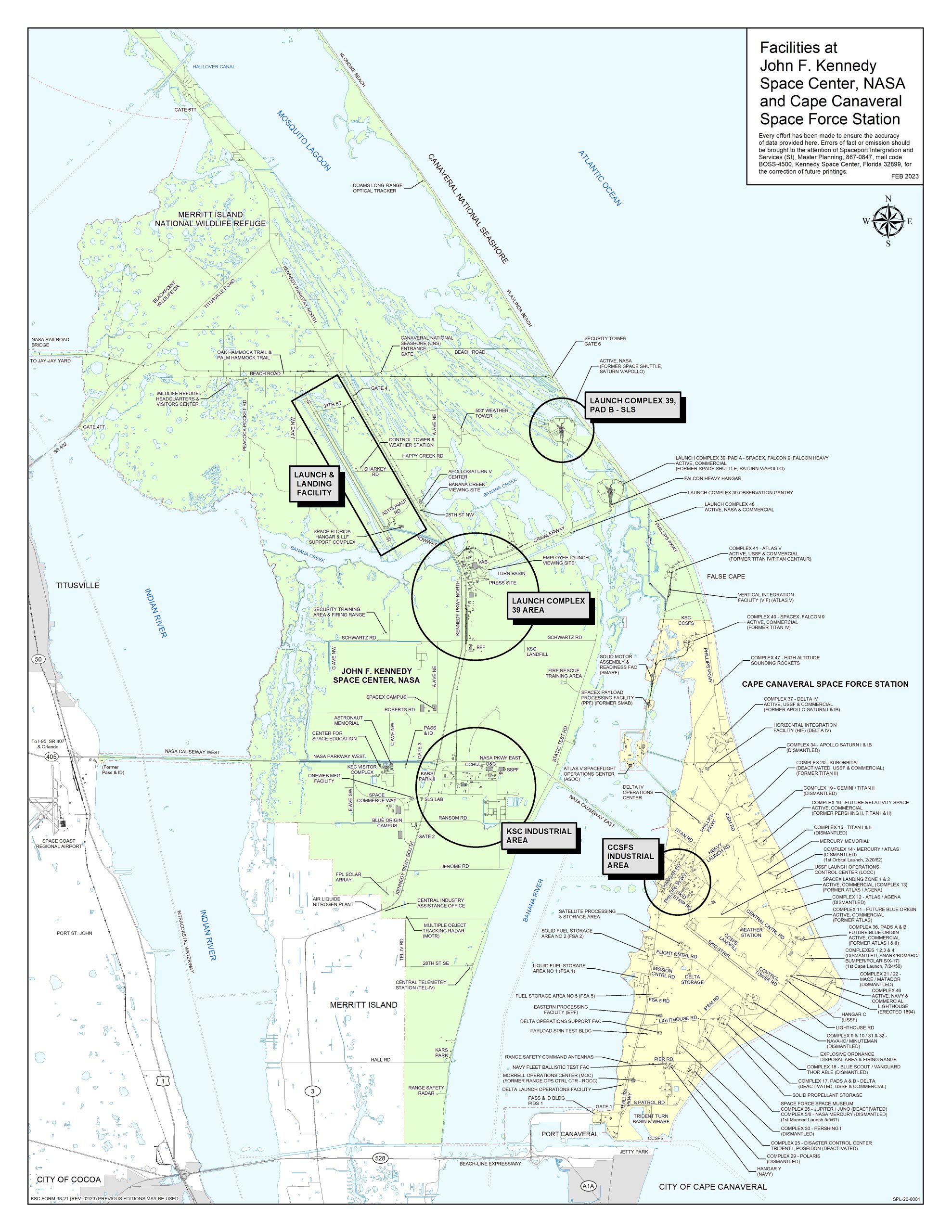
The general location of the wildfire in Merritt Island National Wildlife Refuge. Graphic: original map is from the 2021 KSC Facilities Map, NASA
12 PM EDT, Sunday: Beach Road Open, Fire Seems To Be Dwindling
From a distance and to the uneducated naked eye, the wildfire is now starting to burn itself out, especially on its northern edges. Still far away from operational KSC facilities and buildings, no flames could be seen from Beach Road or US-1 in Titusville, which is very different than twelve hours earlier.
That does not mean that the fire is no longer any danger — a change in weather conditions or wind direction and speeds could fan the flames. Stay tuned to local authorities for official status updates. We will pass them along as soon as we receive them.
1 PM Sunday, May 26: As seen from US-1 in Titusville, a perspective of the wildfire in MINWR: it is far away from any launch pad or KSC buildings, with the closest operational area of the space center being the Shuttle Landing Facility, but even that is at least two miles east. Click to enlarge Photo: Charles Boyer / Talk of Titusville12PM Sunday, May 26: a fire hotspot as seen across the Indian River from Titusville. Photo: Charles Boyer / ToT
11 PM EDT, Saturday: KSC Closes Beach Road
Around 11 PM EDT, KSC Police were emptying MINWR and were stopping people at the end of Max Brewer Bridge. KSC Police asked me to leave, and that’s exactly what I immediately did: I skedaddled.
Closeup of the fire line near Beach Road Saturday night. Photo: Charles Boyer / Talk of TitusvilleA waning moon rises over Beach Road through the smoke from wildfire in Merritt Island National Wildlife Refuge Saturday night. Photo: Charles Boyer / Talk of TitusvilleCloseup of the blaze. Photo: Charles Boyer / ToT
7 PM EDT, Saturday: Fire Is Spreading
Late afternoon wildfire scene in Merritt Island Wildlife Refuge. Photo: Charles Boyer / Talk of TitusvillePhoto: Charles Boyer / Talk of TitusvillePhoto: Charles Boyer / Talk of Titusville
Here’s a photo of the Apollo 14 capsule that I am licensing under an Creative Commons 2.0 Attribution License. Feel free to include it in your blog posts or whatever, just give proper attribution.
The flight path of Falcon 9 carrying the Starlink 6-63 mission to orbit this evening, as seen from the Mid Course Radar Site on Kennedy Parkway inside the Merritt Island Wildlife Refuge near Allenhurst, Florida. This radar system tracks rockets as they launch. A full moon is in the background. Photo: Charles Boyer / Talk of Titusville
SpaceX launched another 23 Starlink V2 Mini satellites to orbit tonight from Kennedy Space Center, right at the end of the planned launch window. Liftoff was at 10:45 PM EDT from Pad LC-39A.
Booster B1077 completed its 13th mission successfully after it touched down on the droneship ASDS ‘Just Read The Instructions’ northeast of The Bahamas about 8.25 minutes after liftoff. JRTI will return to Port Canaveral after a few days, and the booster will be returned to SpaceX’s Hangar X at Kennedy Space Center for inspection, refurbishment and preparation for its next flight.
At 11:52 PM EDT, SpaceX announced that the payload had been successfully deployed, marking another 100% successful launch by the company.
Booster B1077.13 Record
SpaceXBooster B1077
Flight
Mission
Date
1
Crew-5
10/15/2023
2
GPS III SV06
01/18/2023
3
Inmarsat-6 F2
02/18/2023
4
Starlink Group 5-10
03/29/2023
5
Dragon CRS-2 SpX-28
06/05/2023
6
Galaxy 37
08/03/2023
7
Starlink Group 6-13
09/01/2023
8
Starlink Group 6-25
10/30/2023
9
Starlink Group 6-33
12/07/2023
10
Northrup Grumman NG-20
01/30/2024
11
Starlink Group 6-43
03/10/2024
12
Starlink Group 6-51
04/17/2024
13
Starlink Group 6-63
05/23/2024
Booster B1077 flights as of May 23, 2024
Launch Replay
Next Launch
Memorial Day, SpaceX plans to launch another set of satellites for Starlink Group 6. This launch is planned for the morning hours, one where Falcon 9 will travel the well-flown path to the southeast as it delivers more members of its low-Earth orbit constellation that provides Internet access to underserved markets.
Mission: Starlink 6-60
Date: NET May 27, 2024
Organization: SpaceX
Rocket: Falcon 9
Launch Site: SLC-40, Cape Canaveral Space Force Station
Launch Window: 07:30 AM – 11:30 AM EDT
Payload: 23 communications satellites
As of May 17, 2024. Subject to change without notice.
Keep up with launch news and other space events that affect the local area by subscribing to alerts when we publish a new article by entering your email at the link at the bottom of this page, or by visiting Space Talk here on the website. It’s free and you can unsubscribe at any time.
The flight path of Falcon 9 carrying the Starlink 6-63 mission to orbit this evening, as seen from the Mid Course Radar Site on Kennedy Parkway inside the Merritt Island Wildlife Refuge near Allenhurst, Florida. This radar system tracks rockets as they launch. A full moon is in the background.
SpaceX launched another 23 Starlink V2 Mini satellites to orbit tonight from Kennedy Space Center, right at the end of the planned launch window. Liftoff was at 10:45 PM EDT from Pad LC-39A.
Booster B1077 completed its 13th mission successfully after it touched down on the droneship ASDS ‘Just Read The Instructions’ northeast of The Bahamas about 8.25 minutes after liftoff. JRTI will return to Port Canaveral after a few days, and the booster will be returned to SpaceX’s Hangar X at Kennedy Space Center for inspection, refurbishment and preparation for its next flight.


You must be logged in to post a comment.