#SpaceCoast

Starship’s second test flight lifts off in Texas in 2023.
Photo: SpaceX

The Department of the Air Force (along with cooperating agencies the FAA, NASA, and the U.S. Coast Guard) is undertaking environmental impact studies for launch pads for SpaceX’s heavy-lift Starship rocket according to a a recent public release from them. They are also eliciting public comments, with four meetings scheduled for March 2024.

Contents

For your convenience, here is a list of sections to this lengthy article. Click an option to jump to the part you are interested in. To return to the top, click the Back button in your browser.

NOTE: This Environmental Impact Statement is for Cape Canaveral Space Force Station and is not the EIS for the proposed usage of SLC-39A. For more information on that, click here: Notice of Environmental Impact Statement for Starship Launches From KSC’s LC-39A Filed.

Information Website Published 16 FEB 2024

The DAF has placed a new website online for information regarding a new Environmental Impact Statement for Cape Canaveral Space Force Station at https://spaceforcestarshipeis.com/. On it, they say

“The need for the Action is to ensure DAF Assured Access to Space without compromising current launch capabilities and fulfill (in part) the U.S. Congress’s grant of authority to the Secretary of Defense, pursuant to 10 U.S.C. Section 2276(a), “Commercial space launch cooperation,” that the Secretary of Defense is permitted to take action to:”

  • “Maximize the use of the U.S. Department of Defense (DOD) space transportation infrastructure by the private sector in the U.S.
  • “Maximize the effectiveness and efficiency of the space transportation infrastructure of the DOD.
  • “Reduce the cost of services provided by the DOD related to space transportation infrastructure at launch support facilities and space recovery support facilities.
  • “Encourage commercial space activities by enabling investment by covered entities in the space transportation infrastructure of the DOD.
  • “Foster cooperation between the DOD and covered entities.”
Department of the Air Force, Retrieved February 16, 2024

Starship At a Glance

Currently under development near Brownville, Texas, Starship is the largest and most powerful rocket ever built. According to SpaceX, it will be fully reusable, and capable of lifting 150 tons of payload to orbit in a reusable configuration, and 250 tons when it is configured as a conventional expendable rocket.

Current Starship designs are 397 feet tall, and 29.5 feet in diameter, producing some 16.7 million pounds of thrust at liftoff.

By comparison, the Saturn V rockets used for the Apollo Program were 362 feet tall, and produced 7.6 million pounds of thrust. By any measure, Starship is a huge rocket with immense power, and its launches and returns will be heard across the Space Coast.

Similar to how SpaceX Falcon 9 completes in many of its launches today, the Starship booster would return to land at its launch site when its task for the mission has been completed. Unlike Falcon 9, which lands at a landing area close by, Starship would return to its pad, where it would be grappled by “chopsticks” as it completed its final approach.

Starship is planned to be a fully reusable vehicle, meaning that its second stage (often simply called “the ship” in SpaceX parlance) would reenter and return to land at its launch pad using the same chopsticks as the booster.

Starship is still somewhat early in its development, with two test launches so far, and a third on the plate for the next few weeks. Along with SLS, it is a vehicle integral to Project Artemis, this time in the role of being the Human Landing System. HLS is where astronauts will land, live and work on the lunar surface, with the forward plan being for extended stays.

Starship’s Propellants: Are They Toxic?

Unlike other rockets in the past that use highly toxic propellants, Starship relies on commonly found materials. The two propellants the power Starship’s Raptor engines are liquid oxygen and liquid methane. Methane is also known as “natural gas” and is used in many homes as stoves, heating systems and even some pool heaters here locally.

Methane combustion produces carbon dioxide and water as its byproducts. Starship utilizes a highly pure form of methane and oxygen, meaning that it does not have many other byproducts in its exhaust.

By comparison, rockets that use RP-1 as their fuel (Falcon 9, Saturn V, Atlas-V and many others) have carbon dioxide, water vapor, soot, sulfur containing compounds and small amounts of nitrogen oxide. All things considered, methane is a far cleaner fuel than RP-1.

Starship does not rely on solid rocket boosters (SLS, Atlas-V, Vulcan, Space Shuttle) SRBs typically emit aluminum oxide, soot, carbon dioxide, hydrogen chlorides, nitrogen oxides, hydrogen and other trace gases.

What About The Starship Tower at LC-39A?

The Starship tower under construction at LC-39A at Kennedy Space Center prior to Crew-7 launching from the adjacent Falcon 9 / Falcon Heavy launch mount.
Photo: Charles Boyer / Talk of Titusville

SpaceX began construction of a Starship launch mount adjacent to its Falcon 9 / Falcon Heavy launch pad at LC-39A at Kennedy Space Center a couple of years, but it appears that construction has been halted for the time being while the company perfects and finalizes their Starship design and along with it, the launch mount itself.

The proposed action by DAF for the Cape Canaveral Space Force Station does not address that launch mount or its future. There is a separate Environmental Impact Statement for that launch pad and Starship. That EIS is being conducted by the FAA as the lead agency, while for this one, the Department of the Air Force is the lead agency. Both EIS efforts have major stakeholders as part of the EIS team.

See also: NASA: No Activities Underway To Build LC-49 At KSC

Three launch pads: on the left in the background, SpaceX is raising a launch tower for Starship. Center, Artemis-1 on its launch pad. Right, in the background, is where SpaceX launches its Falcon-class rockets, including astronauts into Earth orbit.
Photo: Charles Boyer / Talk of Titusville

Proposed Launch Pads At CCSFS from Department of the Air Force

The US Space Force is part of the Department of the Air Force, much like the US Marines are to the US Navy, as such DAF is the lead agency where Cape Canaveral Space Force Station is involved. For Starship DAF has proposed the following:

  • SpaceX would modify and use SLC-37 at Cape Canaveral Space Force Station (CCSFS)
  • SpaceX and CCSFS would build a new pad, SLC-50, between the current SLC-37 and SLC-40
  • No action, where no Starship constructions or launch occurred from CCSFS

Option 1: SLC-37

SLC-37
Photo: Google Earth

Located nearly due east from NASA Parkway, SLC-37 currently is used by United Launch Alliance for Delta IV Heavy launches. That program has all but ended, with only one launch of the venerable heavy lifter remaining. That launch is scheduled for the March time frame when the company will loft the NROL-70 payload from the pad. After that, there are no Delta IV Heavy launches remaining.

A United Launch Alliance (ULA) Delta IV Heavy rocket carrying the NROL-68 mission for the National Reconnaissance Office (NRO) lifts off from Space Launch Complex-37 on June. 22, 2023 at 5:18 a.m. ET. 
Photo: United Launch Alliance

SLC-37 is one of the older launch complexes at the Eastern Range — Construction on it started in 1959 and was used by NASA to support the Saturn I program starting in 1963. It originally had two launch pads, 37A and 37B, though 37A was never used. Saturn I launched from it from 1964-65, and the site was modified for Saturn IB launches, the most notable of which was Apollo 5. After that, in 1972, LC-37 was mothballed until 2001 when ULA began using it for Delta launches.

The Saturn IB launch vehicle (SA204) for the Apollo 5 mission lifted off on January 22, 1968. The unmarned Apollo 5 mission verified the ascent and descent stage propulsion systems, including restart and throttle operations of the Lunar Module.
Photo: NASA

Given that SLC-37 has hosted launches for around sixty years, it presumably would have the least environmental impact of the two options the Space Force listed. Undoubtedly, that would have to studied and verified before SpaceX could begin construction at the facility.

Option 2: SLC-50

Slightly north of SLC-37 is another potential location for a new pad, according to the Space Force release.

Approximation of the proposed alternative area for an SLC-50
Photo: Google Earth

This is currently an undeveloped area of the facility, and conversion and construction of a new launch pad would require environmental impact studies to be completed prior to any construction there.

Option 3: No Construction

This is what it sounds like, no Starship launch pad would be built at Cape Canaveral Space Force Station. Given that NASA has stated that no new LC-49 pad studies or activities are underway from the Kennedy Space Center side of the Eastern Range, that leaves either the LC-39A launch mount being completed for Starship or Starship not launching from the Eastern Range at all.

The latter option — no launch pad, no Starship — would be problematic for both SpaceX and for NASA, who is relying on Starship for the Artemis program and its lunar lander. It is possible that SpaceX and NASA could reach agreement to complete the Starship Launch Mount at LC-39A at Kennedy Space Center, but that comes with its own issues.

Project Flight Paths

Many people may be wondering just where Starship would fly. The simple answer appears to be that it would be able to take the typical range of trajectories as other rockets that have flown or are flying from the Eastern Range today.

Notably, however, “polar” (North-South orbits) trajectories such as the ones SpaceX’s Falcon 9 has taken from to time from SLC-40 were not mentioned and we presume not in the current plans for Starship.

It is also worth noting that like Falcon 9, Starship and its boosters will return to the Cape to land, be refurbished and reused. That will bring sonic booms, just like the old Space Shuttle landings and today’s Falcon 9 RTLS missions such as Crew-8 on March 3, 2024.

From the DAF-supplied information packet:

Starship would fly from 40º – 115º from its launch mount, which is a typical range of azimuths for Eastern Range Rockets

Why Not Stay In Texas?

SpaceX’s launch facility in Texas at Boca Chica has a limited acceptable set of trajectories available to it — Florida is to the East, Texas and the Gulf states are to the north, and Cuba and other land masses are to the south.

Two paths from Boca Chica would would avoid overflight of most far downrange landmasses, though they may also require performance reducing “dogleg” maneuvers to avoid other landmasses and achieve proper orbit. The red areas show previous Falcon 9 drop zones. Cape Canaveral can accommodate a much more diverse set of launch inclinations without overflying populated areas.

* Challenges For A South Texas Spaceport.pdf – Embry Riddle Aeronautical University

For test launches, Starship plans to thread a launch path over the Gulf of Mexico and then to orbit. From the Eastern Range, a much wider set of trajectories are available due to the Atlantic Ocean being mostly devoid of people or property over a much wider area.

All things considered, Starship operations from the Eastern Range and the Cape is a preferable destination for SpaceX and for NASA.

Potential Economic Impact For The Space Coast?

Starship launches from the Eastern Range could easily bring billions of dollars in economic activity to the Space Coast region: SpaceX launch support jobs at the Cape, along with the associated jobs that are created to support the families of those workers, and of course tourism.

As a major Starship launch port, the Space Coast would cement itself now and in the future as the starting point for space launches of all types. The area has seen boom and bust in its history, and having the most dominant commercial space company in the world using Cape Canaveral Space Force station as its main operational site would all but ensure a prosperous future for the area.

Local Public Hearings Scheduled

The public has been invited to have their say about the proposed alternatives:

Online Public Hearing

There is also an online meeting for those that cannot attend in person:

Talk of Titusville strongly encourages interested members of the public to participate in these meetings. As the leading company for launch services in the world, much of the Space Coast’s economic future rests on this decision.

Next Steps

February 16, 2024

After making the announcement and holding public hearings in March, the EIS will then conduct studies and prepare a draft release of the EIS in Winter 2024. Being that there is only one winter month in December, that indicates that the draft EIS is due that month. That is not set in stone, however, so stay tuned for an announcement of specially when that date may be.

Read more

SpaceX Falcon 9 lifts off from LC-39A at Kennedy Space Center
Photo: Charles Boyer / Talk of Titusville

SpaceX, NASA and Intuitive Machines are planning to launch the NASA CLPS IM-1 lunar lander Odysseus tonight at Kennedy Space Center from Pad LC-39A at 12:57 AM EST. The launch, aboard a Falcon 9 rocket, aims to be the first successful American soft-landing on the lunar surface since Apollo 17 in 1972.

Following the launch, the booster being used for the mission will return to land at LZ-1 in Cape Canaveral, and will herald its return with a sonic boom that will be heard across the Space Coast region.

That’s the first of two launches scheduled for Valentine’s Day. The second is USSF-124, launching from SpaceX’s pad SLC-40 Cape Canaveral Space Force Station. This mission’s launch window extends from 5:30 PM until 10:00 PM EST and is also an RTLS mission.

Launch Weather Outlook: NASA CLPS IM-1

First, the early launch, NASA CLPS/IM-1: the 45th Weather Squadron of the US Space Force is predicting a low Probability of Violation for the planned liftoff at 12:57 AM EST: only 5%. That means they are expecting a 95% chance of acceptable conditions for liftoff.

NASA CLPS IM-1 Trajectory

As is customary for most missions beyond Earth orbit, NASA CLPS IM-1 will take an easterly path from KSC after liftoff. People watching the launch in person should be able to see the reentry burn and if in the right place, the landing burn of Falcon 9 as it returns to land.

A Falcon 9 Booster landing at LZ-1 in 2023
Photo: Charles Boyer / Talk of Titusville

Launch Weather Outlook: USSF-124

The weather gets even better for the second planned launch of the day, according to the 45th Weather Wing: less than a 5% Probability of Violation, meaning a 95+% chance of acceptable weather conditions at liftoff.

USSF-124 Trajectory

Also eastward. Again, in-person launch viewers should be able to see the reentry burn and if in the right place, the landing burn of Falcon 9 as it returns to land.

SpaceX has not announced which landing pad they will utilize for this launch — either LZ-2, or perhaps the Falcon 9 used for LM-1 will be removed in time for USSF-124. Either way, to launch viewers off of the base itself, the landing will be in the same general direction.

Falcon 9 lifting off from SLC-40 at Cape Canaveral Space Force Station in 2023.
Photo: Charles Boyer / Talk of Titusville
Read more

Polaris Dawn astronauts, L-R: Scott “Kidd” Poteet, Sarah Gillis, Jared Isaacman and Anna Menon undergoing zero gravity training in 2022.
Photo: John Kraus / Polaris Dawn

Polaris Dawn, the initial flight of a planned series of three private spaceflights led by American entrepreneur and private astronaut Jared Isaacman, has been delayed according to an announcement from the program today. “We are now targeting no earlier than summer 2024 for launch of Polaris Dawn, the first of the Polaris Program’s three human spaceflights,” they said in a post on the X platform.

Flying aboard a SpaceX Falcon 9 and a Crew Dragon capsule from Kennedy Space Center’s LC-39A, the five-day Polaris Dawn mission will represent several firsts for private spaceflight: the first time an EVA is undertaken from a private spacecraft in orbit, and at a planned altitude of at least 700 km (434 miles) it will be well above the 400 km (~250 mile) orbit of ISS when that spacewalk happens.

SpaceX Crew Dragon on the pad at Kennedy Space Center’s LC-39A in 2024.
Photo: Charles Boyer, Talk of Titusville

They are also planning a 1,400 km (~870 mile) apogee during the flight, according to Polaris Program. Currently, the record for altitude for a crew in Earth orbit is 1,369.0 km, (739.2 nautical miles.) Should Polaris Dawn reach 1,400 km, it will be the highest crewed orbital flight in human history, and certainly the highest in over fifty years.

Polaris Dawn Science Plans

Aside from the groundbreaking EVA, Polaris Dawn will also be “the first crew to test Starlink laser-based communications in space.” They will also perform experiments:

  • “Using ultrasound to monitor, detect, and quantify venous gas emboli (VGE), contributing to studies on human prevalence to decompression sickness;
  • “Gathering data on the radiation environment to better understand how space radiation affects human biological systems;
  • “Providing biological samples towards multi-omics analyses for a long-term Biobank; and
  • “Research related to Spaceflight Associated Neuro-Ocular Syndrome (SANS), which is a key risk to human health in long-duration spaceflight.”

There are other experiments planned for Polaris Dawn. More information about the Polaris Dawn mission is at the program’s website.

After the Polaris Dawn flight, the Polaris Program plans one additional flight on a Falcon 9 / Crew Dragon, and a final flight being planned to be completed using a SpaceX Starship, the company’s new rocket under development in south Texas. The third flight is also slated to be the first crewed flight of Starship according to the Polaris Program website. Launch timelines for those missions have not yet been publicly disclosed.

More Development Time Needed

According to the Polaris Program, “The additional time continues to provide necessary developmental time to ensure both the completion of these mission goals and a safe launch and return of Dragon and the crew.” They did not give specifics about which aspects of the mission require further time, but did add that the crew is already training at SpaceX headquarters in Hawthorne, California and also that additional time gives the crew additional time to raise funds for the St. Jude Children’s Research Hospital.

About St. Jude

St. Jude Children’s Research Hospital is located in Memphis, Tennessee, and according to their website, they “Advance cures, and means of prevention, for pediatric catastrophic diseases through research and treatment. Consistent with the vision of our founder Danny Thomas, no child is denied treatment based on race, religion or a family’s ability to pay.”

There are few causes with greater impact than helping families whose children are undergoing treatment for severe, life-threatening illnesses. Interested people can donate to St. Jude through the Polaris Dawn website.

Statue of St. Jude on the campus in Memphis.
Photo: St. Jude’s Children’s Research Hospital


Read more

SpaceX and NASA plan to launch the PACE (Plankton, Aerosol, Cloud, ocean Ecosystem) satellite at 1:33 AM EST Thursday from the company’s launch facility at SLC-40 at Cape Canaveral. Booster 1071 will return to the Cape and land about 5.6 miles away at Landing Zone 1 a little more than seven minutes after liftoff (T-plus 00:07:32.)

The launch has been delayed twice this week due to high winds created by an intense low-pressure system off the Florida coast in the Atlantic but it is now moving away, and winds have been steadily calming throughout the day. The 45th Weather Squadron’s Mission Execution Forecast calls for a 95% chance of acceptable conditions this morning.

A Sonic Boom Will Be Heard In The Space Coast Area

A sonic boom will accompany the landing and spread out through the Space Coast at roughly 1:41 AM EST. Remember that sound travels one mile in five seconds at sea level, so the specific time the sonic boom will arrive at your location will be relative to your distance from LZ-1.

PACE is a NASA Earth-observing satellite mission that will perform advanced observations of global ocean color, biogeochemistry, and ecology, as well as the carbon cycle, aerosols, and clouds. That data is key to identifying the scope of climate changes in the Earth’s atmosphere.

The launch trajectory is roughly due south, so areas in southern Brevard County may hear louder than normal launch rumble, and it may last longer as the flying booster passes by.

A live webcast of this mission will begin on NASA+ and NASA Television about 45 minutes before liftoff.

Axiom-3 Landing Planned for Friday Near Daytona Beach

The Axiom-3 crew aboard the International Space Station
Photo: Axiom Space

The return of the Axiom-3 crew has also been affected by windy conditions; SpaceX and Axiom Space have announced that the splashdown of the Dragon capsule should be around 7:25 AM Friday. AX-3 astronauts Axiom Mission 3 (Ax-3) Commander Michael López-Alegría, Pilot Walter Villadei, Mission Specialist Alper Gezeravcı, and Mission Specialist Marcus Wandt departed ISS at 9:20 AM EST today.

“We hope you had a wonderful time on station, and we’re looking forward to seeing your smiling faces,” SpaceX ground control told the astronauts as the departed ISS.

On Wednesday, February 7 at 9:20 a.m. ET, Dragon autonomously undocked from the International Space Station. After performing a series of burns to move away from the space station, Dragon will conduct multiple orbit-lowering maneuvers, jettison its trunk, and re-enter Earth’s atmosphere for splashdown off the coast of Florida approximately two days later on Friday, February 9.

SpaceX, retrieved 2/7/2024 1:00 PM EST

Splashdown is currently planned for near Daytona Beach. That is subject to change, however, as wave height, wind and rain in the landing area must meet NASA and SpaceX’s criteria for the safe return and retrieval of the Dragon spacecraft.

Locally, it’s somewhat unlikely that most people in Brevard County will hear the sonic boom that heralds a returning spacecraft to Earth. Residents can see Crew Dragon streaking across the sky as it re-enters by looking northwards, relatively low to the horizon.

Read more

Official NASA’s SpaceX Crew-9 portrait: (L-R) Stephanie Wilson, Aleksandr Gorbunov, Nick Hague, and Zena Cardman.
Photo: NASA

NASA announced the four astronauts that will travel aboard a SpaceX Falcon 9 rocket to the International Space Station later this year: Zena Cardman will be the Mission Commander,  Nick Hague will be the Pilot, along with Stephanie Wilson and Russian Mission Specialist Aleksandr Gorbunov will travel to ISS no earlier than August 2024.

Zena Cardman

Zena Cardman
Photo: UNC Chapel Hill

Cardman will be making her first spaceflight on this mission. She is a Williamsburg, Virginia, native and holds a bachelor’s degree in Biology plus a master’s in Marine Sciences from the University of North Carolina at Chapel Hill. While a doctoral candidate, Cardman researched geobiology and geochemical cycling in subsurface environments, from caves to deep-sea sediments. Since joining NASA, she has supported real-time ISS operations and development for lunar surface exploration.

Nick Hague

Nick Hague
Photo: NASA

For Hague, this mission will be his third launch and his second mission to ISS. During his first launch in 2018, Hague and his crewmate Roscosmos cosmonaut Alexey Ovchinin were aboard Soyuz MS-10 when they experienced a booster failure resulting in an in-flight launch abort. The spacecraft landed safely with no serious injuries. Resiliently, only five months later, Hague launched aboard Soyuz MS-12 and served as a flight engineer aboard the space station during Expeditions 59 and 60. He has spent 203 days in space and has conducted three spacewalks as part of his duties aboard ISS.

Soyuz MS-10 breaking up above Kazakhstan with Nick Hague abord. The launch abort system can be seen firing, bottom center.
Photo: NASA

Stephanie Wilson

Stephanie Wilson
Photo: NASA

Wilson has spent 42 days in space aboard three separate space shuttle Discovery missions, STS-121, STS-120, and STS-131. A graduate of  Engineering Science from Harvard University, she also earned a master’s degree in Aerospace Engineering from the University of Texas in Austin. Wilson has been with NASA for 29 years and has served as the integration branch chief for NASA’s Astronaut Office, focusing on International Space Station systems and payload operations. She also served as the acting chief of NASA’s Program and Project Integration Office at the agency’s Glenn Research Center in Cleveland.

As the ground fills with smoke and steam, Space Shuttle Discovery creates its own fireworks display, fitting for the first ever launch on Independence Day. It was the third launch attempt in four days; the others were scrubbed due to weather concerns. Liftoff on mission STS-121 was on-time at 2:38 p.m. EDT. During the 12-day mission, the STS-121 crew of seven will test new equipment and procedures to improve shuttle safety, deliver supplies and make repairs to the International Space Station. Landing is scheduled for July 16 or 17 at Kennedy’s Shuttle Landing Facility.
Photo: NASA/Nikon/Scott Andrews
Aleksandr Gorbunov
Photo: Roscosmos

Aleksandr Gorbunov

The mission will be Gorbunov’s first trip to space and the station. Hailing from Zheleznogorsk, in south-central Russia, he studied engineering with qualifications in spacecraft and upper stages from the Moscow Aviation Institute. Gorbunov graduated from the military department with a specialty in operating and repairing aircraft, helicopters, and aircraft engines.  He previously worked for engineer for Rocket Space Corporation Energia and since joining the Russian cosmonaut corps, he has supported Russian cargo missions to ISS.

This will be the ninth rotational mission to the space station under NASA’s Commercial Crew Program.

Read more

The US Space Force’s 45th Weather Squadron has released their Mission Execution Forecast for tomorrow’s planned launch of a SpaceX Falcon 9 carrying NG’s Cygnus cargo craft towards the International Space Station. They are predicting nearly ideal conditions, with only a 5% chance of a Probability of Violation, meaning they expect a 95% chance of acceptable weather conditions.

Launch Time & Location

The NG-20 mission will launch from SpaceX’s launch pad at SLC-40 at Cape Canaveral Space Force Station. The launch time is an instantaneous window 12:07 PM EST. If for some reason the launch is delayed, there is a backup launch opportunity available on Thursday, February 1 at 11:18 a.m. ET.

Launch Trajectory

Falcon 9 will travel to the northeast, on a 51.2281˚inclination.

Sonic Boom Alert!

NG-20 is an RTLS mission, meaning the booster will return to Cape Canaveral 8.25 minutes after liftoff. As with all RTLS launches, a loud sonic boom will be heard across the Space Coast.

Launch Viewing

Banana River Bridge

For unobstructed views of the liftoff and landing, the Banana River Bridge on FL 528 (aka The Beachline, and sometimes erroneously called A1A) is your best bet.

Basic Overview

Launch View

Landing View

Jetty Park

Jetty Park offers a closer view of the returning booster and landing, but it has an occluded view of the launch.

Jetty Park is located at 100 Jetty Park Rd, Port Canaveral, FL 32920.

Others

Playalinda Beach in the Cape Canaveral National Seashore will likely be open for this launch. It is quite far from the launch and landing, but you should still get some great views.

Parks along US1 In Titusville are further away from the action as well, but especially in the southern end of town, for example at Kennedy Point Park, good views are available.

Cocoa Beach also will have some good views of the rocket flight, but you are not going to see the liftoff and perhaps the landing burns. You will definitely feel the sonic boom, however!

Read more

“[NASA] currently [does] not have any activities underway at LC-49.”

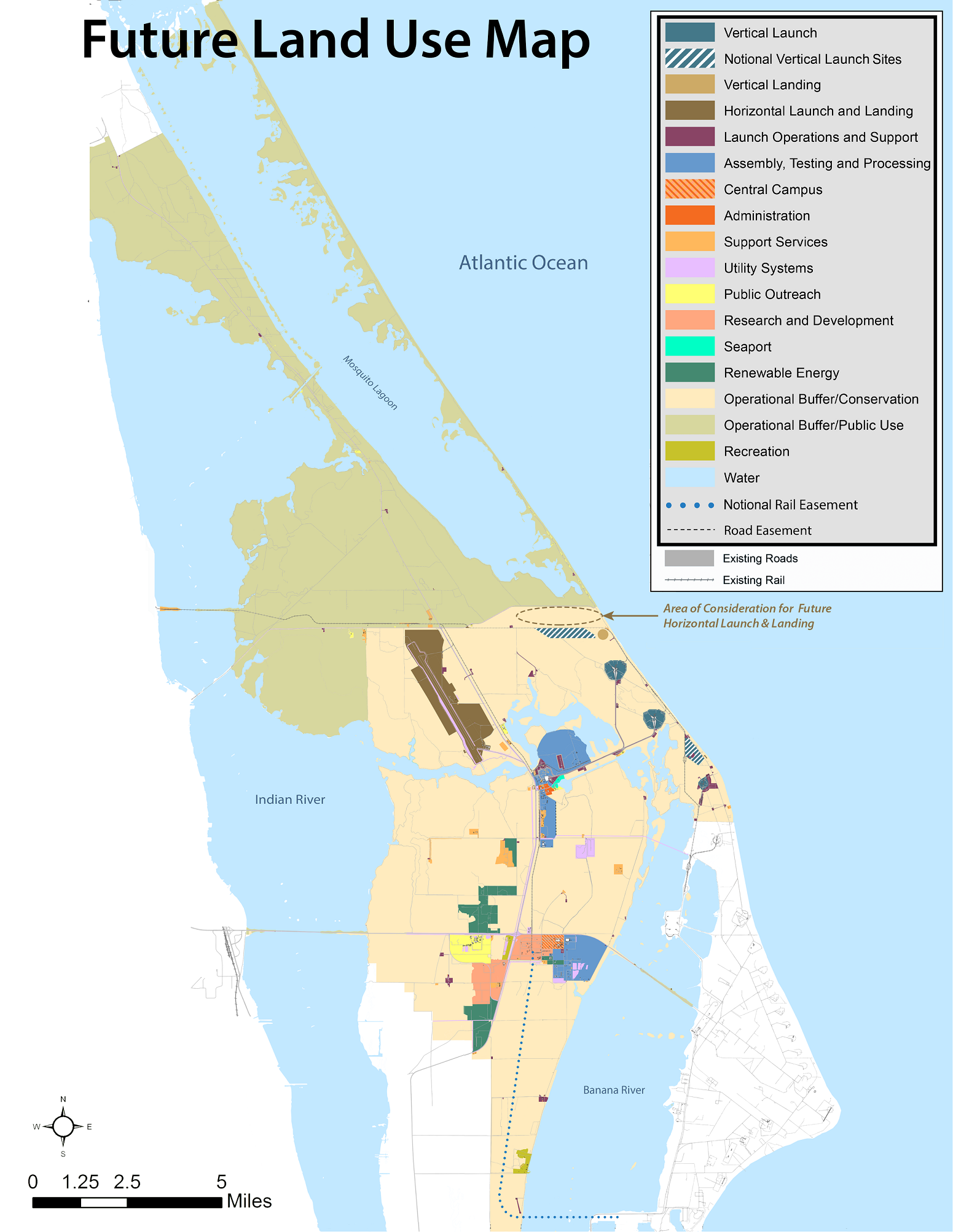
For many years, NASA has had a potential new launch pad on its Master Plan for Kennedy Space Center: LC-49 is projected to be built on the northern end of KSC property near its border with the Merritt Island National Wildlife Refuge.

There is also an LC-48 on the slate, located between the current LC-39A (Falcon 9, Falcon Heavy) and SLC-41 (Atlas/Vulcan) but it has not received the same amount of mention in the space community, nor the same amount of concern among some local residents as the potential LC-49.

Kennedy’s Master Plan

“One potential new vertical launch area, Launch Pad 49, could be sited to the north of Pad 39B.  This location avoids overflight issues with Pad 39B and minimizes conflict with the Canaveral National Seashore, giving potential non-NASA entities a flexible set of operational options.  In addition, Pad 49 could use Beach Road as an access road, allowing for more autonomous operations and the option to operate outside of KSC’s secured area.”

Kenndy Space Center’s Master Plan

This has been on the site’s master plan in one form or another, dating back to the 1960s, and speculation of the potential of a new pad being built has risen lately due to SpaceX’s Starship due to come online in the near term.

Spacenews.com reported on December 22, 2021:

“[Kennedy Space Center] announced last week that it was starting the process of an environmental review of the proposed Launch Complex (LC) 49 in response to an inquiry from SpaceX. The center did not disclose a timeline for conducting the review but said it would precede any agreement with SpaceX to develop the site.

“Launch Complex 49 is located to the northwest of Launch Complex 39B, the former Apollo and shuttle launch pad that will be used by the Space Launch System. The site was originally reserved in the 1960s for Launch Complex 39C but never developed.”

SpaceX Starship Facility at LC-39A

In 2021, SpaceX began building a launch tower for its future Starship operations at the Cape, but it appears that the company has taken a pause in constructing that launch tower, ostensibly to focus on completing Starship development, which will almost certainly inform the final design and construction of the new tower.

Given SpaceX’s iterative development method that makes a lot of sense and should not necessarily be considered a sign that they are abandoning any plans to complete the new pad next to LC-39A. The company has not made any public statement regarding the half-finished pad, and while work has apparently slowed on the structure, there is no sign of it being dismantled either.

SpaceX has made extensive changes to a similar launch pad at their Boca Chica orbital launch pad in recent months, so it makes sense to expect they will want to do the same to the pad at the Cape — when they are ready to bring Starship operations here to the Space Coast and the Eastern Range. That is speculation, however, and should be considered as such until concrete evidence of its accuracy is confirmed or disproven.

But What About LC-49?

At the same time, that apparent pause at LC-39A does not fully address LC-49. Talk of Titusville reached out to NASA to find out what progress is being made towards LC-49 actually being built in the relatively near future. Given that previous reports indicated that an environmental study was underway in 2021, it seems sensible that those studies would be complete or nearly so in 2024. They replied to us on January 18, 2024 and said that “[NASA] currently [does] not have any activities underway at LC-49.”

NASA added that, “all previous activities there have been suspended, including anything involving any commercial companies. We’re not currently working any NEPA or environmental actions. KSC did complete an environmental assessment in 2018-19 for the development and operations of the site, which included the construction of the existing launch pad.”

That “existing launch pad” they are referring to is almost certainly the new Starship launch pad referred to above, and that pad will not be completed for some time.

Good News For Titusville Residents and Visitors

This is likely going to be welcome news for Titusville residents. Were LC-49 built in the area planned for in the NASA Future Land Use Map (FLUM), once operational, it would likely cause repeated closings of Beach Road leading to Playalinda Beach, meaning that local beachgoers would have no route to the undeveloped beach areas located there. That is because at some points on Beach Road, an LC-49 could be as little as one mile away.

Those closures would come during fueling tests, static fires and launch activities due to Beach Road’s proximity to the LC-49 complex. Playalinda Beach is already often closed by KSC Police and the National Park Service for many launches from LC-39A and LC-39B, due to safety and security concerns during launch operations. LC-49 would result in much the same, and given SpaceX’s plans for a high cadence of Starship launches for Artemis and other commercial activities, those closures may have become a major inconvenience for residents and tourists alike.

With an estimated 1.52.0 million visitors a year, the Cape Canaveral National Seashore incorporates Playalinda Beach in its southern section as well as others (Apollo Beach) to the north. It is a major source of tourism dollars for Titusville, and it is the only beach available to local residents between Cape Canaveral’s Jetty Park and Apollo Beach in New Smyrna. In 1962, Titusville Beach was absorbed into Kennedy Space Center, leaving Playalinda, in the Merritt Island National Wildlife Refuge.

According to NASA’s statement that no activities are ongoing to build the new pad, there is little reason to worry about this happening any time in the near future.

Read more

Crew Dragon atop a Falcon 9 at Pad LC-39A at Kennedy Space Center on January 17, 2024.
Photo by Charles Boyer, Talk of Titusville.

With about six hours left in the countdown to liftoff, SpaceX announced that they are canceling today’s planned launch of Falcon 9 carrying four astronauts to orbit aboard a Crew Dragon to the International Space Station. The mission on behalf of Axiom Space is dubbed Axiom-3 and will now launch NET Thursday, January 18, 2024 at 4:47 PM EST.

Read more

SpaceX Falcon 9 lifts off with the Starlink 6-37 mission aboard. It’s destination is low-Earth orbit where 23 satellites will be placed in the Starlink constellation.
Photo: Charles Boyer / Talk of Titusville

SpaceX sent another batch of 23 Starlink satellites for their orbital-based Internet service tonight from Cape Canaveral aboard a Falcon 9 booster. The mission was designated Starlink 6-37, part of Group 6 of Starlink satellites providing global Internet connectivity to the company’s customers.

Liftoff was shortly after 8:52 pm EST from Pad SLC-40 at Cape Canaveral Space Force Station. Tonight’s re-useable booster was B1071 making its 12th flight. Roughly eight and a half minutes after liftoff, B1071 touched down safely near the Bahamas on a droneship in the Atlantic Ocean.

The second stage continued to carry the company’s payload to orbit, which it achieved successfully at about the same time the first stage booster was touching down. Shortly afterward, the Starlink satellites were deployed and the launch was deemed a success by mission managers.

Mission Trajectory

Tonight’s launch was to the southeast, as has been customary with other launches of the Group 6 batch of Starlink satellites.

16th Flight for Booster B-1076

This was the 12th flight for the first stage booster supporting this mission is B1071. The booster previously launched SES-22, ispace’s HAKUTO-R Mission 1, Hispasat Amazonas Nexus mission, CRS-27, and seven Starlink missions.

Following stage separation, the first stage landed on the autonomous spaceport drone ship (ASDS) A Shortfall of Gravitas droneship, stationed in the Atlantic Ocean northeast of the Bahamas.

The booster will be returned to Port Canaveral and then transferred to SpaceX’s Hangar X facility at Kennedy Space Center for inspection and ostensibly refurbishment for another flight on a future mission.

Next Launch

Axiom-3, a crewed launch planned to ferry four astronauts to the International Space Station aboard a Falcon 9.

Axiom-3 Flight Patch
Image courtesy: Axiom Space

The mission will be the first to carry and all-European crew to the International Space Station. It will be the third crewed mission to the International Space Station coordinated by Axiom Space.

Ax-3 will be the first all-European commercial astronaut mission to the ISS. It will also be the first commercial spaceflight mission made up of government and European Space Agency-sponsored astronauts flying on behalf of their nation.

The launch date is NET Wednesday January 17, 2024 at 5:11 PM EST from Pad LC-39A at Kennedy Space Center.

Read more

A SpaceX Falcon 9 carrying the Starling 6-35 mission launches from Pad SLC-40 at Cape Canaveral Space Force Station on January 7, 2024
Photo: Charles Boyer, Talk 0f Titusville

SpaceX sent the next batch of 23 Starlink satellites for their orbital-based Internet service tonight from Cape Canaveral aboard a Falcon 9 booster. Liftoff was shortly after 5:35 pm EST from Pad SLC-40 at Cape Canaveral Space Force Station. Roughly eight and a half minutes after liftoff, the booster used for the flight touched down safely near the Bahamas. The second stage continued to carry the company’s payload to orbit, which it achieved successfully at about the same time the first stage booster was touching down.

Read more