Space

A Starlink launch
Booster B1076 starting the SpaceX Starlink 6-40 mission
Photo: Charles Boyer, ToT

SpaceX is planning to launch another lot of Starlink satellites from Space Launch Complex 40 at Cape Canaveral Space Force Station this evening.

According to SpaceX, liftoff is targeted for 6:08 PM EDT, and the launch window is open until 9:48 PM EDT. If for some reason tonight’s planned liftoff does not happen, the backup launch window open Monday, April 29 starting at 5:45 PM EDT.

Payload

23 Starlink satellites, to be used in SpaceX’s orbital-based Internet service.

SpaceX Starlink satellite depiction
Graphic: SpaceX

Weather

The 45th Weather Squadron is forecasting a 20% chance of creating a Range Violation Sunday, meaning a better than 80% chance of acceptable conditions. On Monday, conditions improve to 90% “Go” in the 45th’s forecast.

Looking at the forecast closely, the 45th says, “Locally, enhanced onshore flow will tap somewhat deeper moisture off the Atlantic, resulting in additional onshore-moving cumulus clouds accompanied by widely scattered showers. The greatest risk of these will be during the late night through early afternoon hours and thus outside our launch windows.”

That sure sounds like a summer coastal front, and given that it’s almost May, summer weather in Florida is starting to make its annual appearance. That means that on many days, launches can and will be affected by daily storms and winds in the vicinity of the launch area.

Sky Cover

The National Weather Center is calling for cloud cover of about 40-50% tonight at the opening of the launch window.

graphic: National Weather Service / NOAA

Trajectory

Falcon 9 will take a southeasterly direction tonight, as is customary for Group 6 Starlink missions.

Given that the flight is immediately offshore with no return to launch site, there will be no sonic boom from the launch this evening on the Space Coast.

Booster: B1076

According to Space, tonight’s booster previously launched “CRS-26, OneWeb Launch 16, Intelsat IS-40e, O3b mPOWER, Ovzon 3, EUTELSAT 36D, and six Starlink missions” and will be on its thirteenth mission overall. That’s Booster B1076.

B1076 last launched thirty days ago when it lofted the Eutelsat 36D mission on March 30, 2024.

Booster B1076
Flight NumberMissionLaunch Date
1CRS-26November 26, 2022
2OneWeb 16January 10, 2023
3Starlink 6-1February 27, 2023
4Intelsat 40eApril 7, 2023
5Starlink 6-3May 19, 2023
6Starlink 6-6July 24. 2023
7Starlink 6-14September 9, 2023
8Starlink 6-21October 5, 2023
9O3b mPOWER 5/6November 12, 2023
10Ovzon-3January 3, 2024
11Starlink 6-40February 29, 2024
12Eutelsat 36DMarch 30, 2024
Booster B1076 record as of April 27, 2024

Landing

Per SpaceX, “Following stage separation, the first stage will land on the Just Read The Instructions droneship, which will be stationed in the Atlantic Ocean.”

After touching down on ”Just Read The Instructions’, the booster will be returned to Port Canveral after a few days, where it will be offloaded and transported to SpaceX’s Hangar X facility at Kennedy Space Center, where it will be inspected, refurbished and possibly prepared for another next flight.

Interesting Stats

  • This will be the 44th SpaceX launch this year1
  • 356th SpaceX launch all time1
  • 20th launch from SLC-40 this year
  • 302nd Falcon family Booster landing
  • If successful, it will be the 257th consecutive successful Falcon 9 launch (excluding Amos-6)2

1: this includes Falcon 9, Falcon Heavy and Starship Heavy Launches
2: Amos-6 is discounted due to a pad failure, not an in-flight anomoly

Watching Online

SpaceCoastLaunchCalendar.com will have a livestream of the launch if you’re not able to watch the launch in person: Livestream

SpaceX will have a livestream of the launch on their website: Starlink 6-54. This will also be available on the X platform.

Spaceflight Now will have coverage of the launch starting about one hour before liftoff on Youtube: link

Watching In Person

This evening’s planned launch is from SLC-40 at Cape Canaveral, which means that the best direct views of liftoff are: Banana River Bridge on FL-528 W near Port Canaveral, or the  southern parks on US-1 / S. Washington Avenue in Titusville. Kennedy Point Park and Rotary Riverfront Park (among others) are your best bets.

Playalinda

Playalinda Beach wil be open during these hours, but be aware that SLC-40 is further away from the beach than is LC-39A, so you won’t get quite the same experience as you would from the closer pad.

That said, it is still a day at the beach, you’ll be plenty close enough to watch the rocket launch and you’ll definitely have a good experience. If you decide to go there, keep in mind the following:

  • Get there at least two hours early, or better, earlier than that. Lines are long at the entry gate and they will only allow as many spectator vehicles as there are parking space available.
  • If the launch L-0 time is moved to after 8PM, you will have to leave Playalinda, as the National Park Service is very strict about closing hours.
  • Cape Canaveral National Seashore has a fee to get in and cash is not accepted. Debit and credit cards are okay, or if you have one of the National Park Service’s passes for the Seashore or the National Parks, that will work as well.
  • Cellphone service is spotty at best and often non-existant at Playalinda. Don’t count on your cellphone to keep up with the launch, because you might get signal or you might not.
  • You are not allowed to view from the pullouts on Beach Road. They will have stanchions blocking them. You’ll have to park and you’ll have to go to the beach.
  • Refreshments are not available. There are no stores at Cape Canaveral National Seashore, and that means you’ll need to bring drinks and food if you want any while you’re there.
  • Rangers will keep you back a certain distance from the launch area. If the beach is open, you’ll still not be able to go all the way down to the fence that demarcates the normal security zone. There’s a line that spectators can’t go past somewhat north of the fence. That’s for safety and security.

Also, as part of both Kennedy Space Center and the US Park system, Merritt Island National Wildlife Refuge is under federal jurisdiction and that means if you happen to get a ticket out there, you’ll be heading to federal court. Best thing to do is strictly obey traffic laws. Don’t speed!

Other Viewing Locations

Cocoa Beach, Cocoa Beach Pier, Jetty Park Pier will have indirect views, meaning that liftoff will not be visible, but after the rocket clears the pad and any ground obstructions, you will be able to see Falcon 9 ascending clearly assuming there are no clouds between you and the rocket.

Be prepared for potential changes or pushbacks in the launch schedule, and keep up by monitoring the live stream links mentioned above.

Read more

Timelapse streak of Galileo L12’s flight path as seen from Merritt Island.

On a somewhat unexpectedly cool, brisk evening on the Space Coast with passing showers in Titusville and other locations nearby Kennedy Space Center, SpaceX launched two navigation satellites for the European Space Agency. Liftoff was at 08:34 PM EDT from Pad LC-39A at KSC. Liftoff and ascent to orbit was successful.

Read more

A Galileo satellite.
Graphic: ESA

SpaceX plans to launch a pair of long-delayed navigation satellites this evening at 8:34PM from Pad 39A at Kennedy Space Center.  Should conditions force a scrub, the next backup opportunity is on Sunday, April 28 at 8:30 PM EDT.

The satellites, FM25 and FM27, are being launched aboard a Falcon 9 booster as part of Europe’s MEO Galileo constellation. They will join twenty-six other satellites that began launching in 2011 to form part of a high-precision navigation system for the European Union. 

Read more

Starliner OFT-2 lifts off in 2022.
Photo: Charles Boyer, ToT

NASA’s Commercial Crew directorate has announced the results of the Readiness Review for the planned launch of Boeing’s CST-100 Starliner flight test: they are “go” for launch at 10:34 PM EDT on May 6.

This image has an empty alt attribute; its file name is image-39-971x1024.png

Jim Free’s Comments

Jim Free, NASA Associate Administrator, began the press conference by saying, “The first crewed flight of a new spacecraft is a absolutely critical milestone. The lives of our crew members Sunny Williams and Butch Wilmore are at stake. We don’t take that lightly at all. The most important thing we can do is protect those two people as well as our crew currently on board the space station. It’s our collective job to ensure we can fly this Mission successfully and to do that it must be safe.”

NASA Associate Administrator Jim Free
Photo: X.com

Free continued, saying that he was satisfied that the Readiness Review was thorough and that Starliner, Atlas V and ISS were prepared properly for the test flight. “Safety has always been our primary core value at NASA,” he said, “And it’s our primary focus during this Readiness Review, all the reviews that have led up to it and the entire development process I can say with confidence that the teams have absolutely done their due diligence.”

Free concluded by summarizing the Review results. “There’s still a little bit of close out work to do, but we are on track for a launch at 10:34 Eastern Daylight time on Monday May 6th.”

Free On Starliner and Orion Shared Technology

Free made an interesting statement about the importance of the Starliner flight: some of the technology used in the Boeing capsule is also used in Orion, which is, of course, used in the Artemis program. “There are many elements of this Mission which have similarity to hardware that will fly on Orion. Parachutes, as an example, so this [the Starliner Crewed Flight Test is] important across our entire agency.”

Ken Bowersox Comments

“May 6th is not a magical date. We’ll launch when we’re ready and we’re looking forward to to when that occurs.”

Ken Bowersox

Ken Bowersox, an Associate Administrator for NASA’s Space Operations Mission Directorate made some comments later in the press conference intended to remind everyone that the planned May 6 launch date is a target date, and not one set in stone. Bowersox is a veteran of five spaceflights, and joined the agency in 1987.

Ken Bowersox pictured during STS-73, prior to re-entry.
Photo: NASA

“Butch reminded us how important it is to keep working thoroughly at a job all the way till you’re finished,” Bowersox said, “And Suni reminded us that launch dates aren’t magical dates. The important thing is to launch when we’re ready.”

“I can tell you at this review the team worked thoroughly through every bit of data that we had to look at as a management team, and I know that the teams that reviewed that data before it was brought to us looked at it even more closely, so when we polled today the team decided that we are ready to move forward to the Crew Flight Test.”

“Again, May 6th is not a magical date. We’ll launch when we’re ready and we’re looking forward to to when that occurs.”

Read more

The prime and backup crews for the upcoming Boeing Starliner Crewed Flight Test arrived at Kennedy Space Center this afternoon. They landed on the storied Launch and Landing Facility (LLF) formerly known as the Shuttle Landing Facility (SLF) — the same runway that Space Shuttle orbiters returned to at the completion of their missions.

After offering some remarks and answering questions from the press, the crew departed to begin final preparations for their upcoming launch, planned for May 6, 2024, at 10:34 PM EDT. After a successful liftoff and some time in orbit to catch up with the International Space Station, the pair will dock at the orbiting laboratory and stay for about a week.

Wilmore began his remarks by saying, “Suni and I were talking. We love Florida! We love Kennedy Space Center because this is where you launch humans into space.” True, and Wilmore thanked everyone working on the upcoming Starliner launch. “You just want to mention everybody’s name,” he said. Wilmore then pointed out the NASA, Boeing and United Launch Alliance managers present at the arrival and thanked them and the backup crew members and other astronauts working this launch alongside the prime crew.

Flying In: Astronauts and backup crew arrive at Kennedy Space Center’s Launch and Landing Facility (LLF) on April 25, 2024.
Photo: Ed Cordero, Florida Media Now
Arriving in style: Boeing Starliner CFT astronauts flew to Kennedy Space Center using T-38 trainer aircraft.
Photo: Charles Boyer / ToT
Butch Willmore and Suni Williams pulling up to the tarmac today at the Launch and Landing Facility (LLF) at Kennedy Space Center
Photo: Charles Boyer / ToT
A confident Butch Wilmore greets the crowd awaiting him at KSC today
Photo: Charles Boyer / ToT
Read more

Starliner lifts off on top of an Atlas V as it begins its Orbital Flight Test 2.
Photo: Charles Boyer / ToT

According to NASA, Flight Readiness Reviews are starting today for the upcoming Boeing Crewed Flight Test of the Starliner Capsule “Calypso.” It is slated to launch with Butch Wilmore and Suni Williams aboard no earlier than May 6, 2024, at 10:34 PM EDT.

In those meetings, reviews of the preparations and technical states of the Atlas V rocket that will carry the capsule, Starliner and NASA will be examined and a determination made afterwards as to mission readiness.

Wilmore and Williams will quarantine at NASA’s Johnson Space Center in Houston before traveling to the agency’s Kennedy Space Center in Florida no earlier than Thursday, April 25, where they’ll remain in quarantine until launch.

Meanwhile, teams also are preparing for the Flight Test Readiness Review, which will take place over the course of two days – Wednesday, April 24, and April 25. That review brings together teams from NASA, Boeing, ULA, and its international partners to verify mission readiness including all systems, facilities, and teams that will support the end-to-end test of the Starliner.

Following a successful flight test, NASA will begin certifying the Starliner system for regular crew rotation missions to space station for the agency.

Launch is scheduled no earlier than 10:34 p.m. EDT May 6.

NASA’s Boeing Crew Flight Test Astronauts Enter Quarantine for Mission

Starliner is already mounted atop Atlas V, and both the launch vehicle and capsule continue to undergo preparations for the launch. As with all launches, there is a lengthy to-do list, and part of the Launch Readiness Review will be to examine where all parties are in the process that leads up to liftoff.

Starliner leaves the Boeing preparation facility at Kennedy Space Center on its way to SLC-41.
Photo: Charles Boyer / ToT

Astronauts In Quarantine

Wilmore and Williams have entered quarantine, a normal step before a crewed launch: NASA and its ISS international partners want to ensure that new astronauts arriving at the ISS do not bring any communicable illnesses—even a common cold—to the crew already aboard the orbiting outpost.

NASA and Boeing also want to ensure that the crew is fit and ready for launch and orbital activities, which culminate in Starliner docking at the ISS a few days after launch from here on the Space Coast.

This has been done for decades and is part of the regimen of a launch campaign.

NASA does not provide coverage of these internal meetings but will instead announce the findings Thursday at 6 PM EDT when they hold a press conference. Stay tuned.

You can learn more about NASA’s Boeing Crew Flight Test by following the mission blog, the commercial crew blog, @commercial_crew on X, and commercial crew on Facebook. Talk of Titusville will also offer full coverage of events leading up to the launch and the launch itself.

Read more

Starlink 6-53 lifts off April 23, 2024
Photo: Charles Boyer / ToT

SpaceX sent another 23 Starlink satellites to orbit early this evening from SLC-40 at Cape Canaveral Space Force Station. Liftoff was at 6:17 PM EDT, right at the opening of today’s launch window.

Around 8.5 minutes after liftoff, the booster used tonight’ – B1078 — completed its ninth mission successfully when it touched down safely on the Automated Spaceport Drone Ship (ASDS) ‘Just Read The Instructions’ which was stationed downrange in the Atlantic Ocean northeast of the Bahamas.

Around an hour after liftoff, the satellites were deployed successfully, making this mission a success.

Booster B1078

This was the ninth flight for the first stage booster supporting this mission, which previously launched Crew-6, SES O3b mPOWER, USSF-124, and six Starlink missions.

B0178 will return to Port Canaveral in a few days aboard ‘Just Read The Instructions’, and will be returned to SpaceX’s Hangar X facility at Kennedy Space Center, for inspection, reconditioning, and preparation for its next flight at some future date to be determined.

Booster B1078
Flight NumberPayloadDate
1Crew-6March 2, 2023
2O3b mPOWER 3 & 4April 28, 2023
3Starlink 6-4June 4, 2023
4Starlink 6-8August 7, 2023
5Starlink 6-16September 16, 2023
6Starlink 6-31December 3, 2023
7USSF-124February 14, 2024
8Starlink 6-46March 25, 2024
9Starlink 6-53April 23, 2024
Booster B1078 as of April 23, 2024

Next Launch

SpaceX plans to launch two satellites for Europe’s Galileo navigation system NET April 27, 2024 from Pad LC-39A at Kennedy Space Center.

  • Date: NET April 27, 2024
  • Organization: SpaceX
  • Mission: Galileo
  • Rocket: Falcon 9
  • Launch Site: LC-39A, Kennedy Space Center
  • Launch Time: 08:34 PM – 09:11 PM EDT
  • Payload: Two communications satellites

Keep in mind that launch dates and times change often. Launch attempts can be scrubbed anytime due to weather, technical reasons, or range conditions.

Read more

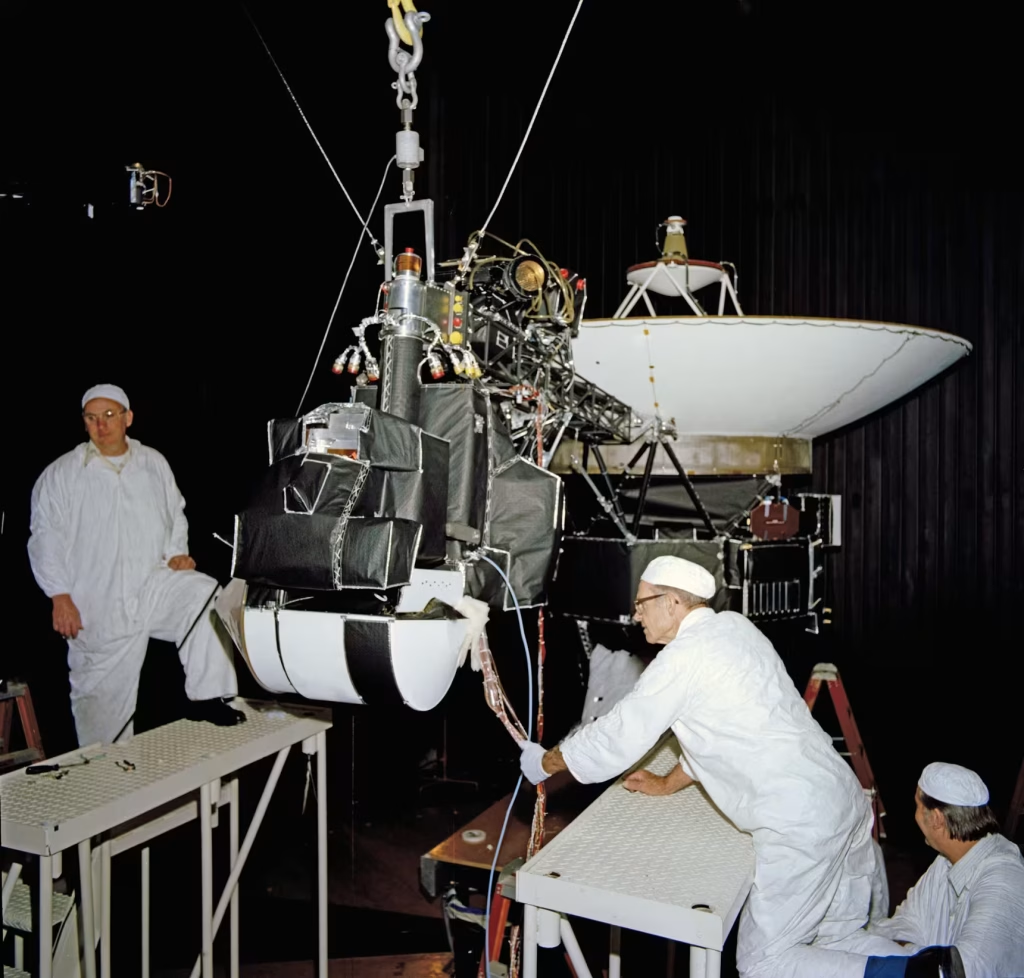
Voyager 1 undergoing testing before launch at NASA’s Jet Propulsion Laboratory in Pasadena, Calif., on April 27, 1977.
Photo: NASA / JPL

According to NASA and the Jet Propulsion Laboratory, Voyager 1, one of humanity’s two probes in interstellar space, has resumed sending engineering data back to Earth.

Last November, Voyager 1 stopped sending readable science and engineering data back to Earth, halting ongoing measurements and investigations. Mission controllers could tell the spacecraft was still receiving their commands and otherwise operating normally but could not do much else, leaving mission managers and engineers scrambling to assemble a team to fix the aging spacecraft.

According to a press release from JPL and NASA, “In March, the Voyager engineering team at NASA’s Jet Propulsion Laboratory in Southern California confirmed that the issue was tied to one of the spacecraft’s three onboard computers, called the flight data subsystem (FDS). The FDS is responsible for packaging the science and engineering data before it’s sent to Earth.”

“The team discovered that a single chip responsible for storing a portion of the FDS memory — including some of the FDS computer’s software code — isn’t working. The loss of that code rendered the science and engineering data unusable. Unable to repair the chip, the team decided to place the affected code elsewhere in the FDS memory. But no single location is large enough to hold the section of code in its entirety.”

In this illustration oriented along the ecliptic plane, NASA’s Hubble Space Telescope looks along the paths of NASA’s Voyager 1 and 2 spacecraft as they journey through the solar system and into interstellar space. Hubble is gazing at two sight lines (the twin cone-shaped features) along each spacecraft’s path. The telescope’s goal is to help astronomers map interstellar structure along each spacecraft’s star-bound route. Each sight line stretches several light-years to nearby stars.
NASA, ESA, and Z. Levay (STScI)

They continued by saying, “[T]hey devised a plan to divide affected the code into sections and store those sections in different places in the FDS. To make this plan work, they also needed to adjust those code sections to ensure, for example, that they all still function as a whole. Any references to the location of that code in other parts of the FDS memory needed to be updated as well.”

Brilliant computer science work that was, especially for a vehicle about 15.12 billion miles from Earth, traveling at 38,026 miles per hour. Currently, it takes roughly 22.5 hours for a signal to travel from Voyager 1 to Earth (and vice versa), creating a major challenge in communications.

Voyager 1 Launch on September 5, 1977

The narrow bandwidth further complicates those communications: about 40 bits per second for engineering data, or roughly five alphanumeric characters each second. By comparison, the median Internet speed in the US is 242.38 Megabits per second, or 30.2 million characters.

In the next few weeks, the Voyager 1 team plans to relocate and adjust the affected portions of the FDS software including portions that will start returning science data. Meanwhile, Voyager 1 will continue to travel away from the Earth.

Read more