Falcon Heavy lifting off of LC-39A at 05:26 PM EDT on June 25, 2024 Photo: Charles Boyer / Talk of Titusville
NASA and SpaceX launched the GOES-U weather satellite for NOAA today from Launch Complex 39A at Kennedy Space Center at 05:26 PM EDT, ten minutes after the launch window opened, with thunderstorms looming in the distance. With mission managers satisfied that the storms would not affect either the launch of landings of Falcon Heavy, the launch proceeded as planned.
Around 8.5 minutes after liftoff, the two side booster used for the mission returned and safely landed at Cape Canaveral Space Force Station, while the center core booster was expended and not recovered.
The satellite was safely delivered into its initial orbit and, after separating from Falcon Heavy’s second stage, it will continue under its own power to its final location in geosynchronous orbit, where it will undergo a commissioning process prior to its entering service for NOAA. SpaceX announced a successful deployment just before 10 PM EDT, marking a successful mission that had begun roughly 4.5 hours earlier.
Falcon 9 Boosters Descending Towards Landing June 25, 2024 Photo: Chris Leymarie / Florida Media Now
Launch Replay
Payload
According to NOAA, “GOES-U will provide critical atmospheric, hydrologic, oceanic, climatic, solar and space data for advanced detection and monitoring of environmental phenomena that threaten the security and well-being of everyone in the Western Hemisphere.”
NASA rendering of the GOES-U satellite.
They add, “GOES-U will be renamed GOES-19 after it reaches geostationary orbit. Following a successful on-orbit checkout of its instruments and systems, NOAA plans to put GOES-19 into operational service, replacing GOES-16 as GOES East. GOES-19 will work in tandem with GOES-18, NOAA’s GOES West satellite. Together, GOES East and GOES West watch over more than half the globe – from the west coast of Africa to New Zealand.”
A Falcon Heavy side booster starting its final landing burn on June 25, 2024
Next Scheduled Launch
SpaceX plans to launch Starlink satellites aboard a Falcon 9 from Cape Canaveral Space Force Station’s SLC-40 on Thursday, June 27th.
Date: NET June 27, 2024
Organization: SpaceX
Mission: Starlink 10-3
Rocket: Falcon 9
Launch Site: SLC-40, Cape Canaveral Space Force Station
Launch Window: 07:00 AM – 11:00 AM EDT
Payload: 22 communications satellites
Keep in mind that launch dates and times change often. Launch attempts can be scrubbed anytime due to weather, technical reasons, or range conditions.
Falcon Heavy on the launch pad at LC-39A early on June 25, 2024. Photo: Charles Boyer / Talk of Titusville
NASA is targeting a two-hour window Tuesday opening at 5:16 PM EDT, June 25, for the launch of the weather satellite aboard a SpaceX Falcon Heavy rocket from Launch Complex 39A. The payload for this mission is the NOAA (National Oceanic and Atmospheric Administration) GOES-U weather satellite, an advanced weather forecasting satellite.
The weather could be a significant concern for any launch attempt tomorrow or Wednesday as storms are expected to form in the Space Coast area. The 45th Weather Squadron is giving a pessimistic forecast of only a 30% chance of acceptable weather for launch, with a 70% chance of weather causing a launch delay.
B1087 (Center Core), B1086 and B1072 (RTLS Side Cores) are all brand new boosters set to debut on this launch. B1086 and B1072 will return and land at SpaceX’s landing zone at Cape Canaveral, and B1087 will have a short life — it will be expended as part of the mission plan. As such, sonic booms will be heard throughout the Space Coast region as the boosters herald their return to land.
Should the launch be delayed for weather-related or technical reasons, the backup window is Wednesday, June 26, at the same time as Tuesday.
At A Glance
Mission: GOES-U Date: NET June 24, 2024 Launch Window: 05:16 PM EDT – 07:16 PM EDT* Organization: NASA / SpaceX Rocket: Falcon Heavy Launch Site: LC-39A, Kennedy Space Center Payload: GOES-U Weather satellite for NOAA
* consult NASA or SpaceX media for the specific target for T-0.
Weather
In their forecast update at 1 PM EDT today, the 45th Weather Squadron states that, “By tomorrow, the ridge axis will be just south of the Spaceport as a surface boundary digs into the Southeastern US, bringing high levels of moisture and light offshore low-level winds before the afternoon sea breeze develops. This set-up will increase afternoon shower and storm chances through most of this week. Both tomorrow and Wednesday, the east coast sea breeze will form and trigger showers/storms in the early to mid-afternoon, before the evening launch window opens.”
That does not sound good, and a delay due to the weather is entirely possible, Still, with a two-hour launch window to work with, mission managers are hopeful that a a period of calm weather will allow the launch to proceed.
Payload
According to NOAA, “GOES-U will provide critical atmospheric, hydrologic, oceanic, climatic, solar and space data for advanced detection and monitoring of environmental phenomena that threaten the security and well-being of everyone in the Western Hemisphere.”
NASA rendering of the GOES-U satellite.
They add, “GOES-U will be renamed GOES-19 after it reaches geostationary orbit. Following a successful on-orbit checkout of its instruments and systems, NOAA plans to put GOES-19 into operational service, replacing GOES-16 as GOES East. GOES-19 will work in tandem with GOES-18, NOAA’s GOES West satellite. Together, GOES East and GOES West watch over more than half the globe – from the west coast of Africa to New Zealand.”
NASA will have a livestream of the launch on their website: NASA GOES-U
Spaceflight Now will have coverage of the launch starting about one hour before liftoff on Youtube: link
For official updates regarding launch times, SpaceX.com and or NASA is the best source of information.
Remember that there is a delay between a launch stream and the actual countdown clock. That is simply because of physics: it takes time for the signal to travel from the launch site, through the Internet, and back down to your phone, resulting in a five to fifteen-second delay.
Next Space Launch an app for iOS and Android phones, has a real-time countdown clock that is accurate to a second, give or take. The app is free. Search the App Store or Google Play.
Launch Viewing: In Person
Today’s launch is from LC-39A at Kennedy Space Center. The Max Brewer Bridge and northern park on Washington Avenue (US1) in Titusville are your best bets.
Given the early hours of the launch window (7:30AM – 11:30AM EDT) these restaurants may not be open for launch viewing. Later in the day, all three may well be, so if you are interested, be sure to call ahead to make sure they’ll be ready to serve you.
The Space Bar ($$$) – atop the Courtyard Marriott near Kennedy Parkway
New York New York ($$) – on the Indian River with an outdoor seating area. Is family-friendly.
Shiloh’s ($$$) — located on the Indian River with an outdoor deck overlooking KSC/CCSFS
Falcon Heavy, as seen from behind LC-39A early Tuesday, June 25, 2024
Indirect Views
There are several excellent viewing spots for launches that offer indirect views — meaning you won’t see the rocket until it clears obstructions such as trees, buildings, even a storm berm in one case.
Parking fees (probably). Pay with your smartphone on the parking app. There are signs everywhere telling you how.
Playalinda Beach
Playalinda Beach out on the Cape Canaveral National Seashore may be open to spectators, that is, if KSC Security and the National Park Service allow viewers for the launch. This varies launch to launch.
That’s by no means a certainty, however, and it would be very wise to call ahead before making the trip out.
Cape Canaveral National Seashore Phone: 386 428-3384 x0
If you are going to Playalinda, and if it is open, remember:
Get there at least two hours early, or better, earlier than that. Lines are long at the entry gate and they will only allow as many spectator vehicles as there are parking space available.
If the launch L-0 time is moved to after 8PM, you will have to leave Playalinda, as the National Park Service is very strict about closing hours.
Cape Canaveral National Seashore has a fee to get in and cash is not accepted. Debit and credit cards are okay, or if you have one of the National Park Service’s passes for the Seashore or the National Parks, that will work as well.
Cellphone service is spotty at best and often non-existant at Playalinda. Don’t count on your cellphone to keep up with the launch, because you might get signal or you might not.
You are not allowed to view from the pullouts on Beach Road. They will have stanchions blocking them. You’ll have to park and you’ll have to go to the beach.
Refreshments are not available. There are no stores at Cape Canaveral National Seashore, and that means you’ll need to bring drinks and food if you want any while you’re there.
Rangers will keep you back a certain distance from the launch area. If the beach is open, you’ll still not be able to go all the way down to the fence that demarcates the normal security zone. There’s a line that spectators can’t go past somewhat north of the fence. That’s for safety and security.
Also, as part of both Kennedy Space Center and the US Park system, Merritt Island National Wildlife Refuge is under federal jurisdiction and that means if you happen to get a ticket out there, you’ll be heading to federal court. Best thing to do is strictly obey traffic laws. Don’t speed!
Thirteen strains of Enterobacter bugandensis,have mutated and became genetically distinct compared to their Earth counterparts. The study also found that E. bugandensis coexisted with multiple other microorganisms, and in some cases could have helped those organisms survive. So far, NASA, Roscosmos, or any other international partners aboard the ISS have not reported infected astronauts or, worse, transmission of the species from the ISS to Earth.
E. bugandensis
A NASA news release this week perhaps states the findings more clearly:
“In a new scientific paper funded by an Ames Space Biology grant, Principal Investigator Dr. Kasthuri Venkateswaran of NASA’s Jet Propulsion Laboratory strains of the bacterial species Enterobacter bugandensis isolated from the International Space Station (ISS) were studied. Thirteen strains of E. bugandensis, a bacterium notorious for being multi-drug resistant, were isolated from the ISS. Study findings indicate under stress, the ISS isolated strains were mutated and became genetically and functionally distinct compared to their Earth counterparts. The strains were able to viably persist in the ISS over time with a significant abundance. E. bugandensis coexisted with multiple other microorganisms, and in some cases could have helped those organisms survive.
“Closed human-built environments, such as the ISS, are unique areas that provide an extreme environment subject to microgravity, radiation, and elevated carbon dioxide levels. Any microorganisms introduced to these areas must adapt to thrive. By delving into microbial dynamics in extreme environments, this research opens doors to effective preventative measure for astronaut health.”
In short, this common species from Earth has traveled to ISS, adapted to the unique environment of the orbiting outpost, and has evolved into something entirely new that is resistant to standard antibiotic treatments.
ISS. Photo: NASA
Known Since 2015
The recently released study backs up other studies that go back as far as 2015. According to a peer-reviewed release in 2018, “Researchers at the Jet Propulsion Laboratory, California Institute of Technology, USA investigated five strains of Enterobacter that were isolated from the space toilet and the exercise platform on the ISS in March 2015 as part of a wider effort to characterize the bacterial communities that live on surfaces inside the space station. To identify the species of Enterobacter collected on the ISS and to show in detail the genetic make-up of the individual strains, the researchers compared the ISS strains to all publicly available genomes of 1,291 Enterobacter strains collected on Earth.”
In 2018, Dr Kasthuri Venkateswaran, a Senior Research Scientist at the Jet Propulsion Laboratory Biotechnology and Planetary Protection Group stated that, “Whether or not an opportunistic pathogen like E. bugandensis causes disease and how much of a threat it is, depends on a variety of factors, including environmental ones. Further in vivo studies are needed to discern the impact that conditions on the ISS, such as microgravity, other space, and spacecraft-related factors, may have on pathogenicity and virulence.”
Health Effects of E. bugandensis?
According to the NIH’s National Center for Biotechnology Information, “Enterobacter species are responsible for causing many nosocomial infections, and less commonly community-acquired infections, including urinary tract infections (UTI), respiratory infections, soft tissue infections, osteomyelitis, and endocarditis, among many others.”
Again, no illnesses specific to E. bugandensis have been reported, and scientists have been monitoring this situation for some time.
Starship Heavy on its launch pad in Texas. Photo: Richard Gallagher / Florida Media Now
During those meetings, people can learn more about the proposed activity in an open house information station format, where the FAA will provide information describing the purpose of the scoping meetings, project schedule, opportunities for public involvement, Proposed Action and alternatives summary, and environmental resource area summary. The meetings will not be hearings, instead, they are designed to provide information.
That said, written and oral comments will be accepted, so it is your chance to make your voice heard, yay or nay. Talk of Titusville encourages you to take the time to attend, learn, and if you are so inclined, to leave your comments.
Public Information Session at The Radisson in Cape Canaveral in March for the SLC-37/50 Pads at Cape Canaveral. The ones for KSC / LC-39A will be much the same. Photo: Charles Boyer / ToT
Official Document from FAA
Here is the official document for the Proposed Action. Interested parties should take the time to read it. You can either download it from here, or if you prefer, from the FAA directly at www.faa.gov/media/80626. Reading the information beforehand may give you better insight to ask more informed questions if you attend one of the informational meetings.
The meetings will be informational, and not public hearings. The public hearings will come later in the process.
That’s important to keep in mind — if you want to make your voice heard, the best way to do so is in writing at the address mentioned below. You can submit written comments at the informational sessions, and a court reporter will also be present to transcribe your comments, as well.
June 12, 2024, 2pm-4pm and 6pm-8pm (Eastern) IN-PERSON Radisson Cape Canaveral, Jamaica Room 8701 Astronaut Blvd Cape Canaveral, FL 32920
According to today’s press release, “The FAA invites interested agencies, organizations, Native American Tribes, and members of the public to submit comments to inform the FAA on the significant issues to be analyzed in depth in the EIS (e.g., range of actions, alternatives, environmental impacts). The public scoping period starts with the publication of the Notice of Intent to Prepare an EIS in the Federal Register. To ensure sufficient time to consider issues identified during the public scoping period, comments should be submitted by one of the methods listed below no later than June 24, 2024. All comments will receive the same attention and consideration in the preparation of the EIS.”
“Comments, statements, or questions concerning scoping issues must be identified with the Docket Number FAA-2024-1395 and may be provided to the FAA as follows:
Federal E-Rulemaking Portal: http://www.regulations.gov. Retrieve the docket by conducting a search for “FAA-2024-1395” and follow the online instructions for submitting comments. Please note that the FAA will post all comments on the Internet without changes, including any personal information provided.
By U.S. mail to Ms. Eva Long, FAA Environmental Protection Specialist, c/o Leidos, 2877 Guardian Lane, Virginia Beach, VA 23452.”
NASA, Boeing and United Launch Alliance Forego Launch Opportunity on June 2nd As Well
The debut of Boeing’s Starliner with crew aboard will have to endure at least one more delay as teams work to assess the latest issue that prevented a launch from Cape Canaveral Space Force Station early this afternoon.
Astronauts Butch Wilmore and Suni Williams will presumable remain at Kennedy Space Center and still in quarantine awaiting the next launch attempt, which could come NET June 5th at 10:52 AM EDT.
Almost Got There
At T-minus three minutes and fifty-six seconds, a hold was called, the launch countdown halted, and the launch attempt was scrubbed for the day.
The reason?
“NASA, Boeing, and ULA (United Launch Alliance) scrubbed today’s launch opportunity due to the computer ground launch sequencer not loading into the correct operational configuration after proceeding into terminal count.”
NASA
In short, a computer systems failure.
Specifically, the failure was in the system that, “Controls things like retracting umbilical [connections from the pad to Atlas V] and the Pyro pin that release the bolts at the base of the rocket, so that when ignition happens the rocket is free to fly away and do its job,” said United Launch Alliance CEO Tory Bruno in a press briefing held after the scrub.
Tory Bruno at the NASA Press Briefing on June 1st, 2024. Photo: from NASA Livestream
Additionally, Bruno added, “For that system we do require all three systems to be running triple redundancy and to assure that [inside] each of those three big racks those three big computers do a health check and they monitor to see that those cards came up. When they were commanded to come up and be begin doing their job two came up normally the third one came up but it was slow to come up, and that tripped a red line that created an automatic hold.”
With that, the scrub, because the mission profile is one based on an instantaneous launch, means Atlas V must depart at a specific moment to catch up to the International Space Station in the most efficient manner. This is normal for ISS-bound crewed flights, dating back to the days of the Space Shuttle.
Teams Forego June 2nd Launch Window
Later in the evening, NASA issued this update:
“NASA, Boeing, and ULA (United Launch Alliance) are forgoing a Crew Flight Test launch attempt Sunday, June 2, to give the team additional time to assess a ground support equipment issue at Cape Canaveral Space Force Station’s Space Launch Complex-41 in Florida.”
NASA
So, there is no fast turnaround, no launch tomorrow, and Starliner is still on the ground awaiting its first crewed mission.
“Everyday Astronaut” Tim Dodd was in town and broadcasting live from CCSFS on Saturday. Photo: Charles Boyer / Talk of Titusville
Starliner Is Not To Blame
It would be fashionable to blame Boeing and Starliner for this latest delay, but in reality, it’s their partner, United Launch Alliance, that has not delivered in both launch attempts. On May 8th, a valve issue on Atlas V scrubbed the mission, and today, another ULA hardware problem has kept Starliner on the ground. In both cases, Starliner was ready for flight, but unfortunately, its ride to space was not. Whether ULA is third-time lucky remains to be seen.
There are two more potential launch dates, June 5 and June 6 available for Starliner before Atlas V will need to have maintenance on its battery systems, a process said to take at least ten days. Not too long after that ISS scheduling comes back into play, with Crew 9 scheduled to to head to ISS aboard a SpaceX Falcon 9 Crew Dragon in August.
Atlas V and Starliner on May 31, 2024. Photo: Charles Boyer / Talk of Titusville
Starliner capsule May 31, 2024 Photo: Charles Boyer / Talk of Totusville
If all goes well, at 12:25 PM EDT this afternoon, Boeing’s long-awaited Crewed Flight Test will lift of atop an Atlas V and on its way to low-Earth orbit. It will be the first time that Atlas V has carried crew, the first time at Starliner has carried crew, and the first crewed launch at Cape Canaveral in decades.
If all goes well.
Keep that in mind, as you hear mission controllers and official give details of the countdown as it proceeds.
Any rocket launch always has a long line of checkpoints, any of which can delay or even scrub the countdown. Until the rocket actually lifts off the pad, you can never be 100% certain that it is going to fly that day because everything has to work properly, or else mission controllers will wisely say, “We’re not going to space today.”
That is how it should be, and that’s how it will be today, especially with the lives of two astronauts at stake.
At the same time, the astronauts, engineers, technicians and staff at ULA, Boeing and NASA have diligently prepared for Starliner CFT, and they have tested, retested, and then tested again. They say the vehicle is ready. The astronauts say they are ready. And Space Station eagerly awaits their arrival, because Starliner was drafted at the last minute to carry a critical piece of hardware to the orbiting outpost.
Godspeed, Starliner.
Launch Time: 12:25 PM EDT.
Liftoff is scheduled for 12:25 PM EDT today, Saturday, June 1st.
The launch window is instantaneous, which means that Atlas V must lift off at its scheduled time, and that it cannot be delayed until later the same afternoon. This is normal for ISS launches because docking with the ISS requires efficiently matching the speed and position of the ISS, which moves at 7.7 km every second. Timing the launch to within a second greatly simplifies chasing down the orbiting outpost.
Starliner will be carried to orbit aboard an Atlas V N22, a crew-rated variant of the Atlas V 422. This version of Atlas V has two solid motor strap-on boosters with two liquid-fueled stages.
Trajectory: Northeast
As Starliner is planned to launch on a northeasterly trajectory, as is customary for ISS-bound launches. Space Coast residents may recall that previous SpaceX cargo resupply and Commercial Crew missions take the same path.
Launch viewers facing the Atlantic Ocean will see the rocket fly right-to-left as it ascends.
Weather: 90% Go, Winds Are A Concern
The 45th Weather Squadron’s official Launch Mission Execution Forecast gives 90% probability of acceptable atmospheric conditions at the launch sites and through Atlas V and Starliner’s ascent corridor.
One concern is wind. Mark Burger, launch weather officer at the 45th Weather Squadron said that, “There is one watch item,” he said, “And that is the local winds. It’s already turning breezy out of there with sort of a stiff onshore flow, and that’s what we’ll be monitoring for tomorrow as well.”
Burger added, “Again, [we’re] not considering any rain or thunderstorms, maybe a few clouds, bu not anything concerning for us. The winds will be a little feisty tomorrow not only in terms of the magnitude of the winds, but also the direction of the winds. [There will be] a pretty good onshore component, nearly perpendicular to the coast. That tightens or restricts us just a little bit in terms of favorability. But again, now, winds, as you know, are a highly variable factor both in time and space. So hopefully we’ll be able to to get off without a hitch.”
via 45th Weather Squadron. Forecast may be updated at any time.
Sky Cover
The National Weather Service is expecting roughly 50% cloud coverage late tomorrow morning. The launch should be well visible to most spectators, but clouds may block others.
Via National Weather Service. Forecast may be updated at any time.
Booster Recovery
None. Atlas V is a fully expendable launch system, so after Main Engine Cutoff of the first stage, it will seperate and fall into the Atlantic Ocean. Atlas V’s second stage, a dual-engine Centaur, will be purposely re-entered after Starliner separation.
Spaceflight Now will have coverage of the launch starting about one hour before liftoff on Youtube: link
Remember that there is a delay between a launch stream and the actual countdown clock. That is simply because of physics: it takes time for the signal to travel from the launch site, through the Internet, and back down to your phone, resulting in a five to fifteen-second delay.
Next Spaceflight, an app for iOS and Android phones, has a real-time countdown clock that is accurate to a second, give or take. The app is free. Search the App Store or Google Play.
Launch Viewing: In Person
This morning’s planned launch is from SLC-40, on the south side of the Eastern Range (KSC and Cape Canaveral Space Force Station combined.) The southern parks in Titusville on Washington Avenue and FL-528/A1A in Cape Canaveral are the best spots to watch liftoff directly.
Given the early hours of the launch window (7:30AM – 11:30AM EDT) these restaurants may not be open for launch viewing. Later in the day, all three may well be, so if you are interested, be sure to call ahead to make sure they’ll be ready to serve you.
The Space Bar ($$$) – atop the Courtyard Marriott near Kennedy Parkway
New York New York ($$) – on the Indian River with an outdoor seating area. Is family-friendly.
Shiloh’s ($$$) — located on the Indian River with an outdoor deck overlooking KSC/CCSFS
Indirect Views
There are several excellent viewing spots for SLC-40 launches that offer indirect views — meaning you won’t see the rocket until it clears obstructions such as trees, buildings, even a storm berm in one case.
Parking fees (probably). Pay with your smartphone on the parking app. There are signs everywhere telling you how.
Further away, but still good views.
Northern Titusville Parks
Further away, but really nice views.
You can also view the launch from the area beaches, which will have good views of the ascending rocket after it clears any ground obstructions.
Be prepared for potential changes or pushbacks in the launch schedule, and keep up by monitoring the live stream links mentioned above.
Keep up with launch news and other space events that affect the local area by subscribing to alerts when we publish a new article by entering your email at the link at the bottom of this page, or by visiting Space Talk here on the website. It’s free, and you can cancel at any time.
Bowing CST-100 Starliner ‘Calypso’ capsule on May 31, 2024 Photo: Charles Boyer, Talk of Titusville
“We’ll fly when we’re ready.”
Those words by the manager of NASA’s Commercial Crew Program, Steve Stich, earlier this spring have hovered over the launch campaign of Boeing’s Crewed Flight Test for several weeks now.
They’ve been a guiding principle for the launch and spacecraft teams, and NASA and astronauts Butch Wilmore and Suni Williams, and now, all parties agree that they’re ready to fly.
With that, the launch of Atlas V carrying Starliner to low-Earth orbit and eventually the International Space Station with Wilmore and Williams aboard is set for 12:26 PM EDT on Saturday June 1st.
The faulty valve in the second stage Centuar II of Atlas V has been replaced, and that problem closed out.
Engineers, scientists, and mission managers have analyzed the helium leak in Starliner discovered after the Centaur valve issue; the rate of loss was calculated and deemed safe for flight, and it will be monitored throughout the mission in case further intervention is required.
The panel for today’s press briefing at Kennedy Space Center, L-R: NASA Host and Moderator Derroll Nail NASA Associate Administrator Jim Free Steve Stich, manager, NASA’s Commercial Crew Program Dana Weigel, manager, NASA’s International Space Station Program NASA astronaut Mike Fincke Mark Nappi, vice president and program manager, Commercial Crew Program, Boeing Gary Wentz, vice president, Government and Commercial Programs, ULA Mark Burger, launch weather officer, 45th Weather Squadron, Cape Canaveral Space Force Station photo: Charles Boyer, Talk of Titusville
Mark Nappi, Mark Nappi, Boeing’s vice president and program manager for the company’s commercial crew program said earlier today that, “The teams are on station and they’re monitoring the spacecraft as we sit here and talk to you.”
“They reported this morning at 03:30 [AM EDT], powered up the vehicle, and have been a continuous monitoring mode and will continue to work the launch preps and the launch countdown leading up until tomorrow morning at 04:00 AM when the launch team will come in and start supporting the mission. So far, there’s been no issues that we’ve been working with the spacecraft, so all is going well,” Nappi added.
Atlas V and Starliner on the launch pad, May 31, 2024 Photo: Charles Boyer / ToT
Regarding the Helium issue that caused the lengthy May delay, Nappi was unequivocal: “It’s really just a matter of safety. When we looked at this problem, it didn’t come down to making trades; it came down to whether it was safe or not. And it is safe. That’s why we determined that we could go fly with what we have.”
Steve Stich added insight behind the determination. “There’s about 50 pounds of helium on board,” he said. “And this leak, if it was left open to vent, all the time, it would lose about a half a pound a day. So there’s plenty of margin left over.”
Weather Is A Slight Concern
Weather may be a concern for tomorrow. Mark Burger, launch weather officer, 45th Weather Squadron located at Cape Canaveral Space Force Station gave a 90% probability of acceptable weather, with a caveat. There is one watch item,” he said, “And that is the local winds. It’s already turning breezy out of there with sort of a stiff onshore flow, and that’s what we’ll be monitoring for tomorrow as well.”
Burger added, “Again, [we’re] not considering any rain or thunderstorms, maybe a few clouds, bu not anything concerning for us. The winds will be a little feisty tomorrow not only in terms of the magnitude of the winds, but also the direction of the winds. [There will be] a pretty good onshore component, nearly perpendicular to the coast. That tightens or restricts us just a little bit in terms of favorability. But again, now, winds, as you know, are a highly variable factor both in time and space. So hopefully we’ll be able to to get off without a hitch.”
The 45th Weather Squadron’s official forecast on May 31, 2024Railway view of the Atlas V with Starliner on May 31, 2024 Photo by Charles Boyer / Talk of Titusville
Keep up with launch news and other space events that affect the local area by subscribing to alerts when we publish a new article by entering your email at the link at the bottom of this page, or by visiting Space Talk here on the website. It’s free, and you can cancel at any time.
Starliner and Atlas V at the launch pad in early May. Photo: Charles Boyer / Talk of Titusville
After three weeks of analysis and discussion between Boeing, NASA, and United Launch Alliance following the May 8, 2024 scrub, Boeing’s long road to lofting crew aboard Starliner to low-Earth orbit will take a step towards launching. Liftoff of Atlas V and Starliner is scheduled for 12:25 PM EDT, Saturday, June 1st, from Space Launch Complex 41.
On May 22, Steve Stich, manager, NASA Commercial Crew Program said, “There has been a great deal of exceptional analysis and testing over the last two weeks by the joint NASA, Boeing, and ULA teams to replace the Centaur Self Regulating Valve and troubleshoot the Starliner Service Module helium manifold leak.”
He added, “It has been important that we take our time to understand all the complexities of each issue including the redundant capabilities of the Starliner propulsion system and any implications to our Interim Human Rating Certification. We will launch Butch and Suni on this test mission after the entire community has reviewed the teams’ progress and flight rationale at the upcoming Delta Agency Flight Test Readiness Review.”
That Flight Readiness Review was completed today, and all parties agreed that Starliner is “go” for liftoff.
Should weather or technical issues cause a scrub on Saturday, backup launch opportunities are available on Sunday, June 2, Wednesday, June 5, and Thursday, June 6.
Butch Wilmore and Suni Williams during their crew walkout prior to departing for the launch pad on May 8, 2024. The launch attempt was later scrubbed
Starliner CFT astronauts Butch Wilmore and Suni Williams returned to Kennedy Space Center yesterday, and will be completing their final preparations in anticipation of Saturday’s liftoff while they remain in quarantine at the Neil Armstrong Operations and Checkout Building.
According to a NASA press release issued today, “During a Delta-Agency Flight Test Readiness Review Wednesday at NASA’s Kennedy Space Center in Florida, leaders from NASA, Boeing, and ULA (United Launch Alliance) verified launch readiness, including all systems, facilities, and teams supporting the test flight.”
The first step in the final phases of the launch campaign is to move the Atlas V launch vehicle with Starliner back to the launch pad from ULA’s Vertical Integration Facility, located about 1,800′ south of the pad. The journey is slated to about ninety minutes and is scheduled to start at 10 AM EDT, Thursday, May 30.
Atlas V in fight with Starliner in 2022 during the Starliner OFT-2 mission. Photo: Charles Boyer, Talk of Titusville
A lightning strike from a severe thunderstorm started a conflagration in Merritt Island Wildlife Refuge this afternoon. It is north of Kennedy Space Center, and is currently no threat to property or human endeavor — in other words, the facilities at Kennedy Space Center.
The smoldering aftermath of a wildfire in Merritt Island National Wildlife Refuge. Photo: Charles Boyer / Talk of Titusville
A lightning strike from a severe thunderstorm started a conflagration in Merritt Island Wildlife Refuge this afternoon. It is north of Kennedy Space Center, and is currently no threat to property or human endeavor — in other words, the facilities at Kennedy Space Center.
1PM EDT Update: Beach Road to Cape Canaveral National Seashore and Playalinda Beach has reopened to traffic. Only lingering wildfire smoke is in the area of the road, and any smoldering fire remaining active appears to be located well south of the road.
Previous Updates
Merritt Island National Wildlife Released this statement on social media at 10:25 AM Sunday: “Update on the current wildfire in the Peacocks Pocket marsh. Fire crews will be flying over the area this morning to better assess the size and scope of the fire. A plan of action will be formed after this flight and will depend greatly on the expected weather conditions. This area last burned a little over 3 years ago which is the natural cycle for refuge.”
MINWR official statement at around 11PM EDT May 25: “A lightning caused fire is currently burning in the Peacocks Pocket impoundment. The fire is estimated to be 150-200 acres. Fish & Wildlife firefighters are onsite and will monitor the blaze throughout the night. Expect all access roads to Peacocks Pocket to be closed tomorrow until fire crews determine they are safe, including: West Gator Creek, Gator Creek East Gator Creek, and Catfish Creek roads.”
11PM MAY 25: KSC Police are currently turning unbadged cars away Gate 4TT, at the end of Max Brewer Bridge. They have also cleared the Refuge of spectators. (see above: the road has reopened to traffic headed towards CCNS/Playlinda Beach and Gate 4 for KSC)
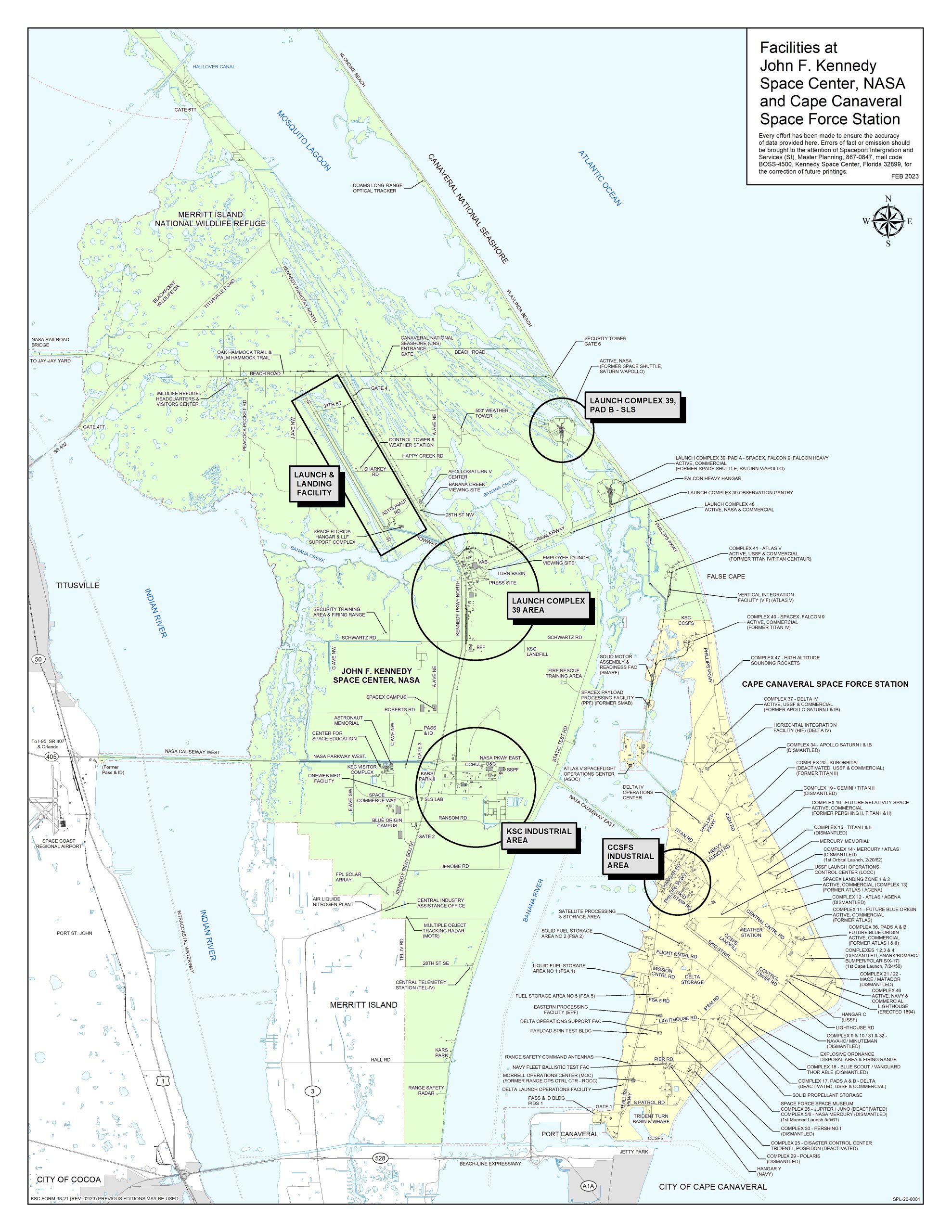
The general location of the wildfire in Merritt Island National Wildlife Refuge. Graphic: original map is from the 2021 KSC Facilities Map, NASA
12 PM EDT, Sunday: Beach Road Open, Fire Seems To Be Dwindling
From a distance and to the uneducated naked eye, the wildfire is now starting to burn itself out, especially on its northern edges. Still far away from operational KSC facilities and buildings, no flames could be seen from Beach Road or US-1 in Titusville, which is very different than twelve hours earlier.
That does not mean that the fire is no longer any danger — a change in weather conditions or wind direction and speeds could fan the flames. Stay tuned to local authorities for official status updates. We will pass them along as soon as we receive them.
1 PM Sunday, May 26: As seen from US-1 in Titusville, a perspective of the wildfire in MINWR: it is far away from any launch pad or KSC buildings, with the closest operational area of the space center being the Shuttle Landing Facility, but even that is at least two miles east. Click to enlarge Photo: Charles Boyer / Talk of Titusville12PM Sunday, May 26: a fire hotspot as seen across the Indian River from Titusville. Photo: Charles Boyer / ToT
11 PM EDT, Saturday: KSC Closes Beach Road
Around 11 PM EDT, KSC Police were emptying MINWR and were stopping people at the end of Max Brewer Bridge. KSC Police asked me to leave, and that’s exactly what I immediately did: I skedaddled.
Closeup of the fire line near Beach Road Saturday night. Photo: Charles Boyer / Talk of TitusvilleA waning moon rises over Beach Road through the smoke from wildfire in Merritt Island National Wildlife Refuge Saturday night. Photo: Charles Boyer / Talk of TitusvilleCloseup of the blaze. Photo: Charles Boyer / ToT
7 PM EDT, Saturday: Fire Is Spreading
Late afternoon wildfire scene in Merritt Island Wildlife Refuge. Photo: Charles Boyer / Talk of TitusvillePhoto: Charles Boyer / Talk of TitusvillePhoto: Charles Boyer / Talk of Titusville


You must be logged in to post a comment.