April 2024

Representative SpaceX Falcon 9 launch from SLC-40 at Cape Canaveral Space Force Station.
Photo: Charles Boyer / ToT

Another day, another Starlink launch from SpaceX, or so it seems lately. The company is regularly launching new batches of of the Internet service providing satellites, with a new set going up every few days on the average.

Averages can be a bit deceiving, of course, as is the case today: there was a Starlink launch late yesterday afternoon from Pad LC-39A at Kennedy Space Center, and today, just over twenty-four hours later, SpaceX is planning to send another 23 satellites to orbit from SLC-40 at Cape Canaveral Space Force Station. The launch window opens at 6:40 PM EDT and runs to 11:11 PM.

Today’s launch will be the 18th launch from SLC-40 this year, the 41st of the year overall from SpaceX, and could mark the 300th Falcon family booster landing. The pace and of course the number of booster landings is remarkable, and the company is making orbital spaceflight seem routine. It never is, of course, and the fact that SpaceX is making it seem as “easy” as they are testifies to their hard work and dedication.

Weather

As they did yesterday, the 45th Weather Squadron has forecasted a 10% Probability of Violation, meaning there is a 90% chance of acceptable weather during the launch window. Their primary concern is the Thick Clouds rule.

Trajectory

Southeast. If you are looking towards the ocean, the rocket will appear to travel left to right as it heads towards space.

Landing

Landing is planned to be on the autonomous spaceport drone ship (ASDS) ‘A Shortfall of Gravitas’ (ASOG) which is stationed in the Atlantic Ocean northeast of the Bahamas.

After the landing, ASOG will return to Port Canaveral with the booster. It will then be returned to SpaceX’s Hangar X facility on Roberts Road inside Kennedy Space Center for inspection, refurbishment and preparation for its next mission.

Booster: B1080

SpaceX stated on their website that “This is the seventh flight for the first stage booster supporting this mission, which previously launched ESA Euclid, Ax-2, Ax-3, CRS-30, and two Starlink missions.”

That’s Booster B1080. It’s last flight was 28 days ago, on March 21st when it launched CRS-30 to the International Space Station.

Booster B1080 launches Axiom 3, Jannuary 18, 2024
Photo: Charles Boyer / ToT
Booster B1080
Flight NumberMissionDate
1Axiom-2May 21, 2023
2EuclidJuly 1, 2023
3Starlink 6-11August 27 2023
4Starlink 6-24October 22, 2023
5Axiom-3January 18, 2024
6CRS-30March 21, 2024
Booster B1080 Flight Record as of March 21, 2024

Online Viewing

A live webcast of this mission will begin on SpaceX’s X account feed about five minutes prior to liftoff. 
Watch live on X.

SpaceX’s official web page has links to live coverage as well as up-to-date planned launch times. Starlink 6-52 Mission Page.

Spaceflight Now will begin its live launch feed one hour prior to liftoff.
SFN on Youtube.

Watching In Person

This evening’s planned launch is from SLC-40 at Cape Canaveral, which means that the best direct views of liftoff are: the Banana River Bridge on FL-528 W near Port Canaveral, or the southern parks on US-1 / S. Washington Avenue in Titusville. Kennedy Point Park and Rotary Riverview Park (among others) are your best bets for free viewing sites.

If you would like to enjoy food and drinks during the launch, you have several options in the Titusville area:

  • Shiloh’s Steak and Seafood (3665 S Washington Ave, Titusville, FL 32780)
    • Casual fine dining, with an outdoor deck overlooking the Indian River and launch pads beyond that.
  • New York New York (5401 Riveredge Dr, Titusville, FL 32780)
    • A local’s go-to for a casual tiki bar on the riverfront without a lot of fuss, but with a very friendly staff. Their kitchen closes at 6:30 PM EDT, so if you’d like to have dinner, get there before 6 PM or so.
  • The Space Bar (6245 Riverfront Center Boulevard, Titusville, FL 32780)
    • On top of the Courtyard by Marriott just off of Kennedy Parkway, the Space Bar has an elevated view of the launch pad as well as food and drinks available. TSB is run by the same company that operates the Kennedy Space Center Visitors Center and is across the bridge from KSCVC.

Cocoa Beach, Cocoa Beach PierJetty Park Pier will have indirect views, meaning that liftoff will not be visible, but after the rocket clears the pad and any ground obstructions, you will be able to see Falcon 9 ascending clearly assuming there are no clouds between you and the rocket. Jetty Park does charge admission and they do not accept cash — visit their web site to purchase an entry pass before you go.

Being that the launch is in the early evening, if you plan to attend in person, don’t forget mosquito spray. Also be prepared for potential changes in the launch schedule, and keep up by monitoring the live stream links mentioned above.

Read more

Falcon 9 pushing through the atmosphere creates a vapor cone on the fairings, April 17, 2024
Photo: Charles Boyer / ToT

SpaceX got Falcon 9 to work right at the beginning of tonight’s launch window when it launched the Starlink 6-51 mission at 5:26 PM EDT into the bluebird skies of the Space Coast. The payload was another 23 Starlink satellites to join the company’s ever-growing constellation of thousands of satellites in low-Earth orbit that provide Internet service to underserved areas globally.

Booster Touches Down Safely Near Bahamas

About eight and a half minutes after liftoff, Booster B1077 touched down safely on SpaceX’s ‘Just Read The Instructions’ automated droneship located offshore in the Atlantic Ocean northeast of the Bahamas, completing its 12th mission safely.

Falcon 9 Ascending: as it near the speed of sound, Falcon 9 created a contrail on April 17, 2024
Photo: Charles Boyer / ToT

Booster B1077

Booster B1077 successfully completed its 12th flight. It entered service on October 5, 2022 and was previously used for Crew-5, GPS III Space Vehicle 06, Inmarsat I6-F2, CRS-28, Intelsat G-37, NG-20, and now six Starlink missions, and safely touched down at sea on the Automated Spaceport Drone Ship ‘Just Read The Instructions.’

The drone ship will return to Port Canaveral, where it will be returned to SpaceX’s Hangar X facility at Kennedy Space Center for inspection, refurbishment and preparation for its next mission.

SpaceX Booster B1077
FlightMissionDate
1Crew-510/15/2023
2GPS III SV0601/18/2023
3 Inmarsat-6 F202/18/2023
4Starlink Group 5-1003/29/2023
5Dragon CRS-2 SpX-2806/05/2023
6Galaxy 3708/03/2023
7Starlink Group 6-1309/01/2023
8Starlink Group 6-2510/30/2023
9Starlink Group 6-3312/07/2023
10Northrup Grumman NG-2001/30/2024
11Starlink Group 6-4303/10/2024
12Starlink Group 6-5104/17/2023
Booster 1077 flight record as of April 17, 2024

Next Launch

The wait won’t be long for the next launch from the Space Coast: weather and spacecraft readiness permitting, SpaceX is planning another Starlink launch Thursday, April 18, this time from SLC-40 at Cape Canaveral Space Force Station.

  • Date: NET April 18, 2024
  • Organization: SpaceX
  • Mission: Starlink 6-52
  • Rocket: Falcon 9
  • Launch Site: SLC -40, Cape Canaveral Space Force Station
  • Launch Time: 06:40-11:11 PM EDT (Tentative and subject to change)
  • Payload: 23 Starink Satellites

Keep in mind that launch dates and times change often. Launch attempts can be scrubbed at any time due to weather, technical reasons or range conditions.

Read more

Representative SpaceX Booster Rising.
Photo: Charles Boyer / ToT

SpaceX is planning to launch the first of three Falcon 9 missions over the next five days today. There’s another launch scheduled for tomorrow, Thursday, April 18, and a final one set for Monday, April 22nd. All three will be ferrying a tranche of Starlink Group 6 satellites to orbit. Today’s launch is from Pad LC-39A at Kennedy Space Center.

Weather

The 45th Weather Squadron has forecasted a 10% Probability of Violation, meaning there is a 90% chance of acceptable weather during the launch window. Their primary concern is the Thick Clouds rule.

Trajectory

Southeast, as has been customary for Group 6 Starlink payloads.

Landing

Landing is planned to be on the autonomous spaceport drone ship (ASDS) ‘Just Read The Instructions’ (JRTI) which is stationed in the Atlantic Ocean northeast of the Bahamas.

After the landing, JRTI will return to Port Canaveral with the booster. It will then be returned to SpaceX’s Hangar X facility on Roberts Road inside Kennedy Space Center for inspection, refurbishment and preparation for its next mission.

Booster: B1077

Booster B1077 will be making its 12th flight. Previously, B1077 was used for Crew-5, GPS III Space Vehicle 06, Inmarsat I6-F2, CRS-28, Intelsat G-37, NG-20, and five Starlink missions.

SpaceX Booster B1077
FlightMissionDate
1Crew-510/15/2023
2GPS III SV0601/18/2023
3 Inmarsat-6 F202/18/2023
4Starlink Group 5-1003/29/2023
5Dragon CRS-2 SpX-2806/05/2023
6Galaxy 3708/03/2023
7Starlink Group 6-1309/01/2023
8Starlink Group 6-2510/30/2023
9Starlink Group 6-3312/07/2023
10Northrup Grumman NG-2001/30/2024
11Starlink Group 6-4303/10/2024
Booster 1077 flight record as of April 16, 2024

Online Viewing

A live webcast of this mission will begin on SpaceX’s X account feed about five minutes prior to liftoff. 
Watch live on X.

SpaceX’s official web page has links to live coverage as well as up-to-date planned launch times. Starlink 6-51 Mission Page.

Spaceflight Now will begin its live launch feed one hour prior to liftoff.
SFN on Youtube.

Launch Viewing: In Person

Today’s launch is from LC-39A at Kennedy Space Center, which means that the best direct views of liftoff are at either the Max Brewer Bridge in Titusville, or the northern parks on US-1 in Titusville.

Video of a Playalinda launch.

If the launch is prior to 8PM EDT, Playalinda Beach out on the Cape Canaveral National Seashore will be open to spectators, that is, if KSC Security and the National Park Service allow viewers for the launch. This varies launch to launch, but as a general rule, they have allowed spectators to watch Starlink launches from the beach. You could be as close as 4.25 miles from the launch pad at liftoff.

Generally speaking, if it is not a national-security mission (for example, a National Reconnaissance Office payload) or a NASA mission, spectators have been allowed at Playalinda. That’s by no means a certainty, however, and it would be very wise to call ahead before making the trip out.

Cape Canaveral National Seashore Phone: 386 428-3384 x0

If you are going to Playalinda, and if it is open, remember:

  • Get there at least two hours early, or better, earlier than that. Lines are long at the entry gate and they will only allow as many spectator vehicles as there are parking space available.
  • If the launch L-0 time is moved to after 8PM, you will have to leave Playalinda, as the National Park Service is very strict about closing hours.
  • Cape Canaveral National Seashore has a fee to get in and cash is not accepted. Debit and credit cards are okay, or if you have one of the National Park Service’s passes for the Seashore or the National Parks, that will work as well.
  • Cellphone service is spotty at best and often non-existant at Playalinda. Don’t count on your cellphone to keep up with the launch, because you might get signal or you might not.
  • You are not allowed to view from the pullouts on Beach Road. They will have stanchions blocking them. You’ll have to park and you’ll have to go to the beach.
  • Refreshments are not available. There are no stores at Cape Canaveral National Seashore, and that means you’ll need to bring drinks and food if you want any while you’re there.
  • Rangers will keep you back a certain distance from the launch area. If the beach is open, you’ll still not be able to go all the way down to the fence that demarcates the normal security zone. There’s a line that spectators can’t go past somewhat north of the fence. That’s for safety and security.

Also, as part of both Kennedy Space Center and the US Park system, Merritt Island National Wildlife Refuge is under federal jurisdiction and that means if you happen to get a ticket out there, you’ll be heading to federal court. Best thing to do is strictly obey traffic laws. Don’t speed!

If you’re not planning to go to Playalinda, the best direct views of liftoff are at either at the northern Titusville parks off of US1 / Washington Avenue. the Max Brewer Bridge in Titusville, or the northern parks on US-1 in Titusville.

The ascending rocket will also be visible on Cocoa Beach, Cocoa Beach PierJetty Park Pier after liftoff when Falcon 9 clears any obstructions.

The ascending rocket will also be visible on the beaches after liftoff when Falcon 9 clears any obstructions.

Weather is forecast to be in the 70º’s around launch time.

Read more

Starliner outside of Boeing’s Starliner facility at Kennedy Space Center on April 16, 2024
Photo: Charles Boyer / ToT

United Launch Alliance and Boeing transported the CST-100 Starliner capsule from Boeing’s preparation facility aside the VAB early this morning and transported it to SLC-41 for mating to its booster, an Atlas V N22. Launch of the Crewed Flight Test is scheduled for NET May 6, 2024, with an eight day mission planned for crew and spacecraft.

On hand to greet Boeing employees and members of the press were CFT Pilot Sunita “Suni” Williams and CFT Commander Barry “Butch” Wilmore. The two thanked everyone for coming out to greet them early in the morning, and they expressed their confidence in a great mission to come. “We’re super proud of this team,” Williams said. “They made it happen, and it’s time to turn [Starliner] over from production to operations.” With that, the pair expressed their readiness to go fly aboard Starliner.

Flight Objectives

Butch Wilmore gives a thumbs-up to onlookers on April 16, 2024.
Photo: Ed Cordero / Florida Media Now

First, and foremost, Boeing and NASA mission managers would like to see a relatively event-free maiden crewed flight of Starliner, with no unexpected major incidents. Boeing’s Starliner has flown twice, once in 2019 and once in 2022, and neither time with crew aboard. 

The first flight, Orbital Flight Test 1 (OFT-1), in 2019, failed to reach the International Space Station (ISS) after the on-board clock malfunctioned. The second flight, Orbital Flight Test 2 (OFT-2), in 2022 met all of its major objectives and docked with the ISS, where it remained for four days before returning to Earth.

Since the second flight, other problems, including a potentially flammable tape used to wrap the wiring harnesses of Starliner were replaced, issues with parachute lines and its harness were improved and tested, and software improvements were made. Those remediations held up this Crewed Flight Test until earlier this year, and after that, scheduling issues on the International Space Station ports has kept Starliner on the ground.

Now that the ISS docking ports are clear and technical issues have been resolved, Boeing, United Launch Alliance and NASA have begun their launch campaign, which begins in earnest with a planned liftoff no earlier than May 6th.

Starliner wiating transportation outside Boeing’s facility at Kennedy Space Center on April 16, 2024
Photo: Charles Boyer / ToT

Crewed Flight Test Objectives

Last month, Mark Nappi, Boeing’s Vice President and Program Manager of the Starliner Program outlined what promises to be a busy schedule for Williams and Willmore during the flight. “The CFT flight is really the introduction of crew into our vehicle system. So a lot of our flight test objectives are about how that interface is going to work.”

Nappi said regarding flight test objectives, “We’ve got just under 90 of them. And it’s all, does the vehicle perform with the human in the loop, as expected?”

“We flew OFT-2,” Nappi added, “And that was the uncrewed mission for the Starliner vehicle. It was very successful. Now we introduce the human. And so what are we going to do to establish that interface?”

“From prelaunch through ascent, we’re going to be looking at how the astronauts fit into the seats, how they interface with the equipment in the vehicle. when we go through approach and rendezvous.” After that, Nappi said, “We’ll confirm the thruster performance and manual scenarios are working as expected. We’ll check the communications. We’ll check the manual and auto navigation systems and the operation of the life support system with crew now in the vehicle.”

“CFT is a test flight, so we expect that there may be some lessons learned,” Nappi concluded.

Read more

A towering dust devil casts a serpentine shadow over the Martian surface in this image from NASA Mars Reconnaissance Orbiter. The scene is a late-spring afternoon in the Amazonis Planitia region of northern Mars.
Photo: NASA / JPL

NASA’s ambitious Mars Sample Return program, which plans to land on the Martian surface, collect rock and dust samples, and return them to Earth has been delayed and will be revised due to its high costs and long lead times.

Mars Sample Return is the highest priority solar system exploration goals identified by the National Academies of Sciences, Engineering and Medicine in the past three decadal surveys, but technical capability, costs and funding have stopped the mission short of execution.

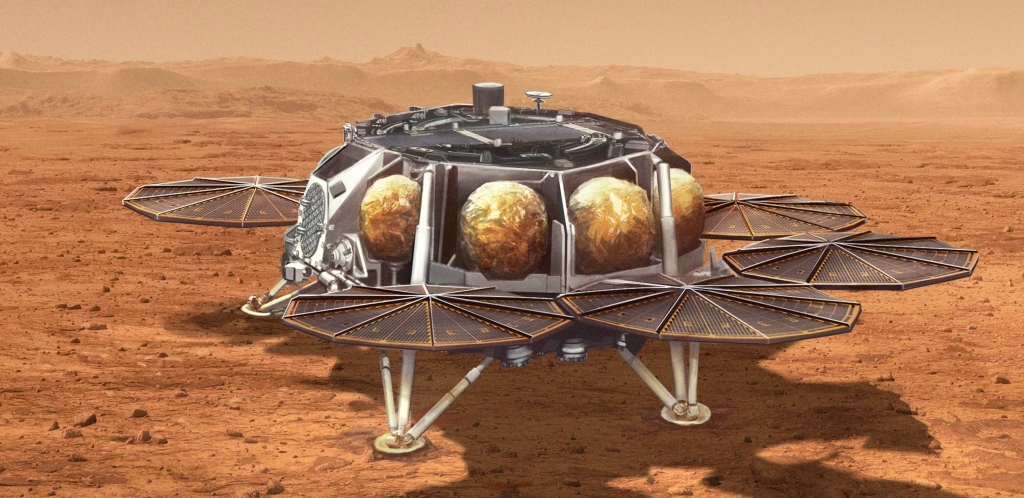
Artist’s concept of what the Mars Sample Return lander might look like.
Graphic: NASA / JPL

Changes Made, In Short

“An $11 billion budget is too expensive, and a 2040 return date is too far away,” NASA Administrator Bill Nelson said today.

NASA has asked the Jet Propulsion Laboratory to create an updated mission design that “has reduced complexity, improve resiliency and risk posture, and well as well as strong accountability and coordination,” sad Nicola “Nicky” Fox, associate administrator for NASA’s Science Mission Directorate today in a NASA press conference.

Original outline of the MSR Program
Graphic: NASA

“NASA SMD will release a competitive solicitation in the immediate future for funded industry studies to investigate either 1) innovative and alternate MSR architectures or 2) innovative and alternate architecture elements, such as a smaller Mars Ascent Vehicle, that could offer lower life cycle cost, lower annual cost, provide earlier sample return,” Fox relayed in an accompanying press release.

Nelson said that JPL and other NASA centers will have until fall to prepare the new mission profile, and that sometime after that a revised plan will be released for Congressional and public scrutiny.

MSR has been in a state of limbo since last fall, when an independent review board said that the project  “[an] unrealistic budget and schedule expectations from the beginning.” (Note: link goes to a PDF file.)

The board also pointed out other classical challenges for a Mars mission, such as launch window constraints (every other year), the potential for dust storms upon arrival, landing site certifications and so on.

Afterwards, Congressional appropriations committees recommended a budget that included a cut of $454.1 Million to NASA’s 2024 budget, specifically from the Mars Sample Return mission. That action left a lot of doubt about the program and whether it would be canceled outright, but it appears that NASA and JPL are attempting to put it back on track with the solicitation of new mission profiles and ideas.

Back To The Drawing Board

In response to the Independent Review Board, NASA filed a response and publicly released it today.

NASA’s response to the second Mars Sample Return Independent Review Board (MSR IRB-2)

In it, NASA says that their new plan is to make several changes to the program in order to balance current technology and innovation. They also plan to reduce programmatic and technical risk, and decouple launch readiness dates.

“Independent review boards like the one we commissioned for Mars Sample Return help review whether we’re on the right track to meet our mission goals within the appropriate budget,” Sandra Connelly, deputy associate administrator for NASA’s Science Mission Directorate, said in a statement the agency released today. “We thank the board for its work, and now our job is to assess the report and address if there are elements of the program that need to change.”

Read more

Deep Space Food Challenge Logo
NASA

NASA and the Canadian Space Agency have been conducting a competition for companies to provide nutritious and tasty food for astronauts on long-term missions, and that competition has been narrowed to five finalists on the American side, with three additional internationally-based competitors rounding out the field. Called the Deep Space Food Challenge, the goal of this competition is to generate novel food production technologies or systems that require minimal resources and produce minimal waste while creating items or cuisine that are actually appealing to the crew.

“The International Space Station is restocked every 60 to 90 days, and we are able to manage the waste generated from those payload deliveries,” said Denise Morris, program manager for Centennial Challenges which is managed out of NASA’s Marshall Space Flight Center. “In order to get to Mars and beyond, we must adapt how we feed our crews with no resupply, little added waste and resources, and an ideal level of labor. The solutions derived from the Deep Space Food Challenge will bridge this massive technology gap, allowing us to venture further and longer than we ever have before.”

Two companies with facilities on the Space Coast are among the eight finalists:

  • Interstellar Lab of Merritt Island, Florida, created a modular bioregenerative system for producing fresh microgreens, vegetables, mushrooms, and insects.
  • The Eternal BIO division of Kernel Deltech USA of Cape Canaveral, Florida, developed a system for cultivating mushroom-based ingredients.
  • Nolux of Riverside, California, created a solution that mimics the photosynthesis that happens in nature to produce plant- and mushroom-based ingredients.
  • SATED (Safe Appliance, Tidy, Efficient, and Delicious) of Boulder, Colorado, developed a space cooking appliance that would allow astronauts to prepare a variety of meals from ingredients with long shelf lives.
  • Air Company of Brooklyn, New York, developed a system and processes for turning air, water, electricity, and yeast into food.

The five finalists will each receive $150,000 in prizes from NASA and advance to compete for up to $1.5 million in total prizes in Phase 3.

Additionally, there three internationally-based companies that were selected by NASA and the CSA to participate in Phase 3:

  • Enigma of the Cosmos of Melbourne, Australia, created an adaptive growing system to increase the efficiency of plants’ natural growth cycles.
  • Mycorena of Gothenburg, Sweden, developed a system that uses a combination of microalgae and fungi to produce a microprotein.
  • Solar Foods of Lappeenranta, Finland, created a system that uses gas fermentation to produce single-cell proteins.

Kernel Deltech / Eternal Bio

According to their press release, Kernel Deltech has created a unit that leverages fungi fermentation to create a sustainable, nutrient-rich food source for astronauts on long-duration missions. To accomplish this they have built a device that relies on artificial intelligence and robotics to do much of the work, reducing the complexity and hours required by human astronauts to gain nutrition from the system.

“After winning the previous phase, expectations were high. We are proud to have made it to the NASA final,” said Lucas Gago, Chief Innovation Officer of Eternal. “This technology has the potential to revolutionize the alternative protein industry, both for space exploration and democratizing access to good nutrition here on Earth.” Added Miguel Neumann, who has recently become the Company CEO.

Kernel Deltech says the prototype is no larger than a kitchen appliance and can be easily modularly introduced into habitats and spacecraft.

Interstellar Lab

Nutritional Closed-Loop Eco-Unit System, or NUCLEUS, developed by Interstellar Lab of Merritt Island, Florida, is a self-sustaining food production system yielding fresh greens, vegetables, mushrooms, and insects, which could provide nutrients for long-term space missions.
Credits: NASA/Methuselah Foundation

Interstellar has developed a device that they are calling “Nucleus.” According to their marketing materials, they have “developed a closed-loop food-production system that incorporates microgreens, vegetables, mushrooms and insects that covering astronaut food gaps during long-term space missions.”

Interstellar adds that Nucleus passed Phase 1 and Phase 2 prototyping and has been tested at Kennedy Space Center. They add that the Phase 3 prototype will be delivered to NASA between July and October of this year.

Experiments To Grow Plants On ISS Already Ongoing

While the “Deep Space Food Challenge” winners will undoubtedly help extend the variety and efficiencies of astronaut cuisine in space, NASA has already been working on growing food aboard the International Space Station:

The agency states in an article they published that they have been experimenting with a device called “Veggie” that can grow greens for astronauts aboard the orbiting outpost: “The Vegetable Production System, known as Veggie, is a space garden residing on the space station. Veggie aims to help NASA study plant growth in microgravity, while adding fresh food to the astronauts’ diet and enhancing happiness and well-being on the orbiting laboratory.”

Three different varieties of plants growing in the Veggie plant growth chamber on the International Space Station were harvested in 2017.
Photo: NASA

“The Veggie garden is about the size of a carry-on piece of luggage and typically holds six plants. Each plant grows in a “pillow” filled with a clay-based growth media and fertilizer. The pillows are important to help distribute water, nutrients and air in a healthy balance around the roots. Otherwise, the roots would either drown in water or be engulfed by air because of the way fluids in space tend to form bubbles.”

“Veggie” is among other prototypes being tested by NASA: “[An] Advanced Plant Habitat (APH), like Veggie, is a growth chamber on station for plant research. It uses LED lights and a porous clay substrate with controlled release fertilizer to deliver water, nutrients and oxygen to the plant roots.”

“Unlike Veggie, it is enclosed and automated with cameras and more than 180 sensors that are in constant interactive contact with a team on the ground at Kennedy, so it doesn’t need much day-to-day care from the crew,” NASA added.

In addition to dwarf wheat and other foods, “Veggie” has grown zinnias, which astronaut Scott Kelly brought back to Earth in 2016.

Astronaut Scott Kelly nursed dying space zinnias back to health on the International Space Station. He photographed a bouquet of the flowers in the space station’s cupola against the backdrop of Earth and shared the photo to his Instagram for Valentine’s Day 2016.
Photo: NASA/Scott Kelly

Since Kelly assembled his orbiting bouquet, additional research has been ongoing. Plant research on Station has led to multiple papers in scientific journals, including results from the Seedling Growth investigations, which were subsequently published in Nature.

Also, according to NASA, “Another plant study, the Advanced Astroculture (ADVASC) experiment, tested a system to protect plants by removing viruses, bacteria, and mold from the plant growth chamber. That system has been used in the grocery industry to prolong the shelf-life of fruits and vegetables and in wine storage cellars.”

NASA adds, “To achieve the ultimate goal – growing plants for food in space and for habitats on the Moon and Mars – researchers must develop larger growth systems. The Veg-05 investigation is taking steps toward that goal by examining the effect of light quality and fertilizer on fruit production and analyzing the safety, nutritional value, and taste of the fruit.”

In addition to the work already completed and other work that is ongoing on ISS right now, NASA undoubtedly hopes to add to its portfolio of equipment, techniques and variety of growing foodstuffs in space. That will be vital not only to a long-duration crew’s health, but also their mental well-being. Having a taste of “home” so far away from it will undoubtedly be one of the little pleasures that make travelling interplanetary distances more bearable.

Read more

Booster B1062’s 20th Ascent Path
Seen from FL 528W in Cape Canaveral. Fishermen were lighting the edges of the river and enjoying the weather as much as the crowd that gathered there to watch the liftoff.
Photo: Charles Boyer / ToT

SpaceX launched a Falcon 9 tonight from Pad SLC-40 at Cape CAnaveral Space Force Station and sent another twenty-three Starlink satellites to orbit. Liftoff occurred at 09:22 PM EDT on a crisp, clear spring evening on the Space Coast.

Booster B1069 nears Main Engine Cutoff April 12, 2024
Photo: Charles Boyer / ToT

Crowds were heavier than normal along the usual spectator spots, and no one left disappointed — long after staging and for almost seven minutes the second stage could be seen rising and building orbital speed.

As one man said to someone beside me, “Enjoy this, [it] won’t be long until the air is thick and hot as soup.” He’s right. If anything, Friday’s weather was one of the last of Florida spring weather: cool, but not cold with pinpoint stars and crescent moon lighting the sky. It won’t be long until humidity rises and the nightly costal front storms will be a concern for mission managers and launch spectators alike.

Falcon 9 rising: Starlink 6-49 in flight on April 12, 2024
Photo: Ed Cordero, Florida Media Now

Booster Touches Down Safely Near Bahamas

About eight and a half minutes after liftoff, Booster B1062 touched down safely on SpaceX’s A Shortfall of Gravitas automated droneship located offshore in the Atlantic Ocean near the Bahamas, completing its 20th mission safely.

After returning to Port Canaveral several days from now, B1062 will be returned to SpaceX’s facilities at Hangar X at Kennedy Space Center, where it will be inspected, refurbished, and presumably prepared for its next flight. If it reaches the launch pad, it will be for the 21st time.

Booster B1062 Record

FlightMissionDate
1GPS III SV04
Sacagawea
11/05/2020
2GPS III SV05
Neil Armstrong
06/17/2021
3Inspiration 409/16/2021
4Starlink 4-501/06/2022
5Axiom-104/08/2022
6Starlink 4-1604/29/2022
7Nilesat-30106/08/2022
8Starlink 4-2507/24/2022
9Starlink 4-2708/19/2022
10Starlink 4-3610/20/2022
11Starlink 5-112/28/2022
12Starlink 5-402/12/2023
13OneWeb 1703/09/2023
14ArabSat 7B05/27/2023
15Starlink 6-707/28/2023
16Starlink 6-2310/18/2023
17Starlink 6-3011/28/2023
18Starlink 6-3801/29/2024
19Starlink 6-4403/15/2024
20Starlink 6-4904/12/2024
Booster 1062 flight record as of April 12, 2024

Payload

Tonight’s mission delivered 23 Starlink satellites to join other Group 6 satellites.

Next Launch

  • Date: NET April 17, 2024
  • Organization: SpaceX
  • Mission: Starlink 6-51
  • Rocket: Falcon 9
  • Launch Site: SLC -40, Cape Canaveral Space Force Station
  • Launch Time: 05:24 PM – 09:55 PM EDT (Tentative and subject to change)
  • Payload: 23 Starink Satellites

Keep in mind that launch dates and times change often. Launch attempts can be scrubbed at any time due to weather, technical reasons or range conditions.

Read more

Booster B1062’s 20th Ascent Path
Seen from FL 528W in Cape Canaveral. Fishermen were lighting the edges of the river and enjoying the weather as much as the crowd that gathered there to watch the liftoff.

SpaceX launched a Falcon 9 tonight from Pad SLC-40 at Cape Canaveral Space Force Station and sent another twenty-three Starlink satellites to orbit. Liftoff occurred at 09:22 PM EDT on a crisp, clear spring evening on the Space Coast.

Crowds were heavier than normal along the usual spectator spots, and no one left disappointed — long after staging and for almost seven minutes the second stage could be seen rising and building orbital speed.

As one man said to someone beside me, “Enjoy this, [it] won’t be long until the air is thick and hot as soup.” He’s right. If anything, Friday’s weather was one of the last of Florida spring weather: cool, but not cold with pinpoint stars and crescent moon lighting the sky. It won’t be long until humidity rises and the nightly costal front storms will be a concern for mission managers and launch spectators alike.

Note: Story and photographs are by Charles Boyer, and were originally published at Talk of Titusville

Read more

On April 7, the day before the Total Solar Eclipse, we were in Austin and stopped by a nightly event that’s really a fun time: watching tens of thousands of bats coming out at dusk to start the night-shift of bug hunting. The event cost nothing, and we found a free parking space not far away and just sat on a rock on the Colorado River. If you’re ever in Austin, I highly recommend this.

Read more

Note: I could not attend this launch, as I was traveling to Texas for the solar eclipse. I was accredited press, however, and was able to photograph the rocket on a few occasions prior to its launch on April 9, 2004. Words and photos were originally published by me at Talk of Titusville and are reprinted here by permission.

United Launch Alliance is planning to launch the final launch of Delta IV Heavy on Thursday from SLC-37 at Cape Canaveral Space Force Station. The launch window extends from 1:40 PM – 6:51 PM EDT. NROL-70 is a mission is set to carry a classified payload for the National Reconnaissance Office, an agency of the United States Department of Defense.

This will be the 16th Delta IV Heavy launch, the 39th orbital launch attempt from SLC-37 and the 941st from Cape Canaveral.

Read more