The prime and backup crews for the upcoming Boeing Starliner Crewed Flight Test arrived at Kennedy Space Center this afternoon. They landed on the storied Launch and Landing Facility (LLF) formerly known as the ShuttleLanding Facility (SLF) — the same runway that Space Shuttle orbiters returned to at the completion of their missions.
Starliner OFT-2 lifts off in 2022. Photo: Charles Boyer, ToT
NASA’s Commercial Crew directorate has announced the results of the Readiness Review for the planned launch of Boeing’s CST-100 Starliner flight test: they are “go” for launch at 10:34 PM EDT on May 6.
Jim Free’s Comments
Jim Free, NASA Associate Administrator, began the press conference by saying, “The first crewed flight of a new spacecraft is a absolutely critical milestone. The lives of our crew members Sunny Williams and Butch Wilmore are at stake. We don’t take that lightly at all. The most important thing we can do is protect those two people as well as our crew currently on board the space station. It’s our collective job to ensure we can fly this Mission successfully and to do that it must be safe.”
NASA Associate Administrator Jim Free Photo: X.com
Free continued, saying that he was satisfied that the Readiness Review was thorough and that Starliner, Atlas V and ISS were prepared properly for the test flight. “Safety has always been our primary core value at NASA,” he said, “And it’s our primary focus during this Readiness Review, all the reviews that have led up to it and the entire development process I can say with confidence that the teams have absolutely done their due diligence.”
Free concluded by summarizing the Review results. “There’s still a little bit of close out work to do, but we are on track for a launch at 10:34 Eastern Daylight time on Monday May 6th.”
Free On Starliner and Orion Shared Technology
Free made an interesting statement about the importance of the Starliner flight: some of the technology used in the Boeing capsule is also used in Orion, which is, of course, used in the Artemis program. “There are many elements of this Mission which have similarity to hardware that will fly on Orion. Parachutes, as an example, so this [the Starliner Crewed Flight Test is] important across our entire agency.”
Ken Bowersox Comments
“May 6th is not a magical date. We’ll launch when we’re ready and we’re looking forward to to when that occurs.”
Ken Bowersox
Ken Bowersox, an Associate Administrator for NASA’s Space Operations Mission Directorate made some comments later in the press conference intended to remind everyone that the planned May 6 launch date is a target date, and not one set in stone. Bowersox is a veteran of five spaceflights, and joined the agency in 1987.
Ken Bowersox pictured during STS-73, prior to re-entry. Photo: NASA
“Butch reminded us how important it is to keep working thoroughly at a job all the way till you’re finished,” Bowersox said, “And Suni reminded us that launch dates aren’t magical dates. The important thing is to launch when we’re ready.”
“I can tell you at this review the team worked thoroughly through every bit of data that we had to look at as a management team, and I know that the teams that reviewed that data before it was brought to us looked at it even more closely, so when we polled today the team decided that we are ready to move forward to the Crew Flight Test.”
“Again, May 6th is not a magical date. We’ll launch when we’re ready and we’re looking forward to to when that occurs.”
The prime and backup crews for the upcoming Boeing Starliner Crewed Flight Test arrived at Kennedy Space Center this afternoon. They landed on the storied Launch and Landing Facility (LLF) formerly known as the ShuttleLanding Facility (SLF) — the same runway that Space Shuttle orbiters returned to at the completion of their missions.
After offering some remarks and answering questions from the press, the crew departed to begin final preparations for their upcoming launch, planned for May 6, 2024, at 10:34 PM EDT. After a successful liftoff and some time in orbit to catch up with the International Space Station, the pair will dock at the orbiting laboratory and stay for about a week.
Wilmore began his remarks by saying, “Suni and I were talking. We love Florida! We love Kennedy Space Center because this is where you launch humans into space.” True, and Wilmore thanked everyone working on the upcoming Starliner launch. “You just want to mention everybody’s name,” he said. Wilmore then pointed out the NASA, Boeing and United Launch Alliance managers present at the arrival and thanked them and the backup crew members and other astronauts working this launch alongside the prime crew.
Flying In: Astronauts and backup crew arrive at Kennedy Space Center’s Launch and Landing Facility (LLF) on April 25, 2024. Photo: Ed Cordero, Florida Media NowArriving in style: Boeing Starliner CFT astronauts flew to Kennedy Space Center using T-38 trainer aircraft. Photo: Charles Boyer / ToTButch Willmore and Suni Williams pulling up to the tarmac today at the Launch and Landing Facility (LLF) at Kennedy Space Center Photo: Charles Boyer / ToTA confident Butch Wilmore greets the crowd awaiting him at KSC today Photo: Charles Boyer / ToT
Starliner lifts off on top of an Atlas V as it begins its Orbital Flight Test 2. Photo: Charles Boyer / ToT
According to NASA, Flight Readiness Reviews are starting today for the upcoming Boeing Crewed Flight Test of the Starliner Capsule “Calypso.” It is slated to launch with Butch Wilmore and Suni Williams aboard no earlier than May 6, 2024, at 10:34 PM EDT.
In those meetings, reviews of the preparations and technical states of the Atlas V rocket that will carry the capsule, Starliner and NASA will be examined and a determination made afterwards as to mission readiness.
Wilmore and Williams will quarantine at NASA’s Johnson Space Center in Houston before traveling to the agency’s Kennedy Space Center in Florida no earlier than Thursday, April 25, where they’ll remain in quarantine until launch.
Meanwhile, teams also are preparing for the Flight Test Readiness Review, which will take place over the course of two days – Wednesday, April 24, and April 25. That review brings together teams from NASA, Boeing, ULA, and its international partners to verify mission readiness including all systems, facilities, and teams that will support the end-to-end test of the Starliner.
Following a successful flight test, NASA will begin certifying the Starliner system for regular crew rotation missions to space station for the agency.
Launch is scheduled no earlier than 10:34 p.m. EDT May 6.
Starliner is already mounted atop Atlas V, and both the launch vehicle and capsule continue to undergo preparations for the launch. As with all launches, there is a lengthy to-do list, and part of the Launch Readiness Review will be to examine where all parties are in the process that leads up to liftoff.
Starliner leaves the Boeing preparation facility at Kennedy Space Center on its way to SLC-41. Photo: Charles Boyer / ToT
Astronauts In Quarantine
Wilmore and Williams have entered quarantine, a normal step before a crewed launch: NASA and its ISS international partners want to ensure that new astronauts arriving at the ISS do not bring any communicable illnesses—even a common cold—to the crew already aboard the orbiting outpost.
NASA and Boeing also want to ensure that the crew is fit and ready for launch and orbital activities, which culminate in Starliner docking at the ISS a few days after launch from here on the Space Coast.
This has been done for decades and is part of the regimen of a launch campaign.
NASA does not provide coverage of these internal meetings but will instead announce the findings Thursday at 6 PM EDT when they hold a press conference. Stay tuned.
You can learn more about NASA’s Boeing Crew Flight Test by following the mission blog, the commercial crew blog, @commercial_crew on X, and commercial crew on Facebook. Talk of Titusville will also offer full coverage of events leading up to the launch and the launch itself.
Starlink 6-53 lifts off April 23, 2024 Photo: Charles Boyer / ToT
SpaceX sent another 23 Starlink satellites to orbit early this evening from SLC-40 at Cape Canaveral Space Force Station. Liftoff was at 6:17 PM EDT, right at the opening of today’s launch window.
Around 8.5 minutes after liftoff, the booster used tonight’ – B1078 — completed its ninth mission successfully when it touched down safely on the Automated Spaceport Drone Ship (ASDS) ‘Just Read The Instructions’ which was stationed downrange in the Atlantic Ocean northeast of the Bahamas.
Around an hour after liftoff, the satellites were deployed successfully, making this mission a success.
Booster B1078
This was the ninth flight for the first stage booster supporting this mission, which previously launched Crew-6, SES O3b mPOWER, USSF-124, and six Starlink missions.
B0178 will return to Port Canaveral in a few days aboard ‘Just Read The Instructions’, and will be returned to SpaceX’s Hangar X facility at Kennedy Space Center, for inspection, reconditioning, and preparation for its next flight at some future date to be determined.
Booster B1078
Flight Number
Payload
Date
1
Crew-6
March 2, 2023
2
O3b mPOWER 3 & 4
April 28, 2023
3
Starlink 6-4
June 4, 2023
4
Starlink 6-8
August 7, 2023
5
Starlink 6-16
September 16, 2023
6
Starlink 6-31
December 3, 2023
7
USSF-124
February 14, 2024
8
Starlink 6-46
March 25, 2024
9
Starlink 6-53
April 23, 2024
Booster B1078 as of April 23, 2024
Next Launch
SpaceX plans to launch two satellites for Europe’s Galileo navigation system NET April 27, 2024 from Pad LC-39A at Kennedy Space Center.
Date: NET April 27, 2024
Organization: SpaceX
Mission: Galileo
Rocket: Falcon 9
Launch Site: LC-39A, Kennedy Space Center
Launch Time: 08:34 PM – 09:11 PM EDT
Payload: Two communications satellites
Keep in mind that launch dates and times change often. Launch attempts can be scrubbed anytime due to weather, technical reasons, or range conditions.
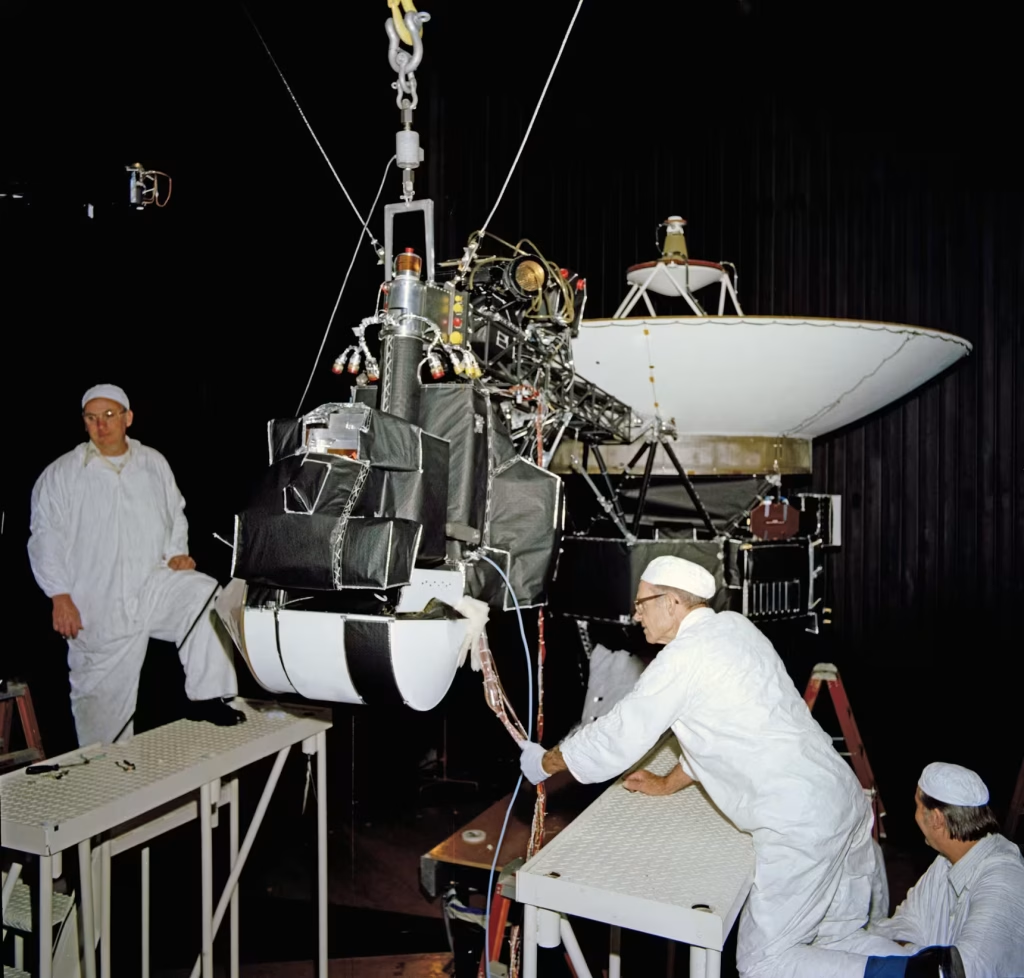
Voyager 1 undergoing testing before launch at NASA’s Jet Propulsion Laboratory in Pasadena, Calif., on April 27, 1977. Photo: NASA / JPL
According to NASA and the Jet Propulsion Laboratory, Voyager 1, one of humanity’s two probes in interstellar space, has resumed sending engineering data back to Earth.
Last November, Voyager 1 stopped sending readable science and engineering data back to Earth, halting ongoing measurements and investigations. Mission controllers could tell the spacecraft was still receiving their commands and otherwise operating normally but could not do much else, leaving mission managers and engineers scrambling to assemble a team to fix the aging spacecraft.
According to a press release from JPL and NASA, “In March, the Voyager engineering team at NASA’s Jet Propulsion Laboratory in Southern California confirmed that the issue was tied to one of the spacecraft’s three onboard computers, called the flight data subsystem (FDS). The FDS is responsible for packaging the science and engineering data before it’s sent to Earth.”
“The team discovered that a single chip responsible for storing a portion of the FDS memory — including some of the FDS computer’s software code — isn’t working. The loss of that code rendered the science and engineering data unusable. Unable to repair the chip, the team decided to place the affected code elsewhere in the FDS memory. But no single location is large enough to hold the section of code in its entirety.”
In this illustration oriented along the ecliptic plane, NASA’s Hubble Space Telescope looks along the paths of NASA’s Voyager 1 and 2 spacecraft as they journey through the solar system and into interstellar space. Hubble is gazing at two sight lines (the twin cone-shaped features) along each spacecraft’s path. The telescope’s goal is to help astronomers map interstellar structure along each spacecraft’s star-bound route. Each sight line stretches several light-years to nearby stars. NASA, ESA, and Z. Levay (STScI)
They continued by saying, “[T]hey devised a plan to divide affected the code into sections and store those sections in different places in the FDS. To make this plan work, they also needed to adjust those code sections to ensure, for example, that they all still function as a whole. Any references to the location of that code in other parts of the FDS memory needed to be updated as well.”
Brilliant computer science work that was, especially for a vehicle about 15.12 billion miles from Earth, traveling at 38,026 miles per hour. Currently, it takes roughly 22.5 hours for a signal to travel from Voyager 1 to Earth (and vice versa), creating a major challenge in communications.
Voyager 1 Launch on September 5, 1977
The narrow bandwidth further complicates those communications: about 40 bits per second for engineering data, or roughly five alphanumeric characters each second. By comparison, the median Internet speed in the US is 242.38Megabits per second, or 30.2 million characters.
In the next few weeks, the Voyager 1 team plans to relocate and adjust the affected portions of the FDS software including portions that will start returning science data. Meanwhile, Voyager 1 will continue to travel away from the Earth.
A representative view of a Starlink launch at night from SLC-40 with a low cloud deck. Photo: Charles Boyer / ToT
SpaceX plans to send another tranche of 23 Starlink satellites to orbit Monday Tuesday evening from Pad SLC-40 at Cape Canaveral Space Force Station. The launch window opens at 6:15 PM EDT and extends to 10:15 PM. Weather may be a concern, especially in the first hours of the launch window, according to the 45th Weather Squadron of the US Space Force in their official launch forecast.
Weather
Note: updated due to the launch schedule change announced on April 22:
Weather for the launch is about as good as it gets in Florida any time during the year: the 45th Space Wing has forecast conditions with a better than 95% chance of acceptable weather conditions for liftoff. Their only concern is a small chance of cumulus clouds interfering at a given T-0 time.
Trajectory
Southeast. This is the well-trodden path of Group 6 Starlink satellites on their way to orbit, and tomorrow’s trajectory is no different.
Landing
The landing will be aboard the autonomous spaceport drone ship (ASDS) ‘Just Read The Instructions’ (JRTI), which is stationed in the Atlantic Ocean northeast of the Bahamas.
After the landing, JRTI will return to Port Canaveral with the booster. It will then be returned to SpaceX’s Hangar X facility on Roberts Road inside Kennedy Space Center for inspection, refurbishment and preparation for its next mission.
Booster: B1078
SpaceX stated on its website that this launch is using the booster that “previously launched Crew-6, SES O3b mPOWER, USSF-124, and five Starlink missions.” That booster’s tail number is B1078.
Booster B1078
Flight Number
Payload
Date
1
Crew-6
March 2, 2023
2
O3b mPOWER 3 & 4
April 28, 2023
3
Starlink 6-4
June 4, 2023
4
Starlink 6-8
August 7, 2023
5
Starlink 6-16
September 16, 2023
6
Starlink 6-31
December 3, 2023
7
USSF-124
February 14, 2024
8
Starlink 6-46
March 25, 2024
Booster B1078 as of March 25, 2024
Online Viewing
A live webcast of this mission will begin on SpaceX’s X account feed about five minutes prior to liftoff. Watch live on X.
SpaceX’s official web page has links to live coverage as well as up-to-date planned launch times. Starlink 6-53 Mission Page.
Spaceflight Now will begin its live launch feed one hour prior to liftoff. SFN on Youtube.
Watching In Person
This evening’s planned launch is from SLC-40 at Cape Canaveral, which means that the best direct views of liftoff are: the Banana River Bridge on FL-528 W near Port Canaveral, or the southern parks on US-1 / S. Washington Avenue in Titusville. Kennedy Point Park and Rotary Riverview Park (among others) are your best bets for free viewing sites
Cocoa Beach, Cocoa Beach Pier, and Jetty Park Pier will have indirect views, meaning that liftoff will not be visible. However, after the rocket clears the pad and any ground obstructions, you will be able to see Falcon 9 ascending clearly, assuming there are no clouds between you and the rocket. Jetty Park does charge admission, and they do not accept cash. Visit their website to purchase an entry pass before you go.
SpaceX may well push back their target launch time more than once tomorrow, especially if conditions are slightly marginal and close to acceptable for liftoff.
Two launches in two days on two nearly perfect Florida late spring evenings: that’s life on the Space Coast these days, and that’s what’s happened over the last 25 or so hours here at The Cape. Tonight, SpaceX launched a Falcon 9 from their launch pad at SLC-40 at Cape Canaveral Space Force Station carrying another 23 Starlink satellites to orbit. Launch was at 6:40 PM EDT, right at the start of the launch window.
Close to Main Engine Cutoff, Falcon 9 passed just above the moon from our point of view on the Banana River in Cape Canaveral. Photo: Charles Boyer / ToT
Two launches in two days on two nearly perfect Florida late spring evenings: that’s life on the Space Coast these days, and that’s what’s happened over the last 25 or so hours here at The Cape. Tonight, SpaceX launched a Falcon 9 from their launch pad at SLC-40 at Cape Canaveral Space Force Station carrying another 23 Starlink satellites to orbit. Launch was at 6:40 PM EDT, right at the start of the launch window.
This evening’s launch was the 18th launch from SLC-40 this year, the 41st of the year overall from SpaceX (40 Falcon family, 1 Starship test launch), and was the 300th landing of a Falcon family booster. On the average, SpaceX is performing a launch every 2.63 days, which far outperforms any other organization globally, including active nation-states such as China.
Now that Spring Break is over, and many of the winter residents are starting to return home, crowds were not as thick in the usual spots as they have been as little as a few weeks ago. That said, there were still hundreds of people lining the riverbanks in Titusville, in Cape Canaveral and of course on the beaches as well. Those spectators enjoyed a beautiful launch, with Falcon 9 clearly visible until well into the second stage’s flight.
Not long before the launch of Falcon 9, two F-22’s flew near the launch pad over the Banana River.
Booster B0180 Touches Down Safely Near Bahamas
About eight and a half minutes after liftoff, Booster B0180 touched down safely on SpaceX’s ‘A Shortfall Of Gravitas’ automated droneship located offshore in the Atlantic Ocean northeast of the Bahamas, completing its seventh mission safely.
ASOG will return to Port Canaveral in a few days, where the booster will be returned to SpaceX’s Hangar X facility at Kennedy Space Center, and after inspection and reconditioning, it will be prepared for its next flight at some future date to be determined.
Booster B1080
Flight Number
Mission
Date
1
Axiom-2
May 21, 2023
2
Euclid
July 1, 2023
3
Starlink 6-11
August 27 2023
4
Starlink 6-24
October 22, 2023
5
Axiom-3
January 18, 2024
6
CRS-30
March 21, 2024
7
Starlink 6-52
April 18, 2024
Booster B1080 Flight Record as of April 18, 2024
Starlink 6-52 heading to orbit. Photo: Charles Boyer ToT
Next Launch
On Monday, April 22, SpaceX plans to launch another tranche of Starlink satellites to low-Earth orbit from SLC-40 at Cape Canaveral Space Force Station.
Date: NET April 22, 2024
Organization: SpaceX
Mission: Starlink 6-53
Rocket: Falcon 9
Launch Site: SLC -40, Cape Canaveral Space Force Station
Launch Time: 06:40 PM EDT (Tentative and subject to change)
Payload: 23 Starink Satellites
Keep in mind that launch dates and times change often. Launch attempts can be scrubbed anytime due to weather, technical reasons, or range conditions.
SpaceX got Falcon 9 to work right at the beginning of tonight’s launch window when it launched the Starlink 6-51 mission at 5:26 PM EDT into the bluebird skies of the Space Coast. The payload was another 23 Starlink satellites to join the company’s ever-growing constellation of thousands of satellites in low-Earth orbit that provide Internet service to underserved areas globally.




You must be logged in to post a comment.