The US Space Force’s 45th Weather Squadron has released their Mission Execution Forecast for tomorrow’s planned launch of a SpaceX Falcon 9 carrying NG’s Cygnus cargo craft towards the International Space Station. They are predicting nearly ideal conditions, with only a 5% chance of a Probability of Violation, meaning they expect a 95% chance of acceptable weather conditions.
The 01/29/2024 forecast from the 45th Weather Squadron. Courtesy US Space Force
Launch Time & Location
The NG-20 mission will launch from SpaceX’s launch pad at SLC-40 at Cape Canaveral Space Force Station. The launch time is an instantaneous window 12:07 PM EST. If for some reason the launch is delayed, there is a backup launch opportunity available on Thursday, February 1 at 11:18 a.m. ET.
Launch Trajectory
Falcon 9 will travel to the northeast, on a 51.2281˚inclination.
Sonic Boom Alert!
NG-20 is an RTLS mission, meaning the booster will return to Cape Canaveral 8.25 minutes after liftoff. As with all RTLS launches, a loud sonic boom will be heard across the Space Coast.
Graphic: Wave pressure at a distance of 5 miles (8.05 km). Via Acoustical Society of America.
Launch Viewing
Banana River Bridge
For unobstructed views of the liftoff and landing, the Banana River Bridge on FL 528 (aka The Beachline, and sometimes erroneously called A1A) is your best bet.
Basic Overview
Launch View
View from the Banana River Bridge. Photo: Charles Boyer
Landing View
View of Booster Landing From Banana River Bridge Photo: Charles Boyer / Talk of Titusville
Jetty Park
Jetty Park offers a closer view of the returning booster and landing, but it has an occluded view of the launch.
Jetty Park is located at 100 Jetty Park Rd, Port Canaveral, FL 32920.
Others
Playalinda Beach in the Cape Canaveral National Seashore will likely be open for this launch. It is quite far from the launch and landing, but you should still get some great views.
Parks along US1 In Titusville are further away from the action as well, but especially in the southern end of town, for example at Kennedy Point Park, good views are available.
Cocoa Beach also will have some good views of the rocket flight, but you are not going to see the liftoff and perhaps the landing burns. You will definitely feel the sonic boom, however!
“[NASA] currently [does] not have any activities underway at LC-49.”
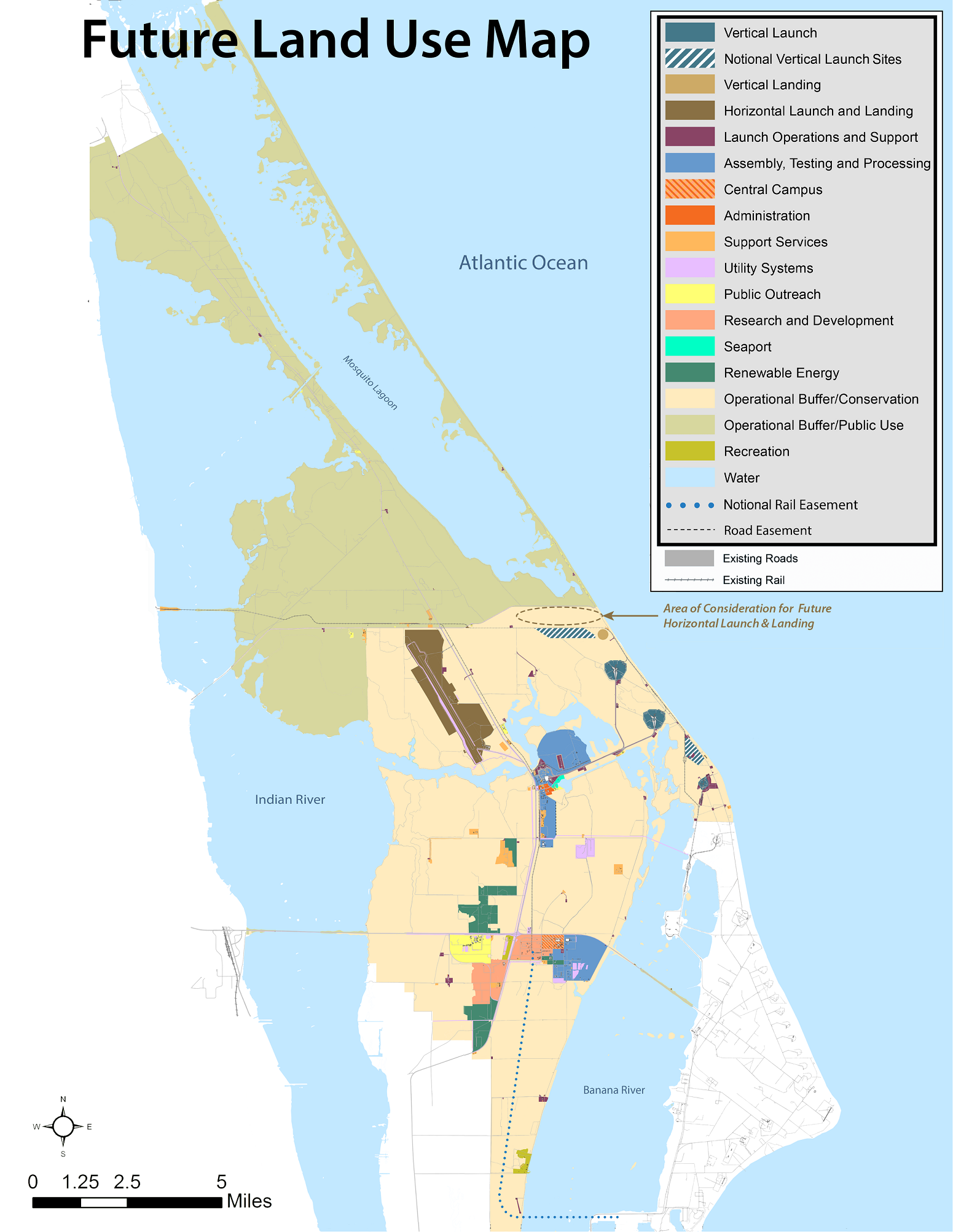
For many years, NASA has had a potential new launch pad on its Master Plan for Kennedy Space Center: LC-49 is projected to be built on the northern end of KSC property near its border with the Merritt Island National Wildlife Refuge.
There is also an LC-48 on the slate, located between the current LC-39A (Falcon 9, Falcon Heavy) and SLC-41 (Atlas/Vulcan) but it has not received the same amount of mention in the space community, nor the same amount of concern among some local residents as the potential LC-49.
Kennedy’s Master Plan
“One potential new vertical launch area, Launch Pad 49, could be sited to the north of Pad 39B. This location avoids overflight issues with Pad 39B and minimizes conflict with the Canaveral National Seashore, giving potential non-NASA entities a flexible set of operational options. In addition, Pad 49 could use Beach Road as an access road, allowing for more autonomous operations and the option to operate outside of KSC’s secured area.”
Annotated map from Kennedy Space Center’s Master Plan. Talk of Titusville added location names in order to clarify the geographical locations shown on this map. Map: NASA Future Land Use Map (FLUM) Retrieved 08/21/22
This has been on the site’s master plan in one form or another, dating back to the 1960s, and speculation of the potential of a new pad being built has risen lately due to SpaceX’s Starship due to come online in the near term.
1967 Plans for Pads LC-39C and LC-39D Drawing 68-DE-FAC-11 / NASA
“[Kennedy Space Center] announced last week that it was starting the process of an environmental review of the proposed Launch Complex (LC) 49 in response to an inquiry from SpaceX. The center did not disclose a timeline for conducting the review but said it would precede any agreement with SpaceX to develop the site.
“Launch Complex 49 is located to the northwest of Launch Complex 39B, the former Apollo and shuttle launch pad that will be used by the Space Launch System. The site was originally reserved in the 1960s for Launch Complex 39C but never developed.”
SpaceX Starship Facility at LC-39A
In 2021, SpaceX began building a launch tower for its future Starship operations at the Cape, but it appears that the company has taken a pause in constructing that launch tower, ostensibly to focus on completing Starship development, which will almost certainly inform the final design and construction of the new tower.
SpaceX Starship tower under construction in August 2022. At the time, construction cranes and other equipment were present at the site. LC-39A’s main tower is the the right, the VAB in the background left. Photo: Charles Boyer, Talk of Titusville
Given SpaceX’s iterative development method that makes a lot of sense and should not necessarily be considered a sign that they are abandoning any plans to complete the new pad next to LC-39A. The company has not made any public statement regarding the half-finished pad, and while work has apparently slowed on the structure, there is no sign of it being dismantled either.
SpaceX has made extensive changes to a similar launch pad at their Boca Chica orbital launch pad in recent months, so it makes sense to expect they will want to do the same to the pad at the Cape — when they are ready to bring Starship operations here to the Space Coast and the Eastern Range. That is speculation, however, and should be considered as such until concrete evidence of its accuracy is confirmed or disproven.
But What About LC-49?
Vicinity of LC-49 in 2021. NASA’s official caption for the photo reads “A view of a proposed new launch site, Launch Complex 49, on Dec. 20, 2021, at NASA’s Kennedy Space Center in Florida. In response to an inquiry from SpaceX, NASA is preparing to conduct environmental assessments to develop the proposed launch site. The 175-acre site, located north of Launch Complex 39B within the center’s security perimeter, would support the launch and landing of SpaceX’s Starship and Super Heavy launch vehicle. NASA and SpaceX are moving forward with the initial environmental assessment before concluding a potential agreement to develop the property.” Photo NASA, KSC-20211220-PH-KLS01_0002
At the same time, that apparent pause at LC-39A does not fully address LC-49. Talk of Titusville reached out to NASA to find out what progress is being made towards LC-49 actually being built in the relatively near future. Given that previous reports indicated that an environmental study was underway in 2021, it seems sensible that those studies would be complete or nearly so in 2024. They replied to us on January 18, 2024 and said that “[NASA] currently [does] not have any activities underway at LC-49.”
NASA added that, “all previous activities there have been suspended, including anything involving any commercial companies. We’re not currently working any NEPA or environmental actions. KSC did complete an environmental assessment in 2018-19 for the development and operations of the site, which included the construction of the existing launch pad.”
That “existing launch pad” they are referring to is almost certainly the new Starship launch pad referred to above, and that pad will not be completed for some time.
Good News For Titusville Residents and Visitors
This is likely going to be welcome news for Titusville residents. Were LC-49 built in the area planned for in the NASA Future Land Use Map (FLUM), once operational, it would likely cause repeated closings of Beach Road leading to Playalinda Beach, meaning that local beachgoers would have no route to the undeveloped beach areas located there. That is because at some points on Beach Road, an LC-49 could be as little as one mile away.
Beach Road and an LC-49 are relatively close together.
Those closures would come during fueling tests, static fires and launch activities due to Beach Road’s proximity to the LC-49 complex. Playalinda Beach is already often closed by KSC Police and the National Park Service for many launches from LC-39A and LC-39B, due to safety and security concerns during launch operations. LC-49 would result in much the same, and given SpaceX’s plans for a high cadence of Starship launches for Artemis and other commercial activities, those closures may have become a major inconvenience for residents and tourists alike.
With an estimated 1.5 – 2.0 million visitors a year, the Cape Canaveral National Seashore incorporates Playalinda Beach in its southern section as well as others (Apollo Beach) to the north. It is a major source of tourism dollars for Titusville, and it is the only beach available to local residents between Cape Canaveral’s Jetty Park and Apollo Beach in New Smyrna. In 1962, Titusville Beach was absorbed into Kennedy Space Center, leaving Playalinda, in the Merritt Island National Wildlife Refuge.
According to NASA’s statement that no activities are ongoing to build the new pad, there is little reason to worry about this happening any time in the near future.
SpaceX Falcon 9 lifts off with the Starlink 6-37 mission aboard. It’s destination is low-Earth orbit where 23 satellites will be placed in the Starlink constellation. Photo: Charles Boyer / Talk of Titusville
SpaceX sent another batch of 23 Starlink satellites for their orbital-based Internet service tonight from Cape Canaveral aboard a Falcon 9 booster. The mission was designated Starlink 6-37, part of Group 6 of Starlink satellites providing global Internet connectivity to the company’s customers.
Liftoff was shortly after 8:52 pm EST from Pad SLC-40 at Cape Canaveral Space Force Station. Tonight’s re-useable booster was B1071 making its 12th flight. Roughly eight and a half minutes after liftoff, B1071 touched down safely near the Bahamas on a droneship in the Atlantic Ocean.
The second stage continued to carry the company’s payload to orbit, which it achieved successfully at about the same time the first stage booster was touching down. Shortly afterward, the Starlink satellites were deployed and the launch was deemed a success by mission managers.
Clouds cleared sufficiently that many in the Space Coast had a spectacular view of Falcon 9 as it ascended from Cape Canaveral. This was the view from an Orlando neighborhood. Photo: Ed Cordero, Florida Media Now
Mission Trajectory
Tonight’s launch was to the southeast, as has been customary with other launches of the Group 6 batch of Starlink satellites.
Mission trajectory for Starlink 6-37. Graphic via flightclub.io and annotated by Charles Boyer.
16th Flight for Booster B-1076
This was the 12th flight for the first stage booster supporting this mission is B1071. The booster previously launched SES-22, ispace’s HAKUTO-R Mission 1, Hispasat Amazonas Nexus mission, CRS-27, and seven Starlink missions.
Following stage separation, the first stage landed on the autonomous spaceport drone ship (ASDS) A Shortfall of Gravitas droneship, stationed in the Atlantic Ocean northeast of the Bahamas.
The booster will be returned to Port Canaveral and then transferred to SpaceX’s Hangar X facility at Kennedy Space Center for inspection and ostensibly refurbishment for another flight on a future mission.
Next Launch
Axiom-3, a crewed launch planned to ferry four astronauts to the International Space Station aboard a Falcon 9.
Axiom-3 Flight Patch Image courtesy: Axiom Space
The mission will be the first to carry and all-European crew to the International Space Station. It will be the third crewed mission to the International Space Station coordinated by Axiom Space.
Ax-3 will be the first all-European commercial astronaut mission to the ISS. It will also be the first commercial spaceflight mission made up of government and European Space Agency-sponsored astronauts flying on behalf of their nation.
The launch date is NET Wednesday January 17, 2024 at 5:11 PM EST from Pad LC-39A at Kennedy Space Center.
A Falcon 9 launching from SLC-40 at Cape Canaveral Space Force Station in 2023. Photo: Charles Boyer / Talk of Titusville
The 2024 launch schedule kicks off today at 6:04pm from Cape Canaveral when SpaceX is planning to launch a satellite to geosynchronous orbit for Swedish telecommunications company Ovzon. Dubbed Ovzon-3, this satellite will offer mobile broadband connectivity in underserved regions and will launch aboard a Falcon 9 from SLC-40 at Cape Canaveral Space Force Station, and once its job is completed, the booster will return to land at its landing zone here at the Cape. Area residents should expect a sonic boom sometime after 6:12pm, depending on their proximity to the landing site.
Launch “Jellyfish?”
Today’s launch comes shortly after local sunset, which is at 5:38pm Eastern Time, during “nautical twilight” — the period of time when the center of the sun is 6–12 degrees below the horizon.
That’s the perfect time for a true “jellyfish” event during staging: Falcon 9 will have risen above the horizon and back into the sunlight, and when the first stage of the rocket’s gasses expand in the lower pressure of the upper atmosphere, they will be brightly illuminated in the bright light above launch spectators. The same will hold true for the second stage as it fires up and weather permitting, this launch could be quite a show.
A launch “jellyfish” from 2022.
Some Good Fortune May Be Necessary for Launch Viewers
“Weather Permitting” may be a key factor regarding what launch viewers see above Space Coast skies. The National Weather service has called for mostly cloudy skies throughout the day. Technically, that means 75-87.5% of the sky is covered by with opaque (not transparent) clouds, and those clouds might diminish any jellyfish that appears during the flight sequence. On the other hand, NWS’s forecast is for the general area and covers a wide-range of time. Florida weather can and does change from moment to moment so matters are literally and figuratively up in the air in terms of what will be seen.
Delving deep into the subject, NOAA does offer more specific cloud cover forecasts and theirs is somewhat more optimistic:
The NOAA forecast for cloud cover has less cloud coverage than does the National Weather Service forecast, and seems to give us a 50/50 chance at seeing something spectacular.
45th Weather Wing Forecast
The authoritative weather forecast service for Eastern Range rocket launches is the 45th Weather Wing of the US Space Force, and their latest forecast for today’s launch is mostly positive, with only a 10% chance of a weather violation:
In their forecast, the 45th mentions that “the main weather concern remains the Thick Cloud Layers Rule as mid and high clouds increase ahead of the low.”
Either way, it’s probably a good idea to bring your camera along if you plan to view the launch.
Trajectory
The trajectory for tonight’s launch is eastward.
Booster History
According to SpaceX, “[t]his is the 10th flight of [Booster B-1076] supporting this mission, which previously launched CRS-26, OneWeb Launch 16, Intelsat IS-40e, O3b mPOWER, and five Starlink missions.” Following stage separation, the first stage will land on Landing Zone 1 (LZ-1) at Cape Canaveral Space Force Station in Florida.”
Artist’s rendering of a Space Perspective flight. Courtesy Space Perspective
Space Perspective, the Titusville-based company planning to launch passengers to the edge of space aboard lighter than air vessels, gave an update today about the status of the fabrication of their latest test capsule, one that will be used to prove in the company’s technologies as well as identify areas for improvement. This craft will be a major milestone along Space Perspective’s planned path to carrying paying passengers as soon as late next year.
They say if you don’t like the weather here in Florida, wait half an hour and it will change. SpaceX tried that this evening with the planned launch of a Falcon 9 carrying the Starlink 6-34 group of Internet connectivity satellites, but luck was not on their side: with roughly seventy seconds left in the countdown to liftoff, an abort and scrub was called by mission controllers, due to high-level ground winds.
Timelapse of SpaceX Starlink 6-33 as seen from Rotary Park on Washington Avenue in Titusville. Photo: Charles Boyer / Talk of Titusville
SpaceX launched 23 Starlink satellites for their orbital-based Internet service Thursday morning from Pad SLC-40 at Cape Canaveral Space Force Station. The successful launch was aboard a Falcon 9 performing its ninth mission.
On a cool night with fog and a slight scent of nearby prescribed forest burns mixed together into a thin layer of smog on many Space Coast waterways, a SpaceX Falcon 9 rocket lifted off from SLC-40 at Cape Canaveral Space Force Station ten minutes before midnight on January 10th, 2023.
The commercial payload launch carried forty satellites for OneWeb for their commercial Internet service, nudging the company’s network closer to full operational capability. Eight minutes later, SpaceX’s Falcon 9 booster returned to Cape Canaveral for landing a few miles away from the launch site.
Falcon 9’s “long tail” flame plume close to main engine cutoff on January 10, 2023
I get asked this question all this time: what’s the best place for a visitor to the Space Coast to go see a SpaceX crewed launch to the International Space Station?
All launches to ISS from LC-39A follow a 45-50 degree trajectory. This rendering is looking due east.
The Best of the Best Views
The best answer is to plan ahead and buy tickets from the Kennedy Space Center Visitors Center, because they will have the closest views on offer: The Apollo / Saturn V Center (see below). They do cost a good bit of money, however: the closest view of the April 4th, 2022 Axiom 1 private mission to ISS is $250 for a ~4.0 mile view.
That’s a lot of money, but if you’re only going to come here once, trust me, it is worth it. You will definitely hear the roar and see the best view of the launch, so think about whether it fits into your budget.
If $250 is beyond what you want to spend, the Visitors Center has cheaper tickets where you view from the Visitors Center grounds itself. It’s 7.5 miles to the launch pad, but you won’t see the rocket until it clears the trees. It’s still really close and you’ll hear the roar and see a lot, so it may be an alternative for you.
Star Fleet is a commercial tour operator out of the Cape Canaveral Port, and they are without a doubt the best one in town for viewing launches, bar none. That’s not to say the other guys are not good folks or a good value, but Star Fleet is a cut above.
They will give you outstanding views of launches from out on the water, but aren’t as close as the KSC Visitors Center tours because of the exclusion zone that extend from the launch pad and out several miles into the Atlantic.
That doesn’t matter, because you’ll see as much as you’d see anywhere off the base, and you’ll also get to view the launch from angles that very few people ever do.
As it is with the KSCVC, there is a cost associated with them, but it’s well worth the money and the time. Click the link above to view their site and definitely consider them.
(Note: I am not compensated by or represent Star Fleet Tours. This is just my honest opinion of them.)
There are are other choices off of KSC property.
Crewed SpaceX launches are from LC-39A, which is on the north end of Kennedy Space Center. Let’s start with the two I consider to be mistakes. Your mileage may vary, but I think you can get a better look at other spots.
his is considered a top-class viewpoint. Get there early and park across the street at the park. Walk to the top of the bridge on the south side. 11.5 miles away, with an elevated viewpoint, you will clearly see ignition and liftoff. You will also be able to see the rocket more clearly as it flies away.
Space View Park, Titusville: Google Maps Link 12.08 miles away, this is another great viewing area. The park is smaller, with less parking but at 6am there should be little issue getting in and out. Ignition and liftoff is visible.
12.05 miles away, and an excellent place to go see the launch. A bit south of Space View and the Max Brewer Bridge, this park is actually closer to the launch pad and you will be able to see the liftoff. Is on the Indian River and and is an excellent vantage point. There is a small parking lot and road-side parking.
KARS Park is an area normally reserved for NASA, on-site contractor and military guests and is a great complex for their enjoyment. While you probably don’t qualify to spend the night, you can still view launches from there. KARS is better for SLC-40 and SLC-41 launches, but it also serves as solid secondary choice for launch spectators.
It’s close to 528 (The Beachline), it’s safe and secure and easy to park. They do charge $10 for crewed launches, but that’s per car and that makes things very reasonable.
Check their Facebook page for more information, but I can say that I have seen over 100 launches from here (including Artemis I) and it was a great view every time.
The causeway that extends over the Indian and then the Banana Rivers between Cocoa and Cape Canaveral are really good places to watch a launch, albeit at a long way away. You won’t hear the sound of the liftoff for over thirty seconds after ignition, but you will be able to see ignition and Falcon 9 for a good while as it heads to space. Here’s a view of a launch from LC-39A seen from the Causeway on A1A/528
For this site for viewing launches from LC-39A (or B) I recommend binoculars and for photography, you’ll need a really long zoom lens. If you want to take closer-in photos, cell phones are not that great to take pictures with from this spot, and I recommend at least a 300mm telephoto on a good DSLR or mirrorless. Even then you’ll be cropping in when you look at the shots on your computer later.
Bennett Causeway, FL-528 / A1A
Here’s a closer view.
If you are coming in from I-95, go to the exit for the port (the cloverleaf above) and then head back west on A1A (it’s the same road as Florida-528.) Cross the first bridge (views are better there,) and pull off and park. Unless you are getting there super-early, you’ll see cars and tracks (and some campers) and fellow launch-watchers on the shore of the river.
While you wait, you’ll no doubt see pelicans, probably osprey hunting, and other waterbirds. More often than not folks will also enjoy seeing dolphins swimming just off shore. This is a wild area, so beware of wildlife. I’ve never seen an alligator at this site, but your mileage may vary. Just keep your eyes open and remember you’re in a natural area and you won’t have any problems.
Not That Great Views (IMO)
Most visitors ask me about these two places the most: Jetty Park in Cape Canaveral and the Cocoa Beach Pier. They’re great spots to visit, but are only okay for crewed launches.
You’ll definitely see the rocket in flight, but they are not what I would consider the best views for KSC-side launches. They’re a little better for launches from Cape Canaveral Space Force Station, but even then, not the best of the best.
(Note: when Blue Origin starts launching New Glenn, Jetty Park will be a prime time spot. Stay tuned.)
Views of the launchpad are pretty good, but it is 13 miles to LC-39A from there. More than likely, there will be surf mist between you and the rocket. Since it is flying NE and away from you.


You must be logged in to post a comment.