Liftoff as seen from SpaceX’s livestream of Starlink 6-60 Courtesy: SpaceX
After a delay of one day for reasons that SpaceX did not disclose, the company launched Falcon 9 and the Starlink 6-60 mission from Cape Canaveral’s Space Launch Complex 40 this morning. Liftoff was at 10:24 into hazy skies.
Spectators reported that the haze — lingering smoke from the weekend’s nearby scrub fire and also the ambient humidity typical of Florida in late may — was so heavy that it was difficult to see the rocket lifting off from the usual spectator spots. Once above the thick air, Falcon 9 was visible to most observers on the Space Coast all the way to first stage Main Engine Cutoff and staging.
Through the ground-haze, Falcon 9’s vapor cone was visible as the rocket ascended today. Photo: Tom McCool (@Cygnusx112) via X.com. Photo republished with author’s permission.
Around 8.25 minutes after liftoff, the first-stage booster used for the mission, tail number B1078, touched down safely on ASDS ‘A Shortfall of Gravitas’, stationed downrange in the Atlantic Ocean near the Bahamas. After landing, B1078 has now flown ten successful missions. ‘A Shortfall of Gravitas’ will now return to Port Canaveral, where the booster will be unloaded, transported to SpaceX’s Hangar X facility at Kennedy Space Center and prepared for its next flight after inspection and refurbishment.
Launch Replay
SpaceX coverage of the Starlink 6-60 launch, streamed on May 28, 2024
Payload
Today’s payload was another 23 Starlink satellites, which will join the ever-growing constellation of low-Earth-based devices in SpaceX’s orbital-based Starlink Internet service. They are manufactured at SpaceX’s Starlink manufacturing facility in Redmond, Washington. There are over 6,000 Starlink satellites in orbit with roughly 3.0 million subscribers in about 100 countries world-wide.
Booster B1078.10 Record
After today’s flight, Booster B1078 has flown ten missions.
Booster B1078
Flight Number
Payload
Date
1
Crew-6
March 2, 2023
2
O3b mPOWER 3 & 4
April 28, 2023
3
Starlink 6-4
June 4, 2023
4
Starlink 6-8
August 7, 2023
5
Starlink 6-16
September 16, 2023
6
Starlink 6-31
December 3, 2023
7
USSF-124
February 14, 2024
8
Starlink 6-46
March 25, 2024
9
Starlink 6-53
April 23, 2024
10
Starlink 6-60
May 28, 2024
Booster B1078 as of May 28, 2024
Interesting Stats
56th SpaceX launch this year
26th launch from SLC-40 this year
28th launch from Cape Canaveral Space Force Station in 2024
Lather, rinse, repeat: another Starlink Group 6 launch is planned for Thursday, May 30, 2024.
Mission: Starlink 6-64
Date: NET May 30, 2024
Organization: SpaceX
Rocket: Falcon 9
Launch Site: TBD
Launch Window: 07:09 PM EDT – 12:03 AM EDT
Payload: 23 communications satellites
As of May 28, 2024
Keep in mind that launch dates and times can change without notice at any time.
Keep up with launch news and other space events that affect the local area by subscribing to alerts when we publish a new article by entering your email at the link at the bottom of this page, or by visiting Space Talk here on the website. It’s free and you can unsubscribe at any time.
SpaceX has set the launch of another 23 Starlink satellites to low-Earth orbit aboard a Falcon 9 Monday morning from Space Launch Complex 40 at Cape Canaveral Space Force Station. According to the company, “Liftoff is targeted for 7:30 a.m. ET, with backup opportunities available until 11:30 a.m. ET. If needed, additional opportunities are also available on Tuesday, May 28 starting at 7:30 a.m. ET.”
The booster used for the mission will land downrange on the droneship Automated Spaceport Drone Ship ‘Just Read The Instructions’, which will be on station northeast of The Bahamas. Since the mission is not a Return To Launch Site mission, there won’t be any sonic boom on the Space Coast.
Payload
23 Starlink satellites, to be used in SpaceX’s orbital-based Internet service.
They are manufactured at SpaceX’s Starlink manufacturing facility in Redmond, Washington, are estimated to weigh 750-800 kg apiece and are about 3.0 meters (9.84 feet) long and 1.3 meters (3.94 feet) wide at liftoff. When a Starlink Mini V2 extends its solar panels, it is an estimated 98.5 feet in diameter.
Starlink Satellites. Photo: SpaceX
Weather
Weather for the launch is again highly favorable, with 95% chances of acceptable weather in the start of the launch window, and slightly degrading to “only” 90% acceptable later in the day. If for some reason the launch doesn’t happen on Monday, the planned backup window is also good, but night quite as good as Monday: opening at a 90% chance of favorable range conditions, as Tuesday morning progresses, cumulus clouds drop the chances of acceptable weather at 85%.
In short, chances are very good that weather will not be a limiting factor for this mission.
These estimates are hit-or-miss and in any case are highly local, but are interesting if you are planning to view the launch in person.
Graphic: National Weather Service
Trajectory
Falcon 9 will take a southeasterly direction tonight towards The Bahamas, as is customary for all Group 6 Starlink missions. Spectators looking toward the Atlantic Ocean from shore will see the rocket flying left to right.
Given that the flight is immediately offshore with no return to launch site, there will be no sonic boom from the launch on the Space Coast.
Booster
According to SpaceX’s Starlink 6-60 Mission page, “This is the 10th flight for the first stage booster supporting this mission, which previously launched Crew-6, SES O3b mPOWER, USSF-124, and six Starlink missions.”
That’s Booster B078, which last flew late last month on the Starlink 6-53 mission.
Booster B1078
Flight Number
Payload
Date
1
Crew-6
March 2, 2023
2
O3b mPOWER 3 & 4
April 28, 2023
3
Starlink 6-4
June 4, 2023
4
Starlink 6-8
August 7, 2023
5
Starlink 6-16
September 16, 2023
6
Starlink 6-31
December 3, 2023
7
USSF-124
February 14, 2024
8
Starlink 6-46
March 25, 2024
9
Starlink 6-53
April 23, 2024
Booster B1078 as of April 23, 2024
Countdown Timeline
There are key events in the countdown that you may hear called out in launch coverage.
Remember that once Propellant Loading (T-minus thirty-eight minutes) starts, Falcon 9 is committed to the launch attempt. Because of the nature of the cryogenic fuels used to power the rockets, any hold precludes a later launch attempt the same day. While it only rarely happens, there have been occasions where that has happened, and a launch scrub is called for the day’s attempt.
SpaceX provides the following countdown milestones on their mission information page:
Hours:Minutes:Seconds
Event
00:38:00
SpaceX Launch Director verifies go for propellant load
00:35:00
RP-1 (rocket grade kerosene) loading begins
00:35:00
1st stage LOX (liquid oxygen) loading begins
00:16:00
2nd stage LOX loading begins
00:07:00
Falcon 9 begins engine chill prior to launch
00:01:00
Command flight computer to begin final prelaunch checks
00:01:00
Propellant tank pressurization to flight pressure begins
00:00:45
SpaceX Launch Director verifies go for launch
00:00:03
Engine controller commands engine ignition sequence to start
00:00:00
Falcon 9 liftoff
Typical SpaceX countdown timeline is presented for information purposes only.
Timeline of Falcon 9 Flight
SpaceX has published a timeline of expected events during the mission:
Hours:Minutes:Seconds
Event
00:00:00
Liftoff
00:01:11
Max-Q (Moment of peak mechanical stress on the rocket)
00:02:26
1st stage main engine cutoff (MECO)
00:02:30
1st and 2nd stages separate
00:02:36
2nd stage engine starts (SES-1)
00:02:56
Fairing deployment
00:06:09
1st stage entry burn begins
00:06:33
1st stage entry burn ends
00:07:59
1st stage landing burn begins
00:08:22
1st stage landing
00:08:41
2nd stage engine cutoff (SECO-1)
00:54:08
2nd stage engine starts (SES-2)
00:54:10
2nd stage engine cutoff (SECO-2)
01:05:17
Starlink satellites deploy
via: SpaceX
All events up to the end of the 1st stage entry burn should be visible for launch spectators watching the launch in person, so long as clouds are not blocking the viewer’s line of sight. Fairing separation is generally only visible during daytime launches and then only using advanced optics like high-powered binoculars or a super-telephoto lens (500mm+).
SpaceX will have a livestream of the launch on their website: Starlink 6-60 This will also be available on the X platform. Coverage starts about five minutes before liftoff.
Spaceflight Now will have coverage of the launch starting about one hour before liftoff on Youtube: link
For official updates regarding launch times, SpaceX.com is the best source of information. Starlink launch times change from time to time, and the company generally updates their website within minutes of the decision to change the launch time. This is very handy if none of the streaming options on YouTube have started their broadcasts.
Remember that there is a delay between a launch stream and the actual countdown clock. That is simply because of physics: it takes time for the signal to travel from the launch site, through the Internet, and back down to your phone, resulting in a five to fifteen-second delay.
Space Launch Schedule, an app for iOS and Android phones, has a real-time countdown clock that is accurate to a second, give or take. The app is free. Search the App Store or Google Play.
Launch Viewing: In Person
This morning’s planned launch is from SLC-40, on the south side of the Eastern Range (KSC and Cape Canaveral Space Force Station combined.) The southern parks in Titusville on Washington Avenue and FL-528/A1A in Cape Canaveral are the best spots to watch liftoff directly.
Given the early hours of the launch window (7:30AM – 11:30AM EDT) these restaurants may not be open for launch viewing. Later in the day, all three may well be, so if you are interested, be sure to call ahead to make sure they’ll be ready to serve you.
The Space Bar ($$$) – atop the Courtyard Marriott near Kennedy Parkway
New York New York ($$) – on the Indian River with an outdoor seating area. Is family-friendly.
Shiloh’s ($$$) — located on the Indian River with an outdoor deck overlooking KSC/CCSFS
Indirect Views
There are several excellent viewing spots for SLC-40 launches that offer indirect views — meaning you won’t see the rocket until it clears obstructions such as trees, buildings, even a storm berm in one case.
Parking fees (probably). Pay with your smartphone on the parking app. There are signs everywhere telling you how.
Further away, but still good views.
Northern Titusville Parks
Further away, but really nice views.
Playalinda Beach
View From Playalinda Beach Photo: Charles Boyer / ToT
Playalinda Beach out on the Cape Canaveral National Seashore will be open to spectators, that is, if KSC Security and the National Park Service allow viewers for the launch. It opens to visitors at 6 AM.
This varies from launch to launch, but as a general rule, they have allowed spectators to watch Starlink launches from the beach. A now-dwindling brush fire near Beach Roadmay affect Playalinda plans, so call ahead to be sure.
Cape Canaveral National Seashore • Playalinda Beach Phone: (386) 428-3384 x0 Current operating hours: 6:00 AM–8:00 PM
If you are going to Playalinda, and if it is open, remember these general tips. Some may not apply to this particular launch.
Get there at least two hours early, or better, earlier than that. Lines are long at the entry gate and they will only allow as many spectator vehicles as there are parking space available.
If the launch L-0 time is moved to after 8PM, you must leave Playalinda, as the National Park Service is very strict about closing hours.
Cape Canaveral National Seashore has a fee to get in and cash is not accepted. Debit and credit cards are okay, or if you have one of the National Park Service’s passes for the Seashore or the National Parks, that will work as well.
Cellphone service is spotty at best and often non-existent at Playalinda. Don’t count on your cellphone to keep up with the launch; you might get a signal, or you might not.
You are not allowed to view from the pullouts on Beach Road. Stanchions will block them. You’ll have to park and go to the beach.
Refreshments are not available. There are no stores at Cape Canaveral National Seashore, so you’ll need to bring drinks and food if you want any while you’re there.
Rangers will keep you back a certain distance from the launch area on the beach. Even if the beach is open, you’ll still be unable to go down to the fence that demarcates the normal security zone. There’s a line that spectators can’t go past somewhat north of the fence. That’s for safety and security.
Be prepared for potential changes or pushbacks in the launch schedule, and keep up by monitoring the live stream links mentioned above.
Keep up with launch news and other space events that affect the local area by subscribing to alerts when we publish a new article by entering your email at the link at the bottom of this page, or by visiting Space Talk here on the website. It’s free, and you can cancel at any time.
The smoldering aftermath of a wildfire in Merritt Island National Wildlife Refuge. Photo: Charles Boyer / Talk of Titusville
A lightning strike from a severe thunderstorm started a conflagration in Merritt Island Wildlife Refuge this afternoon. It is north of Kennedy Space Center, and is currently no threat to property or human endeavor — in other words, the facilities at Kennedy Space Center.
1PM EDT Update: Beach Road to Cape Canaveral National Seashore and Playalinda Beach has reopened to traffic. Only lingering wildfire smoke is in the area of the road, and any smoldering fire remaining active appears to be located well south of the road.
Previous Updates
Merritt Island National Wildlife Released this statement on social media at 10:25 AM Sunday: “Update on the current wildfire in the Peacocks Pocket marsh. Fire crews will be flying over the area this morning to better assess the size and scope of the fire. A plan of action will be formed after this flight and will depend greatly on the expected weather conditions. This area last burned a little over 3 years ago which is the natural cycle for refuge.”
MINWR official statement at around 11PM EDT May 25: “A lightning caused fire is currently burning in the Peacocks Pocket impoundment. The fire is estimated to be 150-200 acres. Fish & Wildlife firefighters are onsite and will monitor the blaze throughout the night. Expect all access roads to Peacocks Pocket to be closed tomorrow until fire crews determine they are safe, including: West Gator Creek, Gator Creek East Gator Creek, and Catfish Creek roads.”
11PM MAY 25: KSC Police are currently turning unbadged cars away Gate 4TT, at the end of Max Brewer Bridge. They have also cleared the Refuge of spectators. (see above: the road has reopened to traffic headed towards CCNS/Playlinda Beach and Gate 4 for KSC)
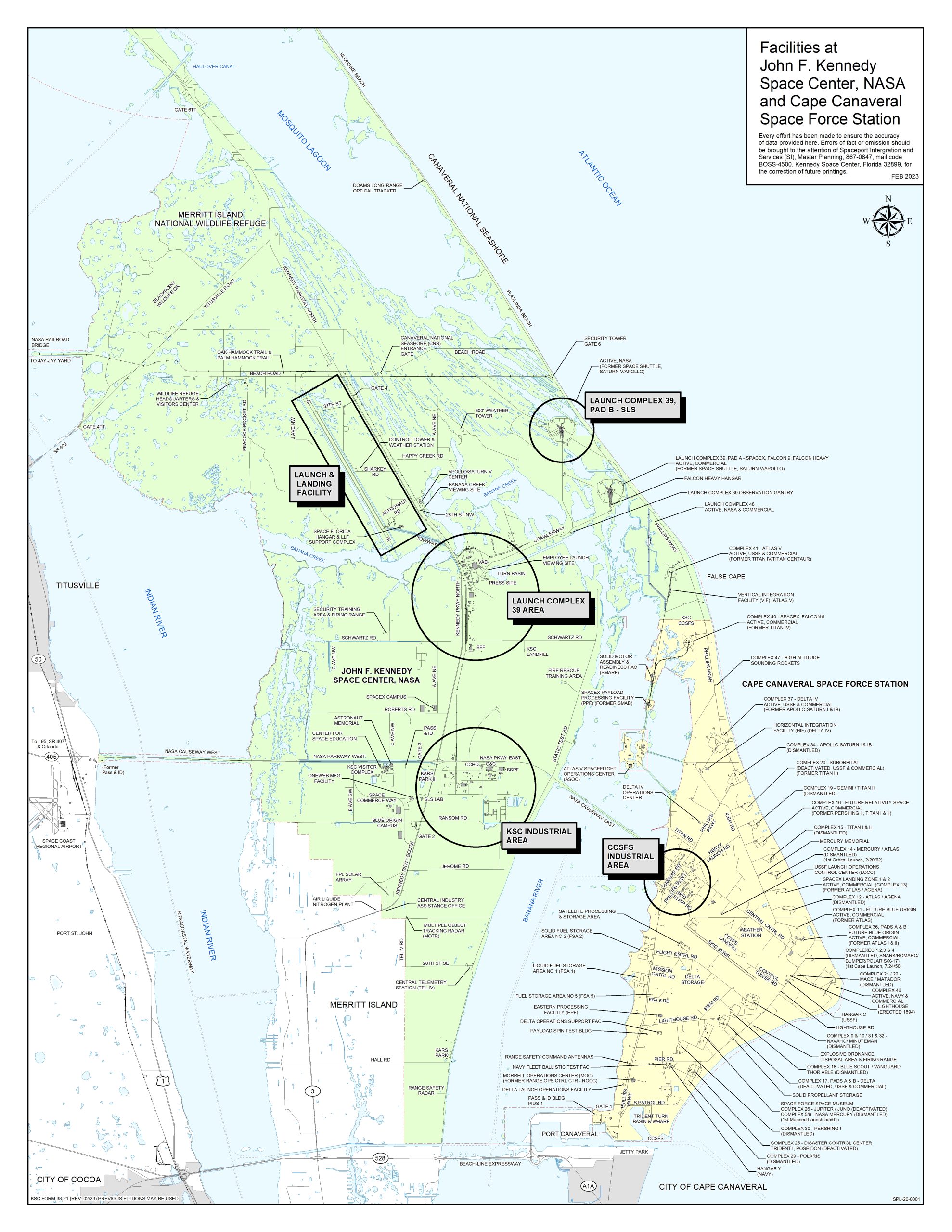
The general location of the wildfire in Merritt Island National Wildlife Refuge. Graphic: original map is from the 2021 KSC Facilities Map, NASA
12 PM EDT, Sunday: Beach Road Open, Fire Seems To Be Dwindling
From a distance and to the uneducated naked eye, the wildfire is now starting to burn itself out, especially on its northern edges. Still far away from operational KSC facilities and buildings, no flames could be seen from Beach Road or US-1 in Titusville, which is very different than twelve hours earlier.
That does not mean that the fire is no longer any danger — a change in weather conditions or wind direction and speeds could fan the flames. Stay tuned to local authorities for official status updates. We will pass them along as soon as we receive them.
1 PM Sunday, May 26: As seen from US-1 in Titusville, a perspective of the wildfire in MINWR: it is far away from any launch pad or KSC buildings, with the closest operational area of the space center being the Shuttle Landing Facility, but even that is at least two miles east. Click to enlarge Photo: Charles Boyer / Talk of Titusville12PM Sunday, May 26: a fire hotspot as seen across the Indian River from Titusville. Photo: Charles Boyer / ToT
11 PM EDT, Saturday: KSC Closes Beach Road
Around 11 PM EDT, KSC Police were emptying MINWR and were stopping people at the end of Max Brewer Bridge. KSC Police asked me to leave, and that’s exactly what I immediately did: I skedaddled.
Closeup of the fire line near Beach Road Saturday night. Photo: Charles Boyer / Talk of TitusvilleA waning moon rises over Beach Road through the smoke from wildfire in Merritt Island National Wildlife Refuge Saturday night. Photo: Charles Boyer / Talk of TitusvilleCloseup of the blaze. Photo: Charles Boyer / ToT
7 PM EDT, Saturday: Fire Is Spreading
Late afternoon wildfire scene in Merritt Island Wildlife Refuge. Photo: Charles Boyer / Talk of TitusvillePhoto: Charles Boyer / Talk of TitusvillePhoto: Charles Boyer / Talk of Titusville
The flight path of Falcon 9 carrying the Starlink 6-63 mission to orbit this evening, as seen from the Mid Course Radar Site on Kennedy Parkway inside the Merritt Island Wildlife Refuge near Allenhurst, Florida. This radar system tracks rockets as they launch. A full moon is in the background. Photo: Charles Boyer / Talk of Titusville
SpaceX launched another 23 Starlink V2 Mini satellites to orbit tonight from Kennedy Space Center, right at the end of the planned launch window. Liftoff was at 10:45 PM EDT from Pad LC-39A.
Booster B1077 completed its 13th mission successfully after it touched down on the droneship ASDS ‘Just Read The Instructions’ northeast of The Bahamas about 8.25 minutes after liftoff. JRTI will return to Port Canaveral after a few days, and the booster will be returned to SpaceX’s Hangar X at Kennedy Space Center for inspection, refurbishment and preparation for its next flight.
At 11:52 PM EDT, SpaceX announced that the payload had been successfully deployed, marking another 100% successful launch by the company.
Booster B1077.13 Record
SpaceXBooster B1077
Flight
Mission
Date
1
Crew-5
10/15/2023
2
GPS III SV06
01/18/2023
3
Inmarsat-6 F2
02/18/2023
4
Starlink Group 5-10
03/29/2023
5
Dragon CRS-2 SpX-28
06/05/2023
6
Galaxy 37
08/03/2023
7
Starlink Group 6-13
09/01/2023
8
Starlink Group 6-25
10/30/2023
9
Starlink Group 6-33
12/07/2023
10
Northrup Grumman NG-20
01/30/2024
11
Starlink Group 6-43
03/10/2024
12
Starlink Group 6-51
04/17/2024
13
Starlink Group 6-63
05/23/2024
Booster B1077 flights as of May 23, 2024
Launch Replay
Next Launch
Memorial Day, SpaceX plans to launch another set of satellites for Starlink Group 6. This launch is planned for the morning hours, one where Falcon 9 will travel the well-flown path to the southeast as it delivers more members of its low-Earth orbit constellation that provides Internet access to underserved markets.
Mission: Starlink 6-60
Date: NET May 27, 2024
Organization: SpaceX
Rocket: Falcon 9
Launch Site: SLC-40, Cape Canaveral Space Force Station
Launch Window: 07:30 AM – 11:30 AM EDT
Payload: 23 communications satellites
As of May 17, 2024. Subject to change without notice.
Keep up with launch news and other space events that affect the local area by subscribing to alerts when we publish a new article by entering your email at the link at the bottom of this page, or by visiting Space Talk here on the website. It’s free and you can unsubscribe at any time.
Falcon 9 Liftoff From LC-39A Photo: Charles Boyer / ToT
Lather, rinse, repeat: SpaceX plans to launch another Starlink Group 6 mission early this evening from Pad LC-39A at Kennedy Space Center. The launch window opens at 6:45 PM EDT and extends until10:45 PM EDT the same day.
Update: SpaceX now has “Liftoff targeted for 10:13 p.m. ET. If needed, additional opportunities are also available on Friday, May 24, starting at 6:26 p.m. ET.”
The booster used for the mission will land downrange on the droneship ASDS ‘Just Read The Instructions’, which is stationed northeast of The Bahamas, so there won’t be any sonic boom on the Space Coast tonight.
Payload
23 Starlink satellites, to be used in SpaceX’s orbital-based Internet service. They are manufactured at SpaceX’s Starlink manufacturing facility in Redmond, Washington, are estimated to weigh 750-800 kg apiece and are about 3.0 meters (9.84 feet) long and 1.3 meters (3.94 feet) wide at liftoff. When a Starlink Mini V2 extends its solar panels, it is an estimated 98.5 feet in diameter.
Each Starlink satellite is equipped with a Argon-fueled Hall-effect thruster (HET) for maneuverability. Once the satellite’s useful lifetime concludes, SpaceX commands it to re-enter the Earth’s atmosphere, where it burns up safely and leaves no space junk behind.
Just like last night’s forecast for Starlink 6-62, weather is about as good as it gets this time of year on the Space Coast: the 45th Weather Squadron of the US Space Force has forecast only a 5% chance of a weather-related range violation (POV), meaning that they expect a 95% chance for acceptable weather through the launch window. In the event of a scrub or launch delay, tomorrow, conditions are slightly less favorable, with a 90% percent chance of favorable conditions and a 10% Probability of Violation.
Via USSF 45th Weather Squadron
Sky Cover
The National Weather Center forecasts that roughly 5-15% of the sky will be covered by clouds during the launch window. These estimates are often somewhat pessimistic, can be hit-or-miss and in any case are highly local, but are interesting if you are planning to view the launch in person.
The bottom line is that this evening’s launch should not have many clouds interrupting a spectator’s view of the rocket as it flies to space.
Via National Weather Service
Trajectory
The Bimini Highway. Falcon 9 will take a southeasterly direction tonight towards The Bahamas, as has been customary for all Group 6 Starlink missions. Spectators looking in the direction of the Atlantic Ocean will see the rocket flying left to right.
Given that the flight is immediately offshore with no return to launch site, there will be no sonic boom from the launch on the Space Coast.
Booster
According to SpaceX’s Starlink 6-63 Mission page, “This is the 13th flight for the first stage booster supporting this mission, which previously launched Crew-5, GPS III Space Vehicle 06, Inmarsat I6-F2, CRS-28, Intelsat G-37, NG-20, and six Starlink missions.”
That’s Booster B1077. This booster flew 36 days ago when it lofted the Starlink Group 6-51 mission.
SpaceXBooster B1077
Flight
Mission
Date
1
Crew-5
10/15/2023
2
GPS III SV06
01/18/2023
3
Inmarsat-6 F2
02/18/2023
4
Starlink Group 5-10
03/29/2023
5
Dragon CRS-2 SpX-28
06/05/2023
6
Galaxy 37
08/03/2023
7
Starlink Group 6-13
09/01/2023
8
Starlink Group 6-25
10/30/2023
9
Starlink Group 6-33
12/07/2023
10
Northrup Grumman NG-20
01/30/2024
11
Starlink Group 6-43
03/10/2024
12
Starlink Group 6-51
04/17/2024
Booster 1077 flight record as of April 17, 2024
Countdown Timeline
There are key events in the countdown that you may hear called out in launch coverage.
Remember that once Propellant Loading (T-minus thirty-eight minutes) starts, Falcon 9 is committed to the launch attempt. Because of the nature of the cryogenic fuels used to power the rockets, any hold precludes a later launch attempt the same day. While it only rarely happens, there have been occasions where that has happened, and a launch scrub is called for the day’s attempt.
SpaceX provides the following countdown milestones on their mission information page:
Hours:Minutes:Seconds
Event
00:38:00
SpaceX Launch Director verifies go for propellant load
00:35:00
RP-1 (rocket grade kerosene) loading begins
00:35:00
1st stage LOX (liquid oxygen) loading begins
00:16:00
2nd stage LOX loading begins
00:07:00
Falcon 9 begins engine chill prior to launch
00:01:00
Command flight computer to begin final prelaunch checks
00:01:00
Propellant tank pressurization to flight pressure begins
00:00:45
SpaceX Launch Director verifies go for launch
00:00:03
Engine controller commands engine ignition sequence to start
00:00:00
Falcon 9 liftoff
Typical SpaceX countdown timeline is presented for information purposes only.
Timeline of Falcon 9 Flight
SpaceX has published a timeline of expected events during the mission:
Hours:Minutes:Seconds
Event
00:00:00
Liftoff
00:01:11
Max-Q (Moment of peak mechanical stress on the rocket)
00:02:26
1st stage main engine cutoff (MECO)
00:02:30
1st and 2nd stages separate
00:02:36
2nd stage engine starts (SES-1)
00:02:56
Fairing deployment
00:06:09
1st stage entry burn begins
00:06:33
1st stage entry burn ends
00:07:59
1st stage landing burn begins
00:08:22
1st stage landing
00:08:41
2nd stage engine cutoff (SECO-1)
00:54:08
2nd stage engine starts (SES-2)
00:54:10
2nd stage engine cutoff (SECO-2)
01:05:17
Starlink satellites deploy
via: SpaceX
All events up to the end of the 1st stage entry burn should be visible for launch spectators watching the launch in person, so long as clouds are not blocking the viewer’s line of sight. Fairing separation is generally only visible during daytime launches and then only using advanced optics like high-powered binoculars or a super-telephoto lens (500mm+).
SpaceX will have a livestream of the launch on their website: Starlink 6-63 This will also be available on the X platform. Coverage starts about five minutes before liftoff.
Spaceflight Now will have coverage of the launch starting about one hour before liftoff on Youtube: link
For official updates regarding launch times, SpaceX.com is the best source of information. Starlink launch times change from time to time, and the company generally updates their website within minutes of the decision to change the launch time. This is very handy if none of the streaming options on YouTube have started their broadcasts.
Remember that there is a delay between a launch stream and the actual countdown clock. That is simply because of physics: it takes time for the signal to travel from the launch site, through the Internet, and back down to your phone, resulting in a five to fifteen-second delay.
Space Launch Schedule, an app for iOS and Android phones, has a real-time countdown clock that is accurate to a second, give or take. The app is free. Search the App Store or Google Play.
Launch Viewing: In Person
This evening’s planned launch is from LC-39A at Cape Canaveral, which means that the best direct views of liftoff are the northern Titusville riverfront parks, one of the local businesses or Playalinda Beach:
The following restaurants will be open for the beginning of the launch window.
The Space Bar ($$$) – atop the Courtyard Marriott near Kennedy Parkway
New York New York ($$) – on the Indian River with an outdoor seating area. Is family-friendly.
Shiloh’s ($$$) — located on the Indian River with an outdoor deck overlooking KSC/CCSFS
Playalinda Beach
View From Playalinda Beach Photo: Charles Boyer / ToT
Playalinda Beach out on the Cape Canaveral National Seashore will be open to spectators, that is, if KSC Security and the National Park Service allow viewers for the launch. This varies from launch to launch, but as a general rule, they have allowed spectators to watch Starlink launches from the beach. You could be as close as 4.25 miles from the launch pad at liftoff.
Generally speaking, spectators have been allowed at Playalinda if the mission is not a national-security mission (for example, a National Reconnaissance Office payload) or a NASA mission. That’s not a certainty, however, and it would be wise to call ahead before making the trip out.
Cape Canaveral National Seashore Phone: 386 428-3384 x0
If you are going to Playalinda, and if it is open, remember:
Get there at least two hours early, or better, earlier than that. Lines are long at the entry gate and they will only allow as many spectator vehicles as there are parking space available.
If the launch L-0 time is moved to after 8PM, you must leave Playalinda, as the National Park Service is very strict about closing hours.
Cape Canaveral National Seashore has a fee to get in and cash is not accepted. Debit and credit cards are okay, or if you have one of the National Park Service’s passes for the Seashore or the National Parks, that will work as well.
Cellphone service is spotty at best and often non-existent at Playalinda. Don’t count on your cellphone to keep up with the launch; you might get a signal, or you might not.
You are not allowed to view from the pullouts on Beach Road. Stanchions will block them. You’ll have to park and go to the beach.
Refreshments are not available. There are no stores at Cape Canaveral National Seashore, so you’ll need to bring drinks and food if you want any while you’re there.
Rangers will keep you back a certain distance from the launch area. If the beach is open, you’ll still be unable to go down to the fence that demarcates the normal security zone. There’s a line that spectators can’t go past somewhat north of the fence. That’s for safety and security.
Other Viewing Locations
Cocoa Beach, Cocoa Beach Pier, Jetty Park Pier will have indirect views, meaning that liftoff will not be visible, but after the rocket clears the pad and any ground obstructions, you will be able to see Falcon 9 ascending clearly assuming there are no clouds between you and the rocket.
Be prepared for potential changes or pushbacks in the launch schedule, and keep up by monitoring the live stream links mentioned above.
Keep up with launch news and other space events that affect the local area by subscribing to alerts when we publish a new article by entering your email at the link at the bottom of this page, or by visiting Space Talk here on th
SpaceX Starlink 6-62, as seen just south of the Cocoa Beach Pier. Photo: Charles Boyer / ToT
Beneath a full moon this evening, SpaceX launched another twenty-three Starlink Mini V2 satellites to orbit after successfully launching the Starlink 6-62 mission from Space Launch Complex 40 from Cape Canaveral Space Force Station this evening.
Liftoff was at 10:35 PM EDT. Around 8.3 minutes after liftoff, the first-stage booster used for the mission, tail number B1080, touched down safely on ASDS ‘A Shortfall of Gravitas’, stationed downrange in the Atlantic Ocean. After landing, B1080 has now flown eight times.
After a few days, the droneship will return to Port Canaveral, and B1080 will be transported to SpaceX’s Hangar X facility at Kennedy Space Center. There, it will be inspected, refurbished, and prepared for its next mission.
Payload
23 Starlink satellites, to be used in SpaceX’s orbital-based Internet service. They are manufactured at SpaceX’s Starlink manufacturing facility in Redmond, Washington.
Booster B1080.8
As of tonight, SpaceX’s Booster B1080.8 has flown the following missions successfully:
Booster B1080
Flight Number
Mission
Date
1
Axiom-2
May 21, 2023
2
Euclid
July 1, 2023
3
Starlink 6-11
August 27 2023
4
Starlink 6-24
October 22, 2023
5
Axiom-3
January 18, 2024
6
CRS-30
March 21, 2024
7
Starlink 6-52
April 18, 2024
8
Starlink 6-62
May 22, 2024
Booster B1080 Flight Record as of May 22, 2024
Launch Replay
If you missed the launch (or were watching in-person) here’s a replay of the SpaceX coverage of the launch.
SpaceX plans to launch another set of Starlink satellites down the Bimini Highway to join Group 6. Launch will be in late afternoon or early evening. Check back at Talk of Titusville for a launch preview on Thursday May 23.
Mission: Starlink 6-63
Date: NET May 23, 2024
Organization: SpaceX
Rocket: Falcon 9
Launch Site: LC-39A, Kennedy Space Center
Launch Window: 06:45 PM – 10:45 PM EDT
Payload: 23 communications satellites
As of May 22, 2024. Subject to change without notice.
Keep up with launch news and other space events that affect the local area by subscribing to alerts when we publish a new article by entering your email at the link at the bottom of this page, or by visiting Space Talk here on the website. It’s free and you can unsubscribe at any time.
SpaceX will launch another 23 Starlink Mini V2 satellites in the later evening hours tonight from Space Launch Complex 40 at Cape Canaveral Space Force Station in Florida. The launch window opens at 10:33 PM EDT and extends to 2:33 AM EDT Thursday. The booster used for the mission will land downrange on the droneship ASDS ‘A Shortfall of Gravitas’, so there will not be a sonic boom on the Space Coast tonight.
Payload
23 Starlink satellites, to be used in SpaceX’s orbital-based Internet service. They are manufactured at SpaceX’s Starlink manufacturing facility in Redmond, Washington.
Tonight’s forecast is as good as it gets this time of year on the Space Coast: the 45th Weather Squadron of the US Space Force has forecast only a 5% chance of a weather-related range violation (POV), meaning that they expect a 95% chance for acceptable weather through the launch window. The same forecast remains effectively the same should technical reasons delay tonight’s launch: a 5% POV with a 95% chance of acceptable conditions on the range.
The 45th provides a good description of conditions in their forecast discussion: “East-northeasterly winds are expected today around an area of low pressure to the east of Florida that will continue to drift farther east through the day. With the onshore flow, a few showers or a storm may move across the Spaceport at times, with the highest chances midday with the development of the east coast sea breeze. As this feature moves farther out to sea on Wednesday, it will pull in drier air that will limit shower and storm chances along the coast for mid-week.”
Sky Cover
The National Weather Center forecasts that roughly 15% of the sky will be covered by clouds during the launch window. These estimates are often hit-or-miss and are highly local, but are interesting if you are planning to view the launch in person.
Trajectory
Falcon 9 will take a southeasterly direction tonight, as is customary for Group 6 Starlink missions.
Given that the flight is immediately offshore with no return to launch site, there will be no sonic boom from the launch on the Space Coast.
Booster: B-1080
According to SpaceX on the official mission page, the booster used tonight will be on its eighth mission: “This is the eighth flight for the first stage booster supporting this mission, which previously launched ESA Euclid, Ax-2, Ax-3, CRS-30, and three Starlink missions.”
That’s B-1080, which last flew on April 18th.
Booster B-1080, launching Starlink 6-52 on April 18th. Photo: Charles Boyer / ToT
Booster B1080
Flight Number
Mission
Date
1
Axiom-2
May 21, 2023
2
Euclid
July 1, 2023
3
Starlink 6-11
August 27 2023
4
Starlink 6-24
October 22, 2023
5
Axiom-3
January 18, 2024
6
CRS-30
March 21, 2024
7
Starlink 6-52
April 18, 2024
Booster B1080 Flight Record as of April 18, 2024
Countdown Timeline
There are key events in the countdown that you may hear called out in launch coverage.
Remember that once Propellant Loading (T-minus thirty-eight minutes) starts, Falcon 9 is committed to the launch attempt. Because of the nature of the cryogenic fuels used to power the rockets, any hold precludes a later launch attempt the same day. While it only rarely happens, there have been occasions where that has happened, and a launch scrub is called for the day’s attempt.
SpaceX provides the following countdown milestones on their mission information page:
Hours:Minutes:Seconds
Event
00:38:00
SpaceX Launch Director verifies go for propellant load
00:35:00
RP-1 (rocket grade kerosene) loading begins
00:35:00
1st stage LOX (liquid oxygen) loading begins
00:16:00
2nd stage LOX loading begins
00:07:00
Falcon 9 begins engine chill prior to launch
00:01:00
Command flight computer to begin final prelaunch checks
00:01:00
Propellant tank pressurization to flight pressure begins
00:00:45
SpaceX Launch Director verifies go for launch
00:00:03
Engine controller commands engine ignition sequence to start
00:00:00
Falcon 9 liftoff
Typical SpaceX countdown timeline is presented for information purposes only.
Timeline of Falcon 9 Flight
SpaceX has published a timeline of expected events during the mission:
Hours:Minutes:Seconds
Event
00:00:00
Liftoff
00:01:11
Max-Q (Moment of peak mechanical stress on the rocket)
00:02:26
1st stage main engine cutoff (MECO)
00:02:30
1st and 2nd stages separate
00:02:36
2nd stage engine starts (SES-1)
00:02:56
Fairing deployment
00:06:09
1st stage entry burn begins
00:06:33
1st stage entry burn ends
00:07:59
1st stage landing burn begins
00:08:22
1st stage landing
00:08:41
2nd stage engine cutoff (SECO-1)
00:54:08
2nd stage engine starts (SES-2)
00:54:10
2nd stage engine cutoff (SECO-2)
01:05:17
Starlink satellites deploy
via: SpaceX
All events up to the end of the 1st stage entry burn should be visible for launch spectators watching the launch in person, so long as clouds are not blocking the viewer’s line of sight. Fairing separation is generally only visible during daytime launches and then only using advanced optics like high-powered binoculars or a super-telephoto lens (500mm+).
SpaceX will have a livestream of the launch on their website: Starlink 6-62 This will also be available on the X platform. Coverage starts about five minutes before liftoff.
Spaceflight Now will have coverage of the launch starting about one hour before liftoff on Youtube: link
For official updates regarding launch times, SpaceX.com is the best source of information. Starlink launch times change from time to time, and the company generally updates their website within minutes of the decision to change the launch time. This is very handy if none of the streaming options on YouTube have started their broadcasts.
Remember that there is a delay between a launch stream and the actual countdown clock. That is simply because of physics: it takes time for the signal to travel from the launch site, through the Internet, and back down to your phone, resulting in a five to fifteen-second delay.
Space Launch Schedule, an app for iOS and Android phones, has a real-time countdown clock that is accurate to a second, give or take. The app is free. Search the App Store or Google Play.
Launch Viewing: In Person
This evening’s planned launch is from SLC-40 at Cape Canaveral, which means that the best direct views of liftoff are:
Given the late hour of the launch, most local businesses will be closed for the night. Space Bar may still be open for the beginning of the launch window. Call ahead if you are interested in viewing from there to be sure.
The Space Bar ($$$) – atop the Courtyard Marriott near Kennedy Parkway
New York New York ($$) – on the Indian River with an outdoor seating area. Is family-friendly.
Shiloh’s ($$$) — located on the Indian River with an outdoor deck overlooking KSC/CCSFS
Other Viewing Locations
Cocoa Beach, Cocoa Beach Pier, Jetty Park Pier will have indirect views, meaning that liftoff will not be visible, but after the rocket clears the pad and any ground obstructions, you will be able to see Falcon 9 ascending clearly assuming there are no clouds between you and the rocket.
Be prepared for potential changes or pushbacks in the launch schedule, and keep up by monitoring the live stream links mentioned above.
Jetty Park will be closed at the time of the launch, but viewers can walk up the beach to the area.
Keep up with launch news and other space events that affect the local area by subscribing to alerts when we publish a new article by entering your email at the link at the bottom of this page, or by visiting Space Talk here on the website. It’s free and you can unsubscribe at any time
Late this evening, NASA released a statement to credentialed media saying that the oft-delayed Starliner Crewed Flight Test will not launch on May 25th as planned.
NASA, Boeing, and ULA are foregoing the Saturday, May 25 launch attempt for NASA’s Boeing Crew Flight Test. The team has been in meetings for two consecutive days, assessing flight rationale, system performance, and redundancy. There is still forward work in these areas, and the next possible launch opportunity is still being discussed.
NASA will share more details once we have a clearer path forward.
This mission has been delayedseveral times after the first launch attempt was scrubbed on May 6, 2024 due to a faulty valve on the second stage of Atlas V. The rocket was taken off its launch pad and moved back to ULA’s Vertical Integration Facility at SLC-41 where repairs were effected.
A Helium leak was discovered in the Starliner service module during that repair period, and mission managers have been apparently assessing the problem since then with no conclusion reached. There is no word — as of yet — as to whether Starliner will be de-stacked from the Atlas V rocket slated to carry it to orbit and the leaky seal repaired, or whether it will be deemed acceptable and the flight allowed to be launched with Starliner as-is.
That conclusion must be reached before a potential new launch date can be determined. If Starliner requires repair, it will likely take some time, likely best measured in weeks. If it is decided that the vehicle can fly as-is, there are potential launch dates on May 28, June 1 and 2, and June 5 and 6, 2024.
After completing a required environmental review, the US Space Force will permanently base its Training and Readiness Command (STARCOM) at Patrick Space Force Base.
Jacob Ogles of Florida Politics originally reported this story after several members of the Florida Congressional delegation lauded the decision on social media today. According to his story, “a total of 350 personnel are expected to be permanently stationed at the base, including 69 officers, 49 enlisted members and 136 civilian personnel.”
Space Florida, who led the effort to bring STARCOM to PSFB in 2023, said in its annual report that “STARCOM will prepare combat-ready USSF Guardians to fight and win in a contested, degraded, and operationally limited environment through the deliberate development, education, and training of space professionals. It will also develop space warfighting doctrine, tactics, techniques, and procedures to test and evaluate USSF capabilities.”
A sub-unit of STARCOM, Delta-10, will be the leader of that effort. Patrick Space Force Base and the nearby Cape Canaveral Space Force Station are already home to Space Launch Delta 45, which supports Canaveral and Kennedy Space Center launches.
Teams process Dream Chaser Tenacity, Sierra Space’s uncrewed cargo spaceplane, inside the Space Systems Processing Facility (SSPF) at NASA’s Kennedy Space Center in Florida on Monday, May 20, 2024, following its arrival from the agency’s Neil Armstrong Test Facility in Ohio. Photo: NASA
Sierra Space’s Dream Chaser ‘Tenacity’ arrived at Kennedy Space Center on May 18, and is now inside the Space Systems Processing Facility’s (SSPF) High Bay, where it will undergo final testing and prelaunch processing ahead of its maiden launch scheduled for later this year. The novel spacecraft will undergo acoustic and electromagnetic interference and compatibility testing, completion of work on the spaceplane’s thermal protection system, and final payload integration in the SSPF prior to launching later this year.
The move came after Tenacity finished its environmental test suite NASA’s Neil Armstrong Test Facility in Sandusky, Ohio. “Successful completion of an incredibly rigorous environmental testing campaign in close partnership with NASA is a significant milestone and puts Dream Chaser on track for operations later this year,” said Sierra Space CEO, Tom Vice on May 9th. “This is the year that we transition from rigorous research and development to regular orbital operations and – in doing so – transform the way we connect space and Earth.”
Teams process Dream Chaser Tenacity, Sierra Space’s uncrewed cargo spaceplane, inside the Space Systems Processing Facility (SSPF) at NASA’s Kennedy Space Center in Florida on Monday, May 20, 2024, following its arrival from the agency’s Neil Armstrong Test Facility in Ohio. Dream Chaser Tenacity will undergo final testing and prelaunch processing inside the high bay of the SSPF ahead of its inaugural launch atop a ULA (United Launch Alliance) Vulcan rocket from nearby Cape Canaveral Space Force Station. The reusable transportation system is contracted to perform a minimum of seven cargo missions to the International Space Station as part of the agency’s efforts to expand commercial resupply services to low Earth orbit.
Dream Chaser will be the first vehicle to orbit from a legacy of six decades of experimental lifting body vehicle research. Previous iterations include NASA’s HL-20 spaceplane concept of the early 1990s, the X-20 Dyna-Soar, as well as Northrop M2-F2, Northrop M2-F3, Northrop HL-10, Martin Marietta X-24A and X-24B, and Martin Marietta X-23 PRIME vehicles.
On its first mission, Dream Chaser will deliver supplies to ISS, as well as test the vehicle on orbit through re-entry and landing. That mission should happen later this year aboard a ULA Vulcan rocket.
A 2016 rendering of Dream Chaser docked to ISS. Graphic: Sierra Space
Dream Chaser Legacy Vehicles
HL-10HL-20HL-20M2-F2X-24BX-23 PRIMEX-23 PRIMEX-23 PRIME
Credits HL-10: NASA HL-20 1: NASA HL-20 2: NASA M2-F2: NASA X24-A: NASA X-24-B: NASA X-23 PRIME: National Archives via Dwayne Day


You must be logged in to post a comment.