The Artemis II rollout is scheduled to begin no earlier than 7 AM ET NASA tomorrow (Saturday, January 17). The four-mile journey from the VAB to Launch Pad 39B should take between 8-12 hours at about one mile per hour, so you’ll have a long window to get a glimpse of the proceedings as they happen.
Best Places To Watch
Playalinda Beachwill be ideal since it’s the closest public land to both the VAB and Pad 39B (as close as 3.6 miles to 39B from the parking lots). Lot 1 (the southermost) gives you the best angle toward the crawlerway route.
While the National Park Service has not announced any specific closures related to the rollout, it would be a good idea to call ahead to confirm that Playalinda is open and has not reached capacity. That’s when all the parking lots are full, and if it reaches that level of attendance, new entrants are denied. Also, keep in mind that an entrance fee is required. The best way to pay for that is to visit the NPS website here.
In Titusville
The Titusville waterfront on the Indian River is another great place to see Artemis II emerging and then heading towards LC-39B. The parks are free, there’s plenty of parking, with food and other options nearby.
Space View Park – Free, always open, and directly across the water with views of both the VAB and 39B
Max Brewer Bridge itself offers an elevated perspective if you can access it on foot (often closed to traffic for launches, but rollouts may be different).
Rotary Riverfront Park – a favorite for launch viewers, this easy-in, easy-out location off of US-1 will be a great spot to see Artemis II.
William J. Manzo Memorial Park one of Titusville’s lesser known parks, this location has a great view across the river to the VAB and LC-39B.
KSC Visitor Complex– They don’t appear to be offering special rollout viewing packages, and the VAB obstructs direct sightlines from many spots there anyway, so later in the day may be the best time to try to view Artemis II.
The Saturn V Center is the closest public facility within the complex grounds, but it is unclear if tour buses will be affected by the rocket move. Assuming everything works out and the public can get to the SVC, it will be a nice day after a cool start, so that may be the best option. Enquire at KSCVC for more information — things change fast around Kennedy Space Center and we do not want to mislead anyone by posting old or incorrect info.
Relax, You’ve Got All Day To See This
Since the rollout is a slow, multi-hour event rather than a blink-and-miss-it launch, you’ve got flexibility. About an hour after rollout begins, the rocket is expected to emerge from the VAB, offering the public its first full look at the United State’s first crewed moon rocket in over fifty years. Arriving around 8 a.m. should let you see it emerge and begin the trek to the launch pad. If you arrive at 10am, that’s fine, the rocket will have traveled only part of the way.
Canaveral National Seashore will implement temporary schedule changes at Playalinda Beach to support NASA’s upcoming Artemis II mission, the National Park Service announced on January 9th.
Beginning Sunday, January 12th, the Playalinda District will operate on reduced hours of 8:00 a.m. to 5:00 p.m., two hours shorter than the normal 6:00 a.m. to 6:00 p.m. schedule. The modified hours will remain in effect through January 31st.
Playalinda Beach Closures – Artemis II
Playalinda Beach Schedule Changes
Canaveral National Seashore – Artemis II Launch Support
Dates
Hours
Status
January 12 – January 30, 2026
8:00 a.m. – 5:00 p.m.
Reduced Hours
January 31 – February 6, 2026*
—
Closed
Day after successful launch
6:00 a.m. – 6:00 p.m.
Normal Hours Resume
*Closure continues until day of successful Artemis II launch
Starting January 31st, the entire Playalinda Beach District will close completely and remain closed through February 6th—or until the day of a successful Artemis II launch. The closure encompasses the period when NASA’s first launch window opens for the historic crewed lunar mission.
Normal operating hours will resume the day following a successful launch.
Visitors planning trips to the seashore during this period should check the National Park Service website or contact the park directly for the latest access information.
Day OR Night Launch, Most Of MINWR Won’t Be Open For Spectators For Liftoff
The redundantly named Playalinda Beach (playa – beach, linda – beautiful in Spanish) offers some of the closest public viewing locations for launches from Kennedy Space Center and the north end of Cape Canaveral Space Force Station, but that will definitely not the case for Artemis II’s launch.
A Falcon 9 lifts off from LC-39A at Kennedy Space. Photo: Charles Boyer
Not only will Playalinda be closed, but if Artemis I in 2022 serves as any guide, much of Merritt Island National Wildlife Refuge will be in the official security zone and the public will have no access, with KSC Police turning away unauthorized cars at the entrance to the Refuge (near the end of the Max Brewer Bridge on Beach Road.) On the north side, on FL-3, the Haulover Bridge was as far south as people were allowed.
The 2022 Artemis I Launch Hazard Area Source: US Space Force
“[NASA] currently [does] not have any activities underway at LC-49.”
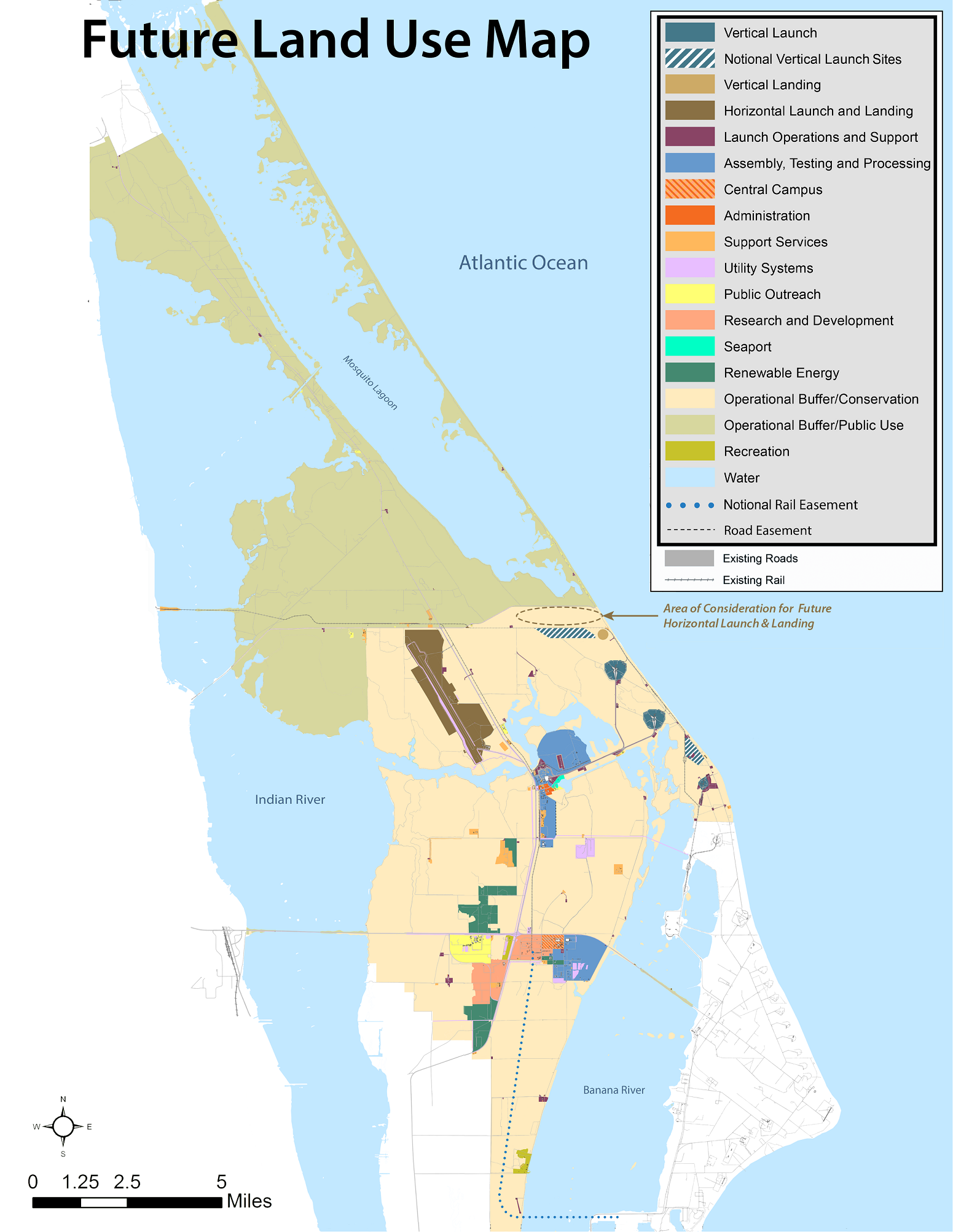
For many years, NASA has had a potential new launch pad on its Master Plan for Kennedy Space Center: LC-49 is projected to be built on the northern end of KSC property near its border with the Merritt Island National Wildlife Refuge.
There is also an LC-48 on the slate, located between the current LC-39A (Falcon 9, Falcon Heavy) and SLC-41 (Atlas/Vulcan) but it has not received the same amount of mention in the space community, nor the same amount of concern among some local residents as the potential LC-49.
Kennedy’s Master Plan
“One potential new vertical launch area, Launch Pad 49, could be sited to the north of Pad 39B. This location avoids overflight issues with Pad 39B and minimizes conflict with the Canaveral National Seashore, giving potential non-NASA entities a flexible set of operational options. In addition, Pad 49 could use Beach Road as an access road, allowing for more autonomous operations and the option to operate outside of KSC’s secured area.”
Annotated map from Kennedy Space Center’s Master Plan. Talk of Titusville added location names in order to clarify the geographical locations shown on this map. Map: NASA Future Land Use Map (FLUM) Retrieved 08/21/22
This has been on the site’s master plan in one form or another, dating back to the 1960s, and speculation of the potential of a new pad being built has risen lately due to SpaceX’s Starship due to come online in the near term.
1967 Plans for Pads LC-39C and LC-39D Drawing 68-DE-FAC-11 / NASA
“[Kennedy Space Center] announced last week that it was starting the process of an environmental review of the proposed Launch Complex (LC) 49 in response to an inquiry from SpaceX. The center did not disclose a timeline for conducting the review but said it would precede any agreement with SpaceX to develop the site.
“Launch Complex 49 is located to the northwest of Launch Complex 39B, the former Apollo and shuttle launch pad that will be used by the Space Launch System. The site was originally reserved in the 1960s for Launch Complex 39C but never developed.”
SpaceX Starship Facility at LC-39A
In 2021, SpaceX began building a launch tower for its future Starship operations at the Cape, but it appears that the company has taken a pause in constructing that launch tower, ostensibly to focus on completing Starship development, which will almost certainly inform the final design and construction of the new tower.
SpaceX Starship tower under construction in August 2022. At the time, construction cranes and other equipment were present at the site. LC-39A’s main tower is the the right, the VAB in the background left. Photo: Charles Boyer, Talk of Titusville
Given SpaceX’s iterative development method that makes a lot of sense and should not necessarily be considered a sign that they are abandoning any plans to complete the new pad next to LC-39A. The company has not made any public statement regarding the half-finished pad, and while work has apparently slowed on the structure, there is no sign of it being dismantled either.
SpaceX has made extensive changes to a similar launch pad at their Boca Chica orbital launch pad in recent months, so it makes sense to expect they will want to do the same to the pad at the Cape — when they are ready to bring Starship operations here to the Space Coast and the Eastern Range. That is speculation, however, and should be considered as such until concrete evidence of its accuracy is confirmed or disproven.
But What About LC-49?
Vicinity of LC-49 in 2021. NASA’s official caption for the photo reads “A view of a proposed new launch site, Launch Complex 49, on Dec. 20, 2021, at NASA’s Kennedy Space Center in Florida. In response to an inquiry from SpaceX, NASA is preparing to conduct environmental assessments to develop the proposed launch site. The 175-acre site, located north of Launch Complex 39B within the center’s security perimeter, would support the launch and landing of SpaceX’s Starship and Super Heavy launch vehicle. NASA and SpaceX are moving forward with the initial environmental assessment before concluding a potential agreement to develop the property.” Photo NASA, KSC-20211220-PH-KLS01_0002
At the same time, that apparent pause at LC-39A does not fully address LC-49. Talk of Titusville reached out to NASA to find out what progress is being made towards LC-49 actually being built in the relatively near future. Given that previous reports indicated that an environmental study was underway in 2021, it seems sensible that those studies would be complete or nearly so in 2024. They replied to us on January 18, 2024 and said that “[NASA] currently [does] not have any activities underway at LC-49.”
NASA added that, “all previous activities there have been suspended, including anything involving any commercial companies. We’re not currently working any NEPA or environmental actions. KSC did complete an environmental assessment in 2018-19 for the development and operations of the site, which included the construction of the existing launch pad.”
That “existing launch pad” they are referring to is almost certainly the new Starship launch pad referred to above, and that pad will not be completed for some time.
Good News For Titusville Residents and Visitors
This is likely going to be welcome news for Titusville residents. Were LC-49 built in the area planned for in the NASA Future Land Use Map (FLUM), once operational, it would likely cause repeated closings of Beach Road leading to Playalinda Beach, meaning that local beachgoers would have no route to the undeveloped beach areas located there. That is because at some points on Beach Road, an LC-49 could be as little as one mile away.
Beach Road and an LC-49 are relatively close together.
Those closures would come during fueling tests, static fires and launch activities due to Beach Road’s proximity to the LC-49 complex. Playalinda Beach is already often closed by KSC Police and the National Park Service for many launches from LC-39A and LC-39B, due to safety and security concerns during launch operations. LC-49 would result in much the same, and given SpaceX’s plans for a high cadence of Starship launches for Artemis and other commercial activities, those closures may have become a major inconvenience for residents and tourists alike.
With an estimated 1.5 – 2.0 million visitors a year, the Cape Canaveral National Seashore incorporates Playalinda Beach in its southern section as well as others (Apollo Beach) to the north. It is a major source of tourism dollars for Titusville, and it is the only beach available to local residents between Cape Canaveral’s Jetty Park and Apollo Beach in New Smyrna. In 1962, Titusville Beach was absorbed into Kennedy Space Center, leaving Playalinda, in the Merritt Island National Wildlife Refuge.
According to NASA’s statement that no activities are ongoing to build the new pad, there is little reason to worry about this happening any time in the near future.


You must be logged in to post a comment.