SpaceX Falcon 9 lifts off from LC-39A at Kennedy Space Center Photo: Charles Boyer / Talk of Titusville
SpaceX, NASA and Intuitive Machines are planning to launch the NASA CLPS IM-1 lunar lander Odysseus tonight at Kennedy Space Center from Pad LC-39A at 12:57 AM EST. The launch, aboard a Falcon 9 rocket, aims to be the first successful American soft-landing on the lunar surface since Apollo 17 in 1972.
Following the launch, the booster being used for the mission will return to land at LZ-1 in Cape Canaveral, and will herald its return with a sonic boom that will be heard across the Space Coast region.
That’s the first of two launches scheduled for Valentine’s Day. The second is USSF-124, launching from SpaceX’s pad SLC-40 Cape Canaveral Space Force Station. This mission’s launch window extends from 5:30 PM until 10:00 PM EST and is also an RTLS mission.
Launch Weather Outlook: NASA CLPS IM-1
First, the early launch, NASA CLPS/IM-1: the 45th Weather Squadron of the US Space Force is predicting a low Probability of Violation for the planned liftoff at 12:57 AM EST: only 5%. That means they are expecting a 95% chance of acceptable conditions for liftoff.
NASA CLPS IM-1 Trajectory
As is customary for most missions beyond Earth orbit, NASA CLPS IM-1 will take an easterly path from KSC after liftoff. People watching the launch in person should be able to see the reentry burn and if in the right place, the landing burn of Falcon 9 as it returns to land.
A Falcon 9 Booster landing at LZ-1 in 2023 Photo: Charles Boyer / Talk of Titusville
Launch Weather Outlook: USSF-124
The weather gets even better for the second planned launch of the day, according to the 45th Weather Wing: less than a 5% Probability of Violation, meaning a 95+% chance of acceptable weather conditions at liftoff.
USSF-124 Trajectory
Also eastward. Again, in-person launch viewers should be able to see the reentry burn and if in the right place, the landing burn of Falcon 9 as it returns to land.
SpaceX has not announced which landing pad they will utilize for this launch — either LZ-2, or perhaps the Falcon 9 used for LM-1 will be removed in time for USSF-124. Either way, to launch viewers off of the base itself, the landing will be in the same general direction.
Falcon 9 lifting off from SLC-40 at Cape Canaveral Space Force Station in 2023. Photo: Charles Boyer / Talk of Titusville
IM-1, the first NASA Commercial Launch Program Services launch for Intuitive Machines’ Nova-C lunar lander, will carry multiple payloads to the Moon, including Lunar Node-1, demonstrating autonomous navigation via radio beacon to support precise geolocation and navigation among lunar orbiters, landers, and surface personnel. NASA’s CLPS initiative oversees industry development of small robotic landers and rovers to support NASA’s Artemis campaign. Photo: NASA / Intuitive Machines
Shortly after midnight this Wednesday, the next NASA CLPS (Commercial Lunar Payload Services) lunar lander is set to begin its trip to the moon’s surface aboard a SpaceX Falcon 9. Launch time is scheduled for 12:57 AM EST, from Pad LC-39A at NASA’s Kennedy Space Center.
The lander was built by Intuitive Machines, a Houston-based company, and is named “Odysseus.” The mission designation is IM-1. Assuming a successful flight to orbit and post-launch vehicle checkouts, IM-1 will undertake a nine-day trip to the moon, where it will then attempt to be the first successful American soft-landing on the lunar surface since Apollo 17 in 1972.
As part of Project Artemis, in May 2019, the agency awarded a task order for scientific payload delivery to Intuitive Machines to build and fly Odysseus and IM-1. The spacecraft will “Demonstrate autonomous navigation,” according to a press release from NASA.
Malapert massif (informal name) is thought to be a remnant of the South Pole – Aitken basin rim, which formed more than 4 billion years ago. More recently, this magnificent peak (lower left) was selected as an Artemis 3 candidate landing region. Image is 25 kilometers wide in the center, Narrow Angle Camera M1432398306LR Photo: NASA/GSFC/Arizona State University
The landing site selected for this mission is Malapert A, a satellite crater to Malapert, a 69 km crater in the Moon’s south pole region. Named after Charles Malapert, a 17th-century Belgian astronomer, the area around the landing site is believed to be made of lunar highland material, similar to Apollo 16’s landing site in the in the Descartes Highlands.
NASA said that “the Lunar Node-1 experiment, or LN-1, is a radio beacon designed to support precise geolocation and navigation observations for landers, surface infrastructure, and astronauts, digitally confirming their positions on the Moon relative to other craft, ground stations, or rovers on the move. These radio beacons also can be used in space to help with orbital maneuvers and with guiding landers to a successful touchdown on the lunar surface.”
Odysseus will then have seven days to complete experiments on the lunar surface before the lunar night sets on the south pole of the Moon, rendering the spacecraft inoperable.
Utility of Lunar Node-1
“Imagine getting verification from a lighthouse on the shore you’re approaching, rather than waiting on word from the home port you left days earlier,” said Evan Anzalone, principal investigator of LN-1 and a navigation systems engineer at NASA’s Marshall Space Flight Center in Huntsville, Alabama. “What we seek to deliver is a lunar network of lighthouses, offering sustainable, localized navigation assets that enable lunar craft and ground crews to quickly and accurately confirm their position instead of relying on Earth.”
Intuitive Machines Leadership
Intuitive Machines was founded by CEO Steve Altemus in 2013, along with CTO Tim Crain, Stephen Altemus, and Kam Ghaffarian (a cofounder of Axiom Space) and is a publicly traded company.
Altemus is a graduate of Embry-Riddle Aeronautical University in Daytona Beach and holds an M.S. in Engineering Management from the University of Central Florida. He is also a former Shuttle program employee working in operations, launch, and landing activities prior to leaving to Johnson Space Flight Center in Houston where he served as a Deputy Director of Engineering.
Ghaffarian holds a B.S. degree in Computer Science and Electronics Engineering, an M.Sc. in Information Management, and a PhD in Management Information Systems. He has worked for Lockheed Martin on various NASA contracts, Loral Space, and as an entrepreneur, Ghaffarian co-founded Axiom Space, IBX, X-energy, and Quantum Space in addition to Intuitive Machines. He is also a philanthropist promoting STEM education.
Crain holds a Bachelor’s, M.S. and Ph.D. in Aerospace engineering, and like Altemus is a NASA employee where he worked as an aerospace engineer, a strategic advisor and as the Guidance, Navigation and Control Lead for the Morpheus Vertical Test Bed, a prototype planetary lander capable of vertical takeoff and landing.
Timelapse of SpaceX/NASA Crew-6 Re-entry over Biolab Road in Merritt Island National Wildlife Refuge in 2023. Photo: Charles Boyer / Talk of Titusville
SpaceX announced overnight that the expected return of the Axiom-3 astronauts aboard a Crew Dragon has been delayed.
SpaceX, Axiom Space, and NASA are targeting no earlier than Tuesday,
Dragon and the Ax-3 crew are now targeting no earlier than Tuesday, February 6 at 9:05 a.m. ET to undock from the [International Space Station.] Teams continue to keep an eye on recovery weather conditions
The company also added more information on their website:
February 6 at 9:05 a.m. ET for Dragon and the Ax-3 astronauts to depart from the International Space Station. After performing a series of burns to move away from the space station, Dragon will conduct multiple orbit-lowering maneuvers, jettison its trunk, and re-enter Earth’s atmosphere for splashdown off the coast of Florida approximately nine hours later the same day.
“[NASA] currently [does] not have any activities underway at LC-49.”
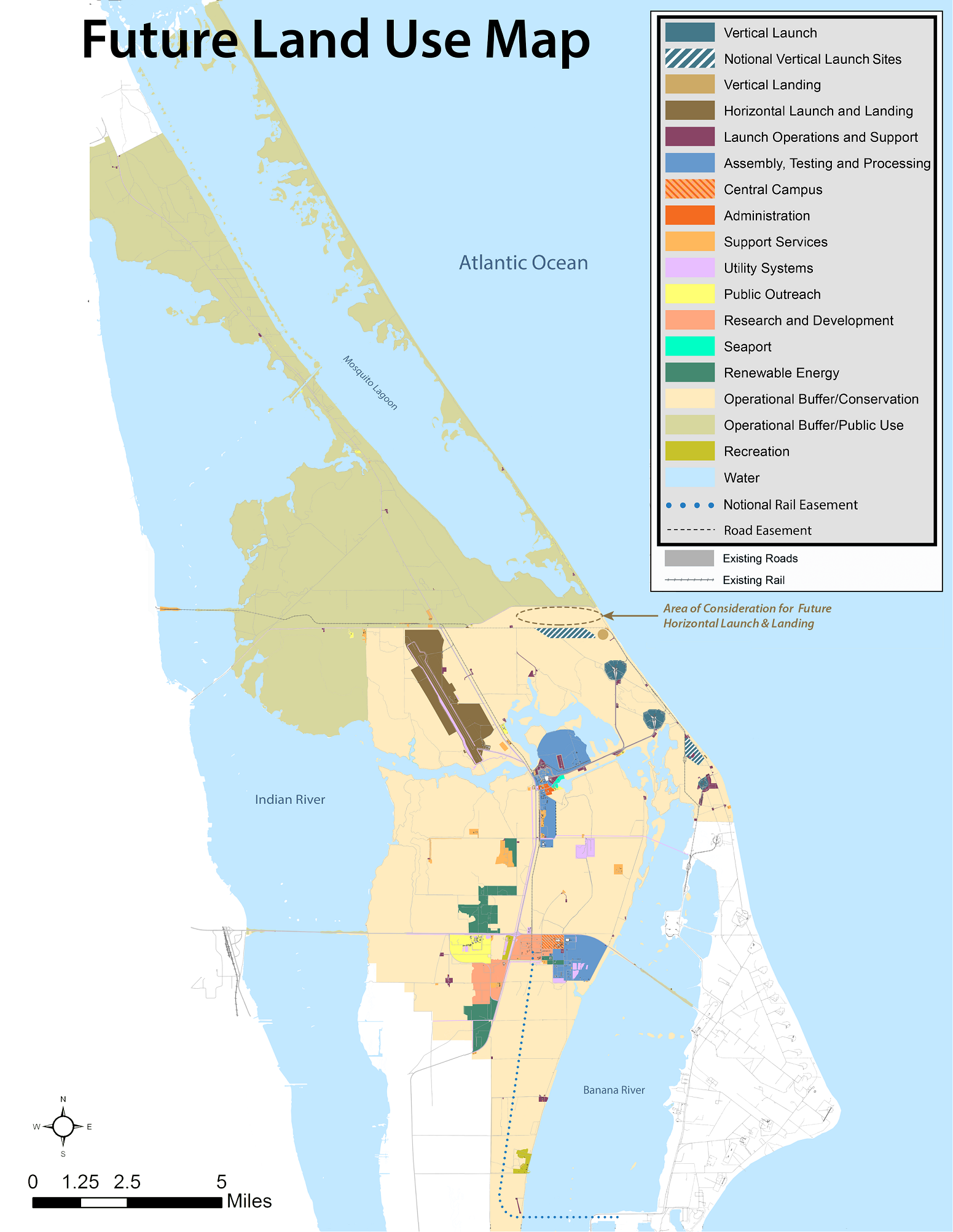
For many years, NASA has had a potential new launch pad on its Master Plan for Kennedy Space Center: LC-49 is projected to be built on the northern end of KSC property near its border with the Merritt Island National Wildlife Refuge.
There is also an LC-48 on the slate, located between the current LC-39A (Falcon 9, Falcon Heavy) and SLC-41 (Atlas/Vulcan) but it has not received the same amount of mention in the space community, nor the same amount of concern among some local residents as the potential LC-49.
Kennedy’s Master Plan
“One potential new vertical launch area, Launch Pad 49, could be sited to the north of Pad 39B. This location avoids overflight issues with Pad 39B and minimizes conflict with the Canaveral National Seashore, giving potential non-NASA entities a flexible set of operational options. In addition, Pad 49 could use Beach Road as an access road, allowing for more autonomous operations and the option to operate outside of KSC’s secured area.”
Annotated map from Kennedy Space Center’s Master Plan. Talk of Titusville added location names in order to clarify the geographical locations shown on this map. Map: NASA Future Land Use Map (FLUM) Retrieved 08/21/22
This has been on the site’s master plan in one form or another, dating back to the 1960s, and speculation of the potential of a new pad being built has risen lately due to SpaceX’s Starship due to come online in the near term.
1967 Plans for Pads LC-39C and LC-39D Drawing 68-DE-FAC-11 / NASA
“[Kennedy Space Center] announced last week that it was starting the process of an environmental review of the proposed Launch Complex (LC) 49 in response to an inquiry from SpaceX. The center did not disclose a timeline for conducting the review but said it would precede any agreement with SpaceX to develop the site.
“Launch Complex 49 is located to the northwest of Launch Complex 39B, the former Apollo and shuttle launch pad that will be used by the Space Launch System. The site was originally reserved in the 1960s for Launch Complex 39C but never developed.”
SpaceX Starship Facility at LC-39A
In 2021, SpaceX began building a launch tower for its future Starship operations at the Cape, but it appears that the company has taken a pause in constructing that launch tower, ostensibly to focus on completing Starship development, which will almost certainly inform the final design and construction of the new tower.
SpaceX Starship tower under construction in August 2022. At the time, construction cranes and other equipment were present at the site. LC-39A’s main tower is the the right, the VAB in the background left. Photo: Charles Boyer, Talk of Titusville
Given SpaceX’s iterative development method that makes a lot of sense and should not necessarily be considered a sign that they are abandoning any plans to complete the new pad next to LC-39A. The company has not made any public statement regarding the half-finished pad, and while work has apparently slowed on the structure, there is no sign of it being dismantled either.
SpaceX has made extensive changes to a similar launch pad at their Boca Chica orbital launch pad in recent months, so it makes sense to expect they will want to do the same to the pad at the Cape — when they are ready to bring Starship operations here to the Space Coast and the Eastern Range. That is speculation, however, and should be considered as such until concrete evidence of its accuracy is confirmed or disproven.
But What About LC-49?
Vicinity of LC-49 in 2021. NASA’s official caption for the photo reads “A view of a proposed new launch site, Launch Complex 49, on Dec. 20, 2021, at NASA’s Kennedy Space Center in Florida. In response to an inquiry from SpaceX, NASA is preparing to conduct environmental assessments to develop the proposed launch site. The 175-acre site, located north of Launch Complex 39B within the center’s security perimeter, would support the launch and landing of SpaceX’s Starship and Super Heavy launch vehicle. NASA and SpaceX are moving forward with the initial environmental assessment before concluding a potential agreement to develop the property.” Photo NASA, KSC-20211220-PH-KLS01_0002
At the same time, that apparent pause at LC-39A does not fully address LC-49. Talk of Titusville reached out to NASA to find out what progress is being made towards LC-49 actually being built in the relatively near future. Given that previous reports indicated that an environmental study was underway in 2021, it seems sensible that those studies would be complete or nearly so in 2024. They replied to us on January 18, 2024 and said that “[NASA] currently [does] not have any activities underway at LC-49.”
NASA added that, “all previous activities there have been suspended, including anything involving any commercial companies. We’re not currently working any NEPA or environmental actions. KSC did complete an environmental assessment in 2018-19 for the development and operations of the site, which included the construction of the existing launch pad.”
That “existing launch pad” they are referring to is almost certainly the new Starship launch pad referred to above, and that pad will not be completed for some time.
Good News For Titusville Residents and Visitors
This is likely going to be welcome news for Titusville residents. Were LC-49 built in the area planned for in the NASA Future Land Use Map (FLUM), once operational, it would likely cause repeated closings of Beach Road leading to Playalinda Beach, meaning that local beachgoers would have no route to the undeveloped beach areas located there. That is because at some points on Beach Road, an LC-49 could be as little as one mile away.
Beach Road and an LC-49 are relatively close together.
Those closures would come during fueling tests, static fires and launch activities due to Beach Road’s proximity to the LC-49 complex. Playalinda Beach is already often closed by KSC Police and the National Park Service for many launches from LC-39A and LC-39B, due to safety and security concerns during launch operations. LC-49 would result in much the same, and given SpaceX’s plans for a high cadence of Starship launches for Artemis and other commercial activities, those closures may have become a major inconvenience for residents and tourists alike.
With an estimated 1.5 – 2.0 million visitors a year, the Cape Canaveral National Seashore incorporates Playalinda Beach in its southern section as well as others (Apollo Beach) to the north. It is a major source of tourism dollars for Titusville, and it is the only beach available to local residents between Cape Canaveral’s Jetty Park and Apollo Beach in New Smyrna. In 1962, Titusville Beach was absorbed into Kennedy Space Center, leaving Playalinda, in the Merritt Island National Wildlife Refuge.
According to NASA’s statement that no activities are ongoing to build the new pad, there is little reason to worry about this happening any time in the near future.
Crew Dragon atop a Falcon 9 at Pad LC-39A at Kennedy Space Center on January 17, 2024. Photo by Charles Boyer, Talk of Titusville.
With about six hours left in the countdown to liftoff, SpaceX announced that they are canceling today’s planned launch of Falcon 9 carrying four astronauts to orbit aboard a Crew Dragon to the International Space Station. The mission on behalf of Axiom Space is dubbed Axiom-3 and will now launch NET Thursday, January 18, 2024 at 4:47 PM EST.
Timelapse of the staging sequence of Falcon Heavy as it soared to orbit off of the Florida coast on December 28, 2023. Top right are the final moments at full power, with bottom left the separation sequence and start of the side boosters returning to Cape Canaveral.
SpaceX and the US Space Force launched Falcon Heavy carrying the USSF-52 mission from Kennedy Space Center at 8:07pm Eastern Standard Time under partly-cloudy skies and huge crowds gathered in Titusville and Cape Canaveral. After separating from the core first stage of the rocket, the two side boosters arced across the sky and returned to Cape Canaveral Space Force Station safely some eight and a half minutes later.
Falcon Heavy rising in November, 2022. Unfortunately, technical issues halted tonight’s planned launch. Photo: Charles Boyer for Talk of Titusville
SpaceX halted the countdown of its planned Falcon Heavy Launch this evening after encountering what the company labeled a “ground side issue.” The next launch attempt will occur no earlier than Dec. 12, 2023 from pad 39A at the Kennedy Space Center at 8:14 PM Eastern Standard Time.
SpaceX launched their 29th Commercial Resupply Services mission on November 10, 2023, sending roughly 6,500 pounds of research gear, supplies and equipment to the International Space Station. The company launched a Falcon 9 from LC-39A at Kennedy Space Center, and the first stage booster landed a few miles south at LZ-1 approximately eight minutes later.
SpaceX NASA CRS-29, from the Banana River on FL-528W. Total exposure time is about 8.5 minutes.
SpaceX launched a Falcon 9 from Pad LC-39A at Kennedy Space Center in Florida on September 3, 2023. This mission carried another batch of Starlink satellites to orbit and it was a record-breaking 62nd orbital launch of the year for SpaceX. There have been 46 launches from Cape Canaveral / Kennedy Space Center this year, with all but two coming from SpaceX.
A long exposure of the SpaceX Starlink 6-14 launch resulted in a “launch streak” showing the trajectory of the rocket. The curve is an optical illusion — the rocket was constantly ascending, but the curve of the Earth shows it getting lower.
Crew-7 crew members NASA astronaut Jasmin Moghbeli, commander; ESA (European Space Agency) astronaut Andreas Mogensen, pilot; and mission specialists JAXA (Japan Aerospace Exploration Agency) astronaut Satoshi Furukawa and Roscosmos cosmonaut Konstantin Borisov aboard a SpaceX Crew Dragon and Falcon 9 as it lifts off from Kennedy Space Center on August 26, 2023.
The launch was captured from several angles and this video was assembled using Florida Media Now’s Mark Stone and my elements, then edited together by me. It was a true team effort.


You must be logged in to post a comment.