The Department of the Air Force has released its Draft Environmental Impact Statement (EIS), which reviews the proposed repurposing of Launch Complex 37 (LC-37) for Starship launches at Cape Canaveral Space Force Station (CCSFS).
LC-37 At was used until recently by United Launch Alliance for Delta IV Heavy, with the last launch coming fourteen months ago when the last Delta IV Heavy built by ULA flew the NROL-70 for the National Reconnaissance Office.
At A Glance – A High Level Summary Of The Impacts
Talk of Titusville is still reading the document, which spans hundreds of pages.
The Draft outlines the anticipated environmental effects of permitting SpaceX to conduct up to 76 Starship launches and landings per year at the site, along with associated construction, fueling, testing, and transportation activities. The document also represents the most detailed public blueprint to date of SpaceX’s plans for regular Starship operations in Florida.
Noise Impacts
A map shows the Noise Contours for a typical Starship launch. Also from the Draft:
Noise Impact Mitigations
From page 12 of the Executive Summary Noise Impact Mitigation:
Mitigation-3 is interesting — if it can be proven that sound damage from Starship has resulted in property damage, under Federal law, SpaceX is responsible for making the property owner whole again.
On March 14, 2025, the Federal Aviation Administration (FAA) unveiled a Draft Environmental Assessment (EA) SpaceX’s proposal to increase the number of launch as well as relocating Falcon landing zones to Space Launch Complex 40 (SLC-40) within Cape Canaveral Space Force Station. The FAA is now seeking your input, which you can do online or by attending a virtual public meeting next week on April 16, 2025. Information is below.
The following changes are planned. Keep in mind that the proposal is for SLC-40 only and does not affect the company’s plans or activities at nearby LC-39A.
Planned Changes at SLC-40. Graphic via FAA EA
The proposed landing site locations are below. Click on each one to enlarge:
EA Draft Findings
In a nutshell, the FAA found
The FAA is posting for public review a Draft Environmental Assessment (EA) analyzing the SpaceX proposal to increase Falcon 9 operations from 50 to up to 120 per year from Space Launch Complex 40 at the Cape Canaveral Space Force Station in Florida. The Draft EA also reviews the construction of a first-stage booster landing zone at the site with up to 34 landings per year.
In order to meet the Department of the Air Force (DAF) National Environmental Policy Act requirements, the FAA has also posted a link to the Draft Finding of No Significant Impact (FONSI) for public comment on behalf of DAF.
A virtual public meeting will be held on April 16 and the public comment period closes on April 24, 2025.
The FAA
Solicitation For Public Comment
The FAA invites interested parties to submit comments on the Draft EA. Instructions on how to submit comments can be found on the FAA webpage linked here:
To further engage stakeholders, the FAA has scheduled a virtual public meeting on April 16, 2025, from 6:00 to 8:00 PM Eastern Time. Participants are required to register in advance to attend. Registration can be completed at:
If any accommodation for public meeting is needed (such as additional translation services), please submit a request by April 11, 2025 to SpaceXFalconSLC40@icf.com
The smoldering aftermath of a wildfire in Merritt Island National Wildlife Refuge. Photo: Charles Boyer / Talk of Titusville
A lightning strike from a severe thunderstorm started a conflagration in Merritt Island Wildlife Refuge this afternoon. It is north of Kennedy Space Center, and is currently no threat to property or human endeavor — in other words, the facilities at Kennedy Space Center.
1PM EDT Update: Beach Road to Cape Canaveral National Seashore and Playalinda Beach has reopened to traffic. Only lingering wildfire smoke is in the area of the road, and any smoldering fire remaining active appears to be located well south of the road.
Previous Updates
Merritt Island National Wildlife Released this statement on social media at 10:25 AM Sunday: “Update on the current wildfire in the Peacocks Pocket marsh. Fire crews will be flying over the area this morning to better assess the size and scope of the fire. A plan of action will be formed after this flight and will depend greatly on the expected weather conditions. This area last burned a little over 3 years ago which is the natural cycle for refuge.”
MINWR official statement at around 11PM EDT May 25: “A lightning caused fire is currently burning in the Peacocks Pocket impoundment. The fire is estimated to be 150-200 acres. Fish & Wildlife firefighters are onsite and will monitor the blaze throughout the night. Expect all access roads to Peacocks Pocket to be closed tomorrow until fire crews determine they are safe, including: West Gator Creek, Gator Creek East Gator Creek, and Catfish Creek roads.”
11PM MAY 25: KSC Police are currently turning unbadged cars away Gate 4TT, at the end of Max Brewer Bridge. They have also cleared the Refuge of spectators. (see above: the road has reopened to traffic headed towards CCNS/Playlinda Beach and Gate 4 for KSC)
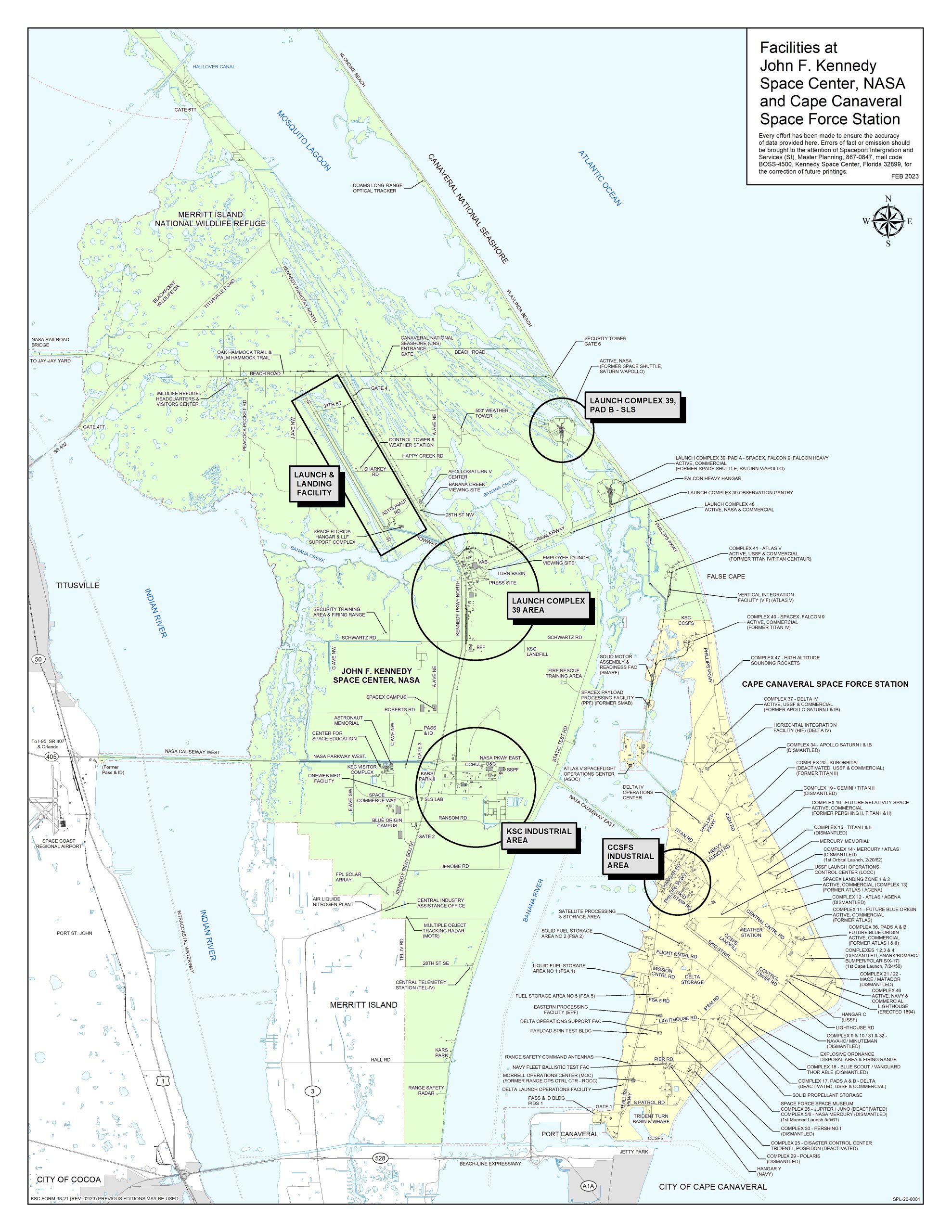
The general location of the wildfire in Merritt Island National Wildlife Refuge. Graphic: original map is from the 2021 KSC Facilities Map, NASA
12 PM EDT, Sunday: Beach Road Open, Fire Seems To Be Dwindling
From a distance and to the uneducated naked eye, the wildfire is now starting to burn itself out, especially on its northern edges. Still far away from operational KSC facilities and buildings, no flames could be seen from Beach Road or US-1 in Titusville, which is very different than twelve hours earlier.
That does not mean that the fire is no longer any danger — a change in weather conditions or wind direction and speeds could fan the flames. Stay tuned to local authorities for official status updates. We will pass them along as soon as we receive them.
1 PM Sunday, May 26: As seen from US-1 in Titusville, a perspective of the wildfire in MINWR: it is far away from any launch pad or KSC buildings, with the closest operational area of the space center being the Shuttle Landing Facility, but even that is at least two miles east. Click to enlarge Photo: Charles Boyer / Talk of Titusville12PM Sunday, May 26: a fire hotspot as seen across the Indian River from Titusville. Photo: Charles Boyer / ToT
11 PM EDT, Saturday: KSC Closes Beach Road
Around 11 PM EDT, KSC Police were emptying MINWR and were stopping people at the end of Max Brewer Bridge. KSC Police asked me to leave, and that’s exactly what I immediately did: I skedaddled.
Closeup of the fire line near Beach Road Saturday night. Photo: Charles Boyer / Talk of TitusvilleA waning moon rises over Beach Road through the smoke from wildfire in Merritt Island National Wildlife Refuge Saturday night. Photo: Charles Boyer / Talk of TitusvilleCloseup of the blaze. Photo: Charles Boyer / ToT
7 PM EDT, Saturday: Fire Is Spreading
Late afternoon wildfire scene in Merritt Island Wildlife Refuge. Photo: Charles Boyer / Talk of TitusvillePhoto: Charles Boyer / Talk of TitusvillePhoto: Charles Boyer / Talk of Titusville
The American Space Museum in Titusville along with the National Space Society has announced “321 Day” on March 21st to celebrate the life and legacy of local legend Robert “Ozzy” Osband — self-proclaimed “Rocket Hobo” and “Father of the 3-2-1 Area Code.”
Osband was a familar and welcome sight to local and tourists alike in Space View Park, where he gave launch updates, countdowns, and the occasional “SCRUB!” to people gathered in Space View Park to watch launch attempts at the Cape. Always the friendly sort, Ozzy was well known for coloring in the details of what was happening, giving the public a much better understanding of what they were watching.
He created the “Rocket Hobos” — someone one “who never misses a rocket launch. They have encyclopedic knowledge of the space program. They possess minutiae on the history of NASA. Their minds are like webs wherein every statistic of space trivia is forever snared. Rocket Hobos set their alarms for 3:11 am Atlas blast-offs.” Remaining Rocket Hobos patches will be for sale at Space View Park on the day of the celebration.
Osband also had the idea for the Space Coast to have its famous “321” area code. The old “407” area code was running out of numbers, and new code was going to be established for the area. Ozzy did some research, found out that “321” was available and started a campaign for its assignment to the Space Coast region.
On Nov. 1, 1999, Florida Gov. Jeb Bush placed the first official “321” phone call from Tallahassee to Kennedy Space Center, with Ozzy sitting beside the deputy director receiving the call.
“We are excited to honor our wonderful friend Ozzy in this celebration,” said Karan Conklin, ASM executive director. “We are happy the National Space Society has helped our museum create a community event to honor Ozzy’s legacy on our Space Coast. “People like Robert Osband carry the torch for the Space Age in the community and help inspire all generations to explore outer space,” said Gabriel Rothblatt, a Director of the National Space Society and Space Coast resident. “This is a special celebration for an extraordinary man, and we welcome the community to join us.”
Ozzy Osband in high school. Photo: classmates.com
Ozzy Osband died Aug. 6, 2023 of natural causes at age 72. He was born in New York, and lived much of his life in the Titusville area. Ozzy had his own computer software company, and was well known in the ham radio community (N4SCY). As an Army veteran, he was interred at the Cape Canaveral National Cemetery in Mims, Florida.
While honoring and recognizing all of America’s space programs and their workers, the foundation agrees with astronaut Alan Shepard, when on May 13, 1996, he said, “We need to remember the people who made it possible; so little is said of them.” The intent of the American Space Museum and US Space Walk of Fame is to honor and place emphasis on American space workers and others who made the space programs possible.
The Celebration
3:21 PM EDT: An informal gathering at Space View Park for friends to remember the life and legacy of Ozzy Osband.
4:00 PM: ASM plans to broadcast, live via YouTube, a special episode in Ozzy’s honor, of the “Stay Curious Podcast” from Space View Park.
5:00 PM: Titusville Mayor Dan Diesel will read a proclamation in honor of Ozzy Osband at the Titusville Welcome Center
After the Proclamation, a block party with food trucks, adult beverages, and exhibitors representing causes that Ozzy worked on will be present
A performance by Interstellar Groove Machine, a local Space Coast band composed of aerospace employees.
Mark your calendars and plan to attend. This will surely be a great time to remember one of Titusville’s most colorful and iconic characters, a man who reflected the city and its other residents perfectly.
Due to its final position on the lunar surface, Intuitive Machine’s IM-1 Nova-C “Odysseus” lander will cease operations within 24 hours. That will be two days earlier than planned. Still, IM said in an update this morning that they continue receiving data from the first American lunar lander to successfully touch down on the moon’s surface in over fifty years.
IM-1 approximately 30 meters above the lunar surface. Photo: Intuitive Machines
Flight Controllers continue to communicate with Odysseus. This morning, Odysseus efficiently sent payload science data and imagery in furtherance of the Company’s mission objectives. Flight controllers are working on final determination of battery life on the lander, which may continue up to an additional 10-20 hours.
The images included here are the closest observations of any spaceflight mission to the south pole region of the Moon. Odysseus is quite the photographer, capturing this image approximately 30 meters above the lunar surface while his main engine throttled down more than 24,000 mph. Another day of exploration on the south pole region of the Moon. (27FEB2024 0835 CST)
After the lander is in the darkness of lunar night and its batteries are exhausted, the mission will end. That endpoint was originally scheduled for sometime Thursday, February 29th, but will occur early due to the angle and final resting position of Odysseus. Because it is on its side, rather than standing vertically, the amount and strength the lander receives to provide power through its solar panels is less than optimal.
As for the final results of the experiments aboard Odysseus, we will have to wait for them to be released by NASA and Intuitive Machines.
Next CLPS Missions
While IM-1 is near its end, NASA’s Commercial Lunar Payload Services (CLPS) program is really just getting started with planned lunar landings in support of both the Artemis program to return humans to the moon and also lunar science in general.
Firefly Aerospace
Blue Ghost M1, by Firefly Aerospace, is set to launch in the third quarter of this year aboard a SpaceX Falcon 9. “Firefly is excited and ready for our Blue Ghost Mission 1,” Trina Patterson, VP of Marketing and Communications told Talk of Titusville. “We got next!”
Blue Ghost lander image: Firefly Aerospace
The 2 x 3.5 meter spacecraft’s landing target is MareCrisium (Latin for “Sea of Crises”) a spot that is barely visible to observers with the naked eye. It will, according to Firefly, carry “ten NASA-sponsored payloads” and is designed to last “for an entire lunar day (about 14 Earth days), and well into the freezing lunar night.”
Mare Crisium on the lunar surface.
Intuitive Machines IM-2
In the fourth quarter of this year, Intuitive Machines will try again with IM-2, its second Nova-C lander. It will land in the southern polar region of the moon, this time carrying a drill (PRIME-1) combined with a mass spectrometer, to attempt harvesting ice from below the surface among other experiments. Like IM-1 and Firefly’s Blue Ghost M1, IM-2 is planned to fly aboard a Falcon 9 rocket on its initial journey to space.
Astrobotics, the Pennsylvania company that built the Peregrine lander that failed to reach the moon earlier this year, has its VIPER lander slated to head towards the lunar South Pole region later this year as well.
2025 will also see multiple CLPS missions to the lunar surface. Intuitive Machines, Firefly and Draper Laboratories all have missions penciled in for next year.
The incomplete Starship Launch Tower pad 39A at KSC stands to the right SpaceX’s Falcon 9 / Falcon Heavy launch tower. Photo: Mark Stone/FMN
In a recent Department of the Air Force announcement, the Air Force said an Environmental Impact Study isunder way for potential new launch facility at Cape Canaveral Space Force Station or Kennedy Space Center.
The proposed facility would be aimed at providing an Eastern Range launch pad for SpaceX’s Starship, the largest, most powerful rocket ever built. By comparison, Starship has over 16 million pounds of thrust, compared to NASA’s new Space Launch System, which has half of that.
What Is An Environmental Impact Study?
In the United States at the federal level, an EIS is a report mandated by the National Environmental Policy Act of 1969 (NEPA), to assess the potential impact of actions “significantly affecting the quality of the human environment.” This requirement under NEPA does not prohibit harm to the environment, but rather requires advanced identification and disclosure of harm.
The first Draft of the Cape Canaveral EIS is scheduled to be released in December of this year.
Debate Starts To Heat Up
While both the future of commercial spaceflight and NASA’s plans for the moon and beyond demand such heavy lift capabilities, an expected debate has started to emerge from environmental groups as well as some local residents, who are gearing up to express opposition to the potential new facility proposed at Cape Canaveral Space Force Station. At the same time, others support the possible move fully and are embracing the idea.
The new Starship has already flown twice from SpaceX’s Starbase development facility in South Texas, with both test flights ending in a “RUD”, or rapid unscheduled disassembly – catastrophic vehicle failure. (RUD is space lingo for “it blew up.”)
It is likely SpaceX will face the similar battles with environmentalists and some locals in Florida that they already face in Texas, even if the situations are somewhat different.
The Lay of the Land In Boca Chica
Space X’s Starship stands on the pad in Boca Chica, TX. prior to it’s second flight test. Photo: Richard Gallagher/FMN
A few years ago, SpaceX had begun construction of a Starship launch tower near Kennedy Space Center’s Launch Complex 39A, but that work has apparently been stopped in favor of a Starship facility near Boca Chica, Texas, where Starship being developed and test flights conducted.
Since then, SpaceX has proceeded with extensive construction of what it calls Starbase, with two highly-publicized Starship launches during 2023.
In the interim some environmental groups loudly complained about the Texas facility, its proximity to federally protected wetlands as well as dust created by the first launch, and noise from both.
In a move to apparently remedy the standoff over, SpaceX offered a lopsided land swap to the Texas Parks and Wildlife Department (TPWD). As reported by ABC 13 News from Houston, SpaceX offered to turn over 477 acres near the Laguna Atascosa National Wildlife Refuge in exchange for only 43 acres from the Boca Chica State Park (near Starbase).
The Parks and Wildlife staff appeared ready to take the deal: “[We] view it as a way for the agency to increase public access and protect grasslands and wetlands … these conversations continue more than a decade of cooperative work with SpaceX to carry out our respective missions as neighbors,” the TPWD statement said. A vote was set for January 25, 2024.
But several days before the vote, the Parks and Wildlife staff sought public comment. Over 1,039 comments were against the land exchange compared to 263 for it. The TPWD also received a letter from influential Cameron County Judge Eddie Trevino Jr against the project. The Parks and Wildlife then hastily postponed the vote until its March 28 meeting.
Texas Public Radio reported:
Save RGV (Save Rio Grand Valley) a nonprofit group advocating against the development of liquified natural gas plants and SpaceX in the Rio Grande Valley, worries how [a] land exchange could impact sensitive wildlife areas in the future.
“The proposed exchange will further environmental impacts, including more light, noise, run-off, pollution, and traffic,” Mary Angela Branch, Save RGV member, said in a public comment to the TPWD commission. “This exchange would set a bad precedent for trading away unique sensitive habitat and public land.”
“Another question posed by Save RGV is whether TPWD possibly blocked a land purchase by Cameron County, where both parcels of land are located. One commissioner has pushed back at the exchange deal, saying the county had plans to use the land for its own conservation project.”
In December, Jeff Foust at SpaceNews reported that Texas’s congressional representatives were getting involved:
Cruz argued that the environmental reviews resulted in “asinine delays” even as the United States competes with China and Russia in spaceflight. “I’m not advocating for a wholesale repeal of our environmental laws or NEPA. I’m just arguing for them not to be applied in a dumbass way that slows down commercial space.”
The second Starship launch was “after months of delay stemming from bureaucratic red tape from AST, Fish and Wildlife and other agencies injecting themselves into the process,” said Sen. Ted Cruz (R-Texas), ranking member of the Senate Commerce Committee, at a Dec. 13 hearing by that committee’s space subcommittee. AST is the FAA’s Office of Commercial Space Transportation.
As both proposed launch pads are on Cape Canaveral Space Force Station, no land exchanges will be needed for Florida. Until a recent deal with the State of Texas, Starbase existed on an approximately 55-acres of land, whereas CCSFS is1,325 acres, and that before the adjacent Kennedy Space Center is considered – that site has 6,000 acres of land for facilities and roads, and has 7.8 million square feet of building area, and 564 miles of roads, including 184 miles of paved and 380 miles of unpaved roads.
It should be noted that the Boca Chica Starbase is located within about 5 miles of populated Port Isabel. In contrast, the CCSFS Launch Complex 37 is about 15 miles from Titusville and 8 miles from Cape Canaveral. Both are well out of the designated Blast Debris Area that is recognized for launches: the Saturn V in the 1960’s and 1970’s and also the recent Artemis I launch of SLS had BDAs of 3.5-4.0 miles from the launch site.
The Debate Begins in Florida
With the third test flight of Starship expected for next month in Texas, attention is shifting to SpaceX’s plans for Florida’s launch facility, and the recent announcement from the DAF of an EIS for a launch pad at CCSFS. The Department of the Air Force, which controls the bulk of the Cape Canaveral peninsula via the US Space Force, has made it clear they are in need of Starship’s heavy lift capability.
At a recent Space Mobility Conference, Gary Henry, senior advisor for national security space solutions at SpaceX, said that Starship holds the potential to become a mobility platform for the U.S. military. “The cost element of this is going to be pretty compelling, and it’ll happen soon,” Henry said. The military also intends to use the massive Starship as an inflight refueling and logistics depot, supporting Space Force missions.
Additionally, NASA’s plans for the moon and beyond hinge on Starship as part of the Artemis program, with plans for a crewed moon landing within this decade.
Such ambitious plans would require a fairly rapid cadence in Starship launches. A NASA official said last year that the use of Starship for Artemis lunar landings will require “in the high teens” of launches both from Texas and Cape Canaveral.
Locals and environmental groups are already voicing their concerns on social media, encouraging residents to research the environmental and community issues and then attend one of the upcoming public comment forums in the area.
Local Concerns Expressed on Social Media
In a Facebook group called “Fight For Zero Brevard”, one resident posted:
“PLEASE go do your research concerning the massive change in attitude by all the people who live near Boca Chica and the huge impact Starship has had to their environment and wildlife….there was such pushback by Boca Chica residents during their time to write in public comments that a much more “rigorous” environmental study was called for pushing SpaceX’s time frame out and there has been a lawsuit filed by numerous groups concerning the environmental impact hence part of the reason for SpaceX’s shift to now focusing on Cape Canaveral.“
In another group, a poster said: “There is no question that a keener eye needs to be placed on the negative effects of launches and space programs in general. Thanks for alerting us to this. The space center is a cool thing to have in our backyards, but not at the expense of human and environmental health.“
Still, others expressed concerns about the increased noise pollution of launches, the safety of residents in the event of a mishap, and the environmental effect of the fallout of heavy metals.
Not all residents shared those concerns, touting the positive effects of the space program. A Facebook poster wrote:
“We are, after all, the Space Coast right? The space program and its associated tourism drives Brevard County’s economy. We have all of the necessary capabilities and infrastructure, so it’s a natural.“
Another said that,
“The economic future of the area depends on Starship coming to the Space Coast. Anyone who remembers the cratering house prices and boarded up businesses after Apollo and the Shuttle should be supporting SpaceX bringing Starship here.“
As of yet, none of the Space Coast’s federal representatives (Congressman Bill Posey, Senators Marco Rubio and Rick Scott) have weighed in on the potential of Starship flying out of Cape Canaveral or the ongoing Environmental Impact Study. Nor have any local officials, but to be fair, it has not been long since the EIS study was announced by the DAF, and their offices may also be evaluating the new documents.
Public Hearing Dates
March 5: 4-7 PM, Catherine Schweinsberg Rood Central Library, 308 Forrest Ave., Cocoa.
March 6: 4-7 PM, Titusville Civic Center, 4220 S. Hopkins Ave., Titusville.
March 7: 4-7 PM Radisson Resort at the Port, 8701 Astronaut Blvd., Cape Canaveral.
There is also an online meeting for those who cannot attend in person:
Talk of Titusville urges all interested parties to attend at least one of the meetings and to make their voice heard.
Draft Study Results Expected Late This Year
After making the study announcement and holding public hearings in March, the Environmental Impact Study will appear as a draft release of the report sometime in “winter” 2024. (As there is only one official winter month, that of December, it may be that the draft EIS is due that month.) That is not set in stone, however, so stay tuned for an announcement of specifically when that date may be.
This article was originally published on Florida Media Now, and is added here courtesy of FMN. Correspondents Jim Siegel, Charles Boyer, and Mark Stone contributed.
SpaceX and NASA are planning to launch a Falcon 9 from SLC-40 NET Tuesday morning at 1:33 AM EST. Weather may be a concern: the 45th Weather Squadron has yet to issue a Probability of Violation forecast, but the National Weather Service and other general forecast products are calling for a good chance of wind and rain at the planned launch time.
NASA’s Plankton, Aerosol, Cloud, ocean Ecosystem (PACE) observatory is inspected and processed on a spacecraft dolly in a high bay at the Astrotech Space Operations Facility near the agency’s Kennedy Space Center in Florida on Monday, Dec. 4, 2023 Photo: NASA
NASA and SpaceX technicians safely encapsulate NASA’s PACE (Plankton, Aerosol, Cloud, ocean Ecosystem) spacecraft in SpaceX’s Falcon 9 payload fairings on Tuesday, Jan. 30, 2024, at the Astrotech Space Operations Facility near the agency’s Kennedy Space Center in Florida. (click to view full size) Photo: NASA
The payload for the mission is NASA’s PACE (Plankton, Aerosol, Cloud, ocean Ecosystem) satellite. It is an Earth-observing instrument that will conduct observations of global ocean color, biogeochemistry, and ecology, as well as the carbon cycle, aerosols as well as as clouds.
According to NASA, “PACE’s data will help us better understand how the ocean and atmosphere exchange carbon dioxide. In addition, it will reveal how aerosols might fuel phytoplankton growth in the surface ocean. Novel uses of PACE data will benefit our economy and society. For example, it will help identify the extent and duration of harmful algal blooms. PACE will extend and expand NASA’s long-term observations of our living planet. By doing so, it will take Earth’s pulse in new ways for decades to come.”
Weather A Concern
Until the 45th Weather Squadron releases their official launch forecast, here’s the general weather forecast. Note that this forecast does not consider rocket launch weather criteria and should be used only for a very general look ahead:
Monday Night: A 40 percent chance of showers. Mostly cloudy, with a low around 56. Windy, with a north northwest wind 15 to 25 mph, with gusts as high as 30 mph.
Tuesday: A 40 percent chance of showers. Partly sunny, with a high near 65. Windy, with a north wind 25 to 30 mph, with gusts as high as 40 mph.
Trajectory will be south, with the final destination being a Sun-synchronous orbit.
Via Flightclub.io
Sonic Boom Advisory
This will be an RTLS (Return To Launch Site) mission. Space Coast residents can expect a sonic boom to spread through the area after 1:42 AM. Remember that sound travels about five miles per second, so the exact time for the sonic boom’s arrival is dependent on your location’s distance to LZ-1.
In an email to media, SpaceX released the following:
SpaceX is targeting Tuesday, February 6 at 1:33 a.m. ET for a Falcon 9 launch of NASA’s PACE (Plankton, Aerosol, Cloud, ocean Ecosystem) mission to a sun-synchronous orbit from Space Launch Complex 40 (SLC-40) at Cape Canaveral Space Force Station in Florida. If needed, a backup opportunity is available Wednesday, February 7 at the same time.
About eight minutes after liftoff, Falcon 9’s first stage will land on SpaceX’s Landing Zone 1 (LZ-1) at Cape Canaveral Space Force Station, Florida. There is the possibility that residents of Brevard, Orange, Osceola, Indian River, Seminole, Volusia, Polk, St. Lucie, and Okeechobee County counties may hear one or more sonic booms during the landing, but what residents experience will depend on weather and other conditions.
SpaceX, February 5, 2024
SpaceX Falcon 9 with PACE aboard, February 5, 2024 Photo: Charles Boyer
Booster
SpaceX will use Booster 1081 for this mission, which will be its fourth mission.


You must be logged in to post a comment.