As seen from Kennedy Point Park in Titusville, Starlink 10-7 rises off of LC-39A on August 12, 2024 Photo: Richard P. Gallagher / Florida Media Now
SpaceX launched a Falcon 9 carrying another group of Starlink satellites from Kennedy Space Center this morning in the predawn hours. Liftoff was at 06:37 AM EDT from Launch Complex 39A.
The booster used for this mission, B1073, completed its portion of the mission successfully a little more than eight minutes later when it touched down safely on the SpaceX drone ship ASDS ‘A Shortfall Of Gravitas’ east of Charleston on the Atlantic Ocean. The drone ship will now return to Port Canaveral after a few days, where the booster will be offloaded, transported to Space X’s ‘Hangar X’ facility at Kennedy Space Center. There it will be inspected, refurbished and prepared for its next mission.
Florida Media Now’s Cal Faxton caught this shot of Falcon 9 racing above and beyond a passing jetliner this morning. Photo: Cal Foxton, Florida Media Now
At 07:34 SpaceX announced a successful second burn of the second stage of the Falcon 9 that it used for this mission, and at 07:41 AM the company announced a successful payload deployment of the Starlink satellites, indicating a successful end to the mission.
The Starlink satellites will now travel to the final orbital locations under their own power, and after commissioning, will joing the other 6100+ active satellites in the Starlink constellation. Those satellites provide Internet connectivity for over 3.1 million people in over 100 countries and territories across the globe.
Launch Replay
Replay of the Starlink 10-7 launch
Next Launch
NET Thursday, August 14, SpaceX will be back in action with a Falcon 9, this time from Space Launch Complex 40 at Cape Canaveral Space Force Station when the company plans to launch the WorldView Legion 3&4 satellites. Those satellites are owned and operated by Maxar, are used for Earth-imaging for Maxar’s customers.
Date: NET August 14, 2024
Organization: SpaceX
Mission: WorldView Legion 3 & 4
Rocket: Falcon 9
Launch Site: SLC-40, Cape Canaveral Space Force Station
Early in the launch window, Playalinda Beach was bright and sunny with light breezes. Spectators were relatively light, probably because it’s Florida, it’s August and it was truly hot. Photo: Charles Boyer / Talk of Titusville
SpaceX Scrubs In The Last Minute, Disappointing Spectators
It was hotter than a dog’s mouth this morning for spectators waiting in vain to watch today’s planned rocket launch. Scheduled to liftoff at 10:59 AM EDT, at 46 seconds, SpaceX called off the launch of Falcon 9 and the Starlink 10-7 mission from Launch Complex 39-A at Kennedy Space Center.
No official reason for the scrub was announced by the company.
Spectators gathered at the stop point on Playalinda Beach. This photo was made with about a minute left on the countdown. The launch scrubbed seconds later.
SpaceX is now targeting liftoff no earlier than 06:37 AM EDT (1037 UTC) on Monday, August 12th.
Weather
Tomorrow’s weather should offer conditions resulting in 95% GO weather-wise.
via 45th Weather Squadron, retrieved 08/11/2024 at 05:00 PM EDT
NASA’s SpaceX Crew-10 members (pictured from left to right) NASA astronaut Nichole Ayers, Roscosmos cosmonaut Kirill Peskov, NASA astronaut Anne McClain, and JAXA (Japan Aerospace Exploration Agency) astronaut Takuya Onishi. Photo: NASA
NASA announced the members of the Crew-10 mission to ISS today. They slated to fly to ISS no earlier than February of next year aboard a SpaceX Crew Dragon and Falcon 9.
NASA astronauts Commander Anne McClain and Pilot Nichole Ayers, JAXA (Japan Aerospace Exploration Agency) astronaut Mission Specialist Takuya Onishi, and Roscosmos cosmonaut Mission Specialist Kirill Peskov will join astronauts at the orbiting laboratory next year.
Anne McClain
Anne McClain Photo: NASA
This will be McClain’s second spaceflight. She was selected as an astronaut in 2013 and is a colonel in the U.S. Army. McClain earned her bachelor’s degree in Mechanical Engineering from the U.S. Military Academy at West Point, New York, and holds master’s degrees in Aerospace Engineering, International Security, and Strategic Studies.
The Spokane, Washington, native is a graduate of the U.S. Naval Test Pilot School in Patuxent River, Maryland. She has more than 2,300 flight hours in 24 rotary and fixed-wing aircraft, including more than 800 in combat, and was a member of the U.S. Women’s National Rugby Team.
On her first spaceflight, McClain spent 204 days as a flight engineer during Expeditions 58 and 59 and was the lead on two spacewalks, totaling 13 hours and 8 minutes. Since then, she has served in various roles, including branch chief and space station assistant to the chief of NASA’s Astronaut Office.
Nichole Ayers
Nichole Ayers Photo: NASA
Ayers is a major in the U.S. Air Force and the first member of NASA’s 2021 astronaut class set to fly to space. The Colorado native graduated from the Air Force Academy in Colorado Springs with a bachelor’s degree in Mathematics and a minor in Russian.
She later earned a master’s in Computational and Applied Mathematics from Rice University in Houston. Ayers served as an instructor pilot and mission commander in the T-38 ADAIR and F-22 Raptor, leading multinational and multiservice missions worldwide. She has more than 1,400 total flight hours, including more than 200 in combat.
Ayers is also a former athlete, and was a member of the academy’s varsity volleyball team.
Takuya Onishi
Takuya Onishi Photo: JAXA
The Crew 10 flight will be Onishi’s second trip to the International Space Station. After being selected by JAXA in 2009, he flew as a flight engineer for Expeditions 48 and 49 became the first Japanese astronaut to robotically capture the Cygnus spacecraft. He has spent 113 days in space. He holds a bachelor’s degree in Aeronautics and Astronautics from the University of Tokyo and was a pilot for All Nippon Airways, flying more than 3,700 flight hours in the Boeing 767.
He also constructed a new experimental environment aboard Kibo, the station’s Japanese experiment module. Since his spaceflight, Onishi became certified as a JAXA flight director, leading the team responsible for operating Kibo from JAXA Mission Control in Tsukuba, Japan.
Kirill Peskov
Kirill Peskov Photo: Roscosmos
NASA’s SpaceX Crew-10 mission also will be Peskov’s first spaceflight. Before his selection as a cosmonaut in 2018, he earned a degree in Engineering from the Ulyanovsk Civil Aviation School and was a co-pilot on the Boeing 757 and 767 aircraft for airlines Nordwind and Ikar. Assigned as a test-cosmonaut in 2020, he has additional experience in skydiving, zero-gravity training, scuba diving, and wilderness survival.
Falcon 9 late in first stage flight. Photo: Charles Boyer / Talk of Titusville
Lather, Rinse, Repeat: SpaceX plans to launch another set of twenty-three Starlink satellites, this time from Pad LC-39A at Kennedy Space Center.
The launch window is similar to last week’s Starlink 10-9 launch — it opens at 12:19 AM EDT and extends until 05:02 AM EDT the same day. Should weather or technical reasons arise and cause a delay, the company has a similar launch window Saturday, August 3.
After it completes its portion of the mission, the booster will land offshore on ASDS ‘A Shortfall Of Gravitas’, which is stationed offshore downrange on the Atlantic Ocean near the Carolinas. Since this is not a Return To Launch Site mission, no sonic booms will be heard on the Space Coast.
The launch will be SpaceX’s 76th of 2024 and its 15th launch from LC-39A this year. Overall, it will be the 386th SpaceX launch of all time.
At A Glance
Mission: Starlink 10-6
Date: NET August 2, 2024
Launch Window: 12:19 AM – 05:02 AM EDT*
Weather: 95% Go during the primary launch window
Organization: SpaceX
Rocket: Falcon 9
Trajectory: Northeastward
Launch Site: LC-39A, Kennedy Space Center
Booster Landing: Offshore on ASDS A Shortfall of Gravitas
Payload: Communications satellite to geosynchronous orbit.
Destination: Low-Earth Orbit
* consult SpaceX website for the specific target for T-0.
Payload
The payload for this mission is a familiar one: twenty-three Starlink satellites. Starlink provides low-latency, high-bandwidth Internet connectivity to its customers.
Starlink orbital rendering by FetchCFD
Weather
General Forecast
Generally speaking, the threat of the usual afternoon and evening storms have died away for the evening by midnight, and tonight is no exception.
Temperature
~81° F / 26.9°C
Humidity
~90%
Precipitation
None, Probably
Cloud cover
~1% estimated
Windspeed (at ground level)
12-14 MPH / 5.5 m/s
Visibility
~8.7 miles / 14.0 km
As shown below, the 45th’s forecast states, “Storms will meander the Space Coast area but will subside in advance of the launch windows each day leaving just lingering dissipating clouds. Additionally, during the launch windows there is a small chance for nocturnal storms to develop over the water near the coastline, especially on Saturday morning. Primary concerns for each day would be the Cumulus Cloud Rule.”
That in mind, the 45th is forecasting only a 5% Probability of Violations for weather conditions, meaning that they rate chances for acceptable conditions at 95%. They also have rated the probability of a problem at the booster landing area as “low.”
The official forecast from the 45th Weather Squadron:
45th Weather Squadron’s forecast on August 1, 2024 Retrieved 11am 08/01/2024
Trajectory
The trajectory for the Starlink 10-6 mission is a familiar path: northeastward, the customary direction for SpaceX’s Group 10 Starlink launches. The rocket right-to-left if you are on the Space Coast and facing in the direction of the Atlantic Ocean.
Landing
After completing its part of the mission, the first stage booster will land offshore on the Automated Spaceport Drone Ship ‘A Shortfall Of Gravitas.’
As such, there will be no sonic boom on the Space Coast.
SpaceX will have a livestream of the launch on their website: Starlink 10-6. This will also be available on the X platform. Coverage starts about five minutes before liftoff.
Spaceflight Now will have coverage of the launch starting about one hour before liftoff on Youtube: link
For official updates regarding launch times, SpaceX.com is the best source of information. Starlink launch times change from time to time, and the company generally updates their website within minutes of the decision to change the launch time. This is very handy if none of the streaming options on YouTube have started their broadcasts.
Remember that there is a delay between a launch stream and the actual countdown clock. That is simply because of physics: it takes time for the signal to travel from the launch site, through the Internet, and back down to your phone, resulting in a five to fifteen-second delay.
Next Space Flight an app for iOS and Android phones, has a real-time countdown clock that is accurate to a second, give or take. The app is free. Search the App Store or Google Play. They are also on the web: nextspaceflight.com.
Launch Viewing: In Person
This morning’s planned launch is from LC-39A of the Eastern Range (KSC and Cape Canaveral Space Force Station combined.) The northern parks in Titusville on Washington Avenue and FL-528/A1A in Cape Canaveral are the best spots to watch liftoff directly.
There are several excellent viewing spots for LC-39A launches that offer indirect views — meaning you won’t see the rocket until it clears obstructions such as trees, buildings, even a storm berm in one case.
Parking fees (probably). Pay with your smartphone on the parking app. There are signs everywhere telling you how.
Further away, but still good views.
Southern Titusville Parks
Further away, but really nice views.
Restaurants With Good Launch Views
Given that the launch window opens after midnight and closes before dawn, local restaurants will be closed before liftoff and will not re-open before the end of the window.
Booster: unknown
SpaceX states “This is the 12th flight for the first stage booster supporting this mission, which previously launched Crew-6, O3b mPOWER, USSF-124, and eight Starlink missions.”
That’s Booster B1078, which last flew forty days ago as part of the Starlink 10-2 mission.
Booster B1078
Flight Number
Payload
Date
1
Crew-6
March 2, 2023
2
O3b mPOWER 3 & 4
April 28, 2023
3
Starlink 6-4
June 4, 2023
4
Starlink 6-8
August 7, 2023
5
Starlink 6-16
September 16, 2023
6
Starlink 6-31
December 3, 2023
7
USSF-124
February 14, 2024
8
Starlink 6-46
March 25, 2024
9
Starlink 6-53
April 23, 2024
10
Starlink 6-60
May 28, 2024
11
Starlink 10-2
June 23, 2024
Booster B1078 as of 06/23/2024
Liftoff of a Falcon 9 as seen from Cocoa Beach. Photo: Charles Boyer / Talk of Titusville
Countdown Timeline
There are key events in the countdown that you may hear called out in launch coverage.
Remember that once Propellant Loading (T-minus thirty-eight minutes) starts, Falcon 9 is committed to the launch attempt. Because of the nature of the cryogenic fuels used to power the rockets, any hold precludes a later launch attempt the same day. While it only rarely happens, there have been occasions where that has happened, and a launch scrub is called for the day’s attempt.
SpaceX provides the following countdown milestones on their mission information page:
Hours:Minutes:Seconds
Event
00:38:00
SpaceX Launch Director verifies go for propellant load
00:35:00*
RP-1 (rocket grade kerosene) loading begins
00:35:00
1st stage LOX (liquid oxygen) loading begins
00:16:00
2nd stage LOX loading begins
00:07:00
Falcon 9 begins engine chill prior to launch
00:01:00
Command flight computer to begin final prelaunch checks
00:01:00
Propellant tank pressurization to flight pressure begins
00:00:45
SpaceX Launch Director verifies go for launch
00:00:03
Engine controller commands engine ignition sequence to start
00:00:00
Falcon 9 liftoff
* after propellant loading begins, SpaceX is committed, and any holds until liftoff results in a scrub for the day. This is important if the weather is marginal. Via SpaceX. SpaceX countdown timeline is presented for information purposes only and can be changed by the launch provider without notice.
Timeline of Falcon 9 Flight
SpaceX has published a timeline of expected events during the mission:
Hours:Minutes:Seconds
Event
00:00:00
Liftoff
00:01:10
Max-Q (Moment of peak mechanical stress on the rocket)
00:02:26
1st stage main engine cutoff (MECO)
00:02:30
1st and 2nd stages separate
00:02:36
2nd stage engine starts (SES-1)
00:02:57
Fairing deployment
00:06:05
1st stage entry burn begins
00:06:28
1st stage entry burn ends
00:07:46
1st stage landing burn begins
00:08:14
1st stage landing
00:08:39
2nd stage engine cutoff (SECO-1)
00:54:40
2nd stage engine starts (SES-2)
00:54:42
2nd stage engine cutoff (SECO-2)
01:03:34
Starlink satellites deploy
via: SpaceX. SpaceX flight timeline is presented for information purposes only and can be changed by the launch provider without notice.
All events up to the end of the 1st stage entry burn should be visible for launch spectators watching the launch in person, so long as clouds are not blocking the viewer’s line of sight.
Keep Up To Date With Space News
Keep up with launch news and other space events that affect the local area by subscribing to alerts when we publish a new article by entering your email at the link at the bottom of this page, or by visiting Space Talk here on the website. It’s free, and you can cancel at any time.
Typical Falcon 9 on its launch pad at Space Launch Complex 40. Photo: Charles Boyer / Talk of Titusville
Fresh on the heels of a successful Return to Flight mission of Falcon 9 this morning, SpaceX plans to launch another set of twenty-three Starlink satellites, this time from Space Launch Complex 40 at Cape Canaveral Space Force Station early Sunday morning.
The launch window is similar to this morning’s Starlink 10-9 launch as well: it opens at 12:13 AM EDT and extends until 04:43 AM EDT the same day. Should weather or technical reasons arise and cause a delay, the company has a similar launch window Monday, July 29.
After it completes its portion of the mission, the booster will land offshore on ASDS ‘A Shortfall Of Gravitas’, which is stationed offshore downrange on the Atlantic Ocean near the Carolinas. Since this is not a Return To Launch Site mission, no sonic booms will be heard on the Space Coast.
The launch will be SpaceX’s 74th of 2024 and its 35th from SLC-40 this year. Overall, it will be the 386th SpaceX launch of all time.
At A Glance
Mission: Starlink 10-4
Date: NET July 28, 2024
Launch Window: 12:13 AM – 04:43 AM EDT*
Weather: 85% Go during the primary launch window
Organization: SpaceX
Rocket: Falcon 9
Trajectory: Northeastward
Launch Site: SLC-40, Cape Canaveral Space Force Station
Booster Landing: Offshore on ASDS A Shortfall of Gravitas
Payload: Communications satellite to geosynchronous orbit.
Destination: Low-Earth Orbit
* consult SpaceX website for the specific target for T-0.
Payload
The payload for this mission is the same as this morning: twenty-three Starlink satellites. Starlink provides low-latency, high-bandwidth Interet connectivity to its customers and began serving its first users in the Autumn of 2020. Currently, there are over 6,000 active Starlink satellites in low Earth orbit, serving over three million customers in over 100 countries worldwide.
Rendering of Starlink satellites in orbit. Graphic: SpaceX
Weather
General Forecast
Once again, the weather looks good for a launch tonight, especially given the season. The 45th Weather Squadron of the US Space Force — the group that produces the official launch forecast and provides range weather services — has not ruled out the possibility of a shower or an anvil cloud entering the launch region and causing a delay.
Temperature
80° F / 26.7°C
Humidity
~80%
Precipitation
None, Probably
Cloud cover
~65%
Windspeed (at ground level)
12 MPH / 5.5 m/s
Visibillity
~10.6 miles / 17.0 km
As shown below, the 45th’s forecast states, “Models are divided on development of any late evening convection nearby, but persistence suggests there will be enough instability that a few popups can’t be ruled out even late night if outflows do move through. Anvil level flow will remain out of the north-northeast, bringing a messy mix of frontal cloudiness, convective debris, and remnant anvils across the Spaceport for both launch windows. These will present the main forecast concern, with a smaller threat for locally developing showers with any outflows. There are currently no clear trends throughout the windows as the front and mid-level trough digging into the east coast will likely keep any convection to the north going into the late evening.”
Despite these concerns the 45th is rating the chances of acceptable weather at 85% GO, with only a 15% Probability of Violation.
The official forecast from the 45th Weather Squadron:
45th Weather Squadron Starlink 10-4 Forecast issued July 27. Retrieved 11:00 AM EDT, 27 July 2024 A cumulonimbusincus — an Anvil Cloud. Photo: Wikimedia Commons
Trajectory
The trajectory for the Starlink 10-4 mission is northeastward, the customary direction for SpaceX’s Group 10 Starlink launches. The rocket right-to-left if you are on the Space Coast and facing in the direction of the Atlantic Ocean.
Landing
After completing its part of the mission, the first stage booster will land offshore on the Automated Spaceport Drone Ship ‘A Shortfall Of Gravitas.’
As such, there will be no sonic boom on the Space Coast.
SpaceX will have a livestream of the launch on their website: Starlink 10-4. This will also be available on the X platform. Coverage starts about five minutes before liftoff.
Spaceflight Now will have coverage of the launch starting about one hour before liftoff on Youtube: link
For official updates regarding launch times, SpaceX.com is the best source of information. Starlink launch times change from time to time, and the company generally updates their website within minutes of the decision to change the launch time. This is very handy if none of the streaming options on YouTube have started their broadcasts.
Remember that there is a delay between a launch stream and the actual countdown clock. That is simply because of physics: it takes time for the signal to travel from the launch site, through the Internet, and back down to your phone, resulting in a five to fifteen-second delay.
Next Space Launch an app for iOS and Android phones, has a real-time countdown clock that is accurate to a second, give or take. The app is free. Search the App Store or Google Play.
Launch Viewing: In Person
This morning’s planned launch is from SLC-40, on the south side of the Eastern Range (KSC and Cape Canaveral Space Force Station combined.) The southern parks in Titusville on Washington Avenue and FL-528/A1A in Cape Canaveral are the best spots to watch liftoff directly.
There are several excellent viewing spots for SLC-40 launches that offer indirect views — meaning you won’t see the rocket until it clears obstructions such as trees, buildings, even a storm berm in one case.
Parking fees (probably). Pay with your smartphone on the parking app. There are signs everywhere telling you how.
Further away, but still good views.
Northern Titusville Parks
Further away, but really nice views.
Restaurants With Good Launch Views
Given that the launch window opens after midnight and closes before dawn, local restaurants will be closed before liftoff and will not re-open before the end of the window.
Booster: B1077
According to SpaceX, “This is the 14th flight for the first stage booster supporting this mission, which previously launched Crew-5, GPS III Space Vehicle 06, Inmarsat I6-F2, CRS-28, Intelsat G-37, NG-20, and seven Starlink missions.” That’s Booster B1077.
SpaceXBooster B1077
Flight
Mission
Date
1
Crew-5
10/15/2023
2
GPS III SV06
01/18/2023
3
Inmarsat-6 F2
02/18/2023
4
Starlink Group 5-10
03/29/2023
5
Dragon CRS-2 SpX-28
06/05/2023
6
Galaxy 37
08/03/2023
7
Starlink Group 6-13
09/01/2023
8
Starlink Group 6-25
10/30/2023
9
Starlink Group 6-33
12/07/2023
10
Northrup Grumman NG-20
01/30/2024
11
Starlink Group 6-43
03/10/2024
12
Starlink Group 6-51
04/17/2024
13
Starlink Group 6-63
06/05/2024
Booster 1077 flight record as of June 5, 2024
SpaceX has not yet announced which Falcon 9 booster will fly tonight’s mission.
A time-lapse “launch streak” shot of a Falcon 9’s flight as seen from Cocoa Beach. While ignition and liftoff will not be directly visible, the majority of the flight will be clear to observers, clouds permitting. Photo: Charles Boyer / Talk of Titusville
Countdown Timeline
There are key events in the countdown that you may hear called out in launch coverage.
Remember that once Propellant Loading (T-minus thirty-eight minutes) starts, Falcon 9 is committed to the launch attempt. Because of the nature of the cryogenic fuels used to power the rockets, any hold precludes a later launch attempt the same day. While it only rarely happens, there have been occasions where that has happened, and a launch scrub is called for the day’s attempt.
SpaceX provides the following countdown milestones on their mission information page:
Hours:Minutes:Seconds
Event
00:38:00
SpaceX Launch Director verifies go for propellant load
00:35:00*
RP-1 (rocket grade kerosene) loading begins
00:35:00
1st stage LOX (liquid oxygen) loading begins
00:16:00
2nd stage LOX loading begins
00:07:00
Falcon 9 begins engine chill prior to launch
00:01:00
Command flight computer to begin final prelaunch checks
00:01:00
Propellant tank pressurization to flight pressure begins
00:00:45
SpaceX Launch Director verifies go for launch
00:00:03
Engine controller commands engine ignition sequence to start
00:00:00
Falcon 9 liftoff
* after propellant loading begins, SpaceX is committed, and any holds until liftoff results in a scrub for the day. This is important if the weather is marginal. Via SpaceX. SpaceX countdown timeline is presented for information purposes only and can be changed by the launch provider without notice.
Timeline of Falcon 9 Flight
SpaceX has published a timeline of expected events during the mission:
Hours:Minutes:Seconds
Event
00:00:00
Liftoff
00:01:10
Max-Q (Moment of peak mechanical stress on the rocket)
00:02:26
1st stage main engine cutoff (MECO)
00:02:30
1st and 2nd stages separate
00:02:36
2nd stage engine starts (SES-1)
00:02:57
Fairing deployment
00:06:05
1st stage entry burn begins
00:06:28
1st stage entry burn ends
00:07:46
1st stage landing burn begins
00:08:14
1st stage landing
00:08:39
2nd stage engine cutoff (SECO-1)
00:54:40
2nd stage engine starts (SES-2)
00:54:42
2nd stage engine cutoff (SECO-2)
01:03:34
Starlink satellites deploy
via: SpaceX. SpaceX flight timeline is presented for information purposes only and can be changed by the launch provider without notice.
All events up to the end of the 1st stage entry burn should be visible for launch spectators watching the launch in person, so long as clouds are not blocking the viewer’s line of sight.
Keep Up To Date With Space News
Keep up with launch news and other space events that affect the local area by subscribing to alerts when we publish a new article by entering your email at the link at the bottom of this page, or by visiting Space Talk here on the website. It’s free, and you can cancel at any time.
A SpaceX Falcon 9 lifts off in August of last year to start a Starlink mission from Florida. Photo: Charles Boyer / Talk of Titusville
SpaceX plans to launch a Falcon 9 carrying twenty-three Starlink satellites from Kennedy Space Center’s Pad LC-39A early Saturday morning. The launch window opens at 12:21 AM EDT on July 27 and extends until 04:21 AM the same day. If needed, the company has a backup launch window at the same time, twenty-four hours later, on July 28.
After it completes its portion of the mission, the booster will land offshore on ASDS ‘Just Read The Instructions’, which is stationed offshore.
SpaceX is targeting Saturday, July 27 for a Falcon 9 launch of 23 Starlink satellites to low-Earth orbit from Launch Complex 39A (LC-39A) at NASA’s Kennedy Space Center in Florida. Liftoff is targeted for 12:21 a.m. ET, with backup opportunities available until 4:21 a.m. ET. If needed, additional opportunities are also available on Sunday, July 28 starting at the same time.
The launch will be SpaceX’s 73rd launch of 2024, and its 14th launch from LC-39A this year. Overall, it will 384th SpaceX launch all time. This flight will be the first since the Starlink 9-3 mishap on July 11.
At A Glance
Mission: Starlink 10-9
Date: NET July 27, 2024
Launch Window: 12:21 AM – 04:21 AM EDT*
Weather: 85% Go during the primary launch window
Organization: SpaceX
Rocket: Falcon 9
Trajectory: Northeastward
Launch Site: LC-39A, Kennedy Space Center
Booster Landing: Offshore on ASDS Just Read The Instructions
Payload: Communications satellite to geosynchronous orbit.
Destination: Low-Earth Orbit
* consult SpaceX website for the specific target for T-0.
Payload
The payload for this mission is a familiar one: twenty-three Starlink satellites. Once deployed and operational, the satellites will join SpaceX’s Starlink constellation that provides Internet connectivity to over three million subscribers in over 100 countries globally.
Starlink Mini V2 satellites being deployed in orbit. Photo: SpaceX
Weather
Weather is looking good, considering that it is the Dog Days of summer in Florida, which means that inclement weather is a threat anywhere at any time.
As such, the 45th Weather Squadron states, “The western Atlantic ridge axis is north of the Spaceport with deep onshore flow continuing to drive the east coast seabreeze quickly inland each afternoon. Lingering effects from Saharan dust will keep conditions drier than normal, with lower chances for overnight coastal showers. The primary weather concern for an attempt early Saturday morning is the Cumulus Cloud Rule associated with a stray coastal shower.”
They are rating the chances of a weather-related scrub at 15% in the primary launch window, meaning there is an 85% chance of acceptable conditions during the launch window.
Trajectory
The trajectory for the Starlink 10-9 mission is northeastward, or right-to-left if you are on the Space Coast and facing in the direction of the Atlantic Ocean.
Landing
After completing its part of the mission, the first stage booster will land offshore on the Automated Spaceport Drone Ship ‘Just Read The Instructions.’
As such, there will be no sonic boom on the Space Coast.
SpaceX will have a livestream of the launch on their website: Starlink 10-9. This will also be available on the X platform. Coverage starts about five minutes before liftoff.
Spaceflight Now will have coverage of the launch starting about one hour before liftoff on Youtube: link
For official updates regarding launch times, SpaceX.com is the best source of information. Starlink launch times change from time to time, and the company generally updates their website within minutes of the decision to change the launch time. This is very handy if none of the streaming options on YouTube have started their broadcasts.
Remember that there is a delay between a launch stream and the actual countdown clock. That is simply because of physics: it takes time for the signal to travel from the launch site, through the Internet, and back down to your phone, resulting in a five to fifteen-second delay.
Next Space Launch an app for iOS and Android phones, has a real-time countdown clock that is accurate to a second, give or take. The app is free. Search the App Store or Google Play.
Launch Viewing: In Person
Late-night/early morning launches from LC-39A have somewhat limited viewing options, meaning that Playalinda Beach, the Merritt Island National Seashore, and most restaurants will be closed during the launch window.
That does not mean that good views are not available there are some excellent options, albeit from a slightly further distance than day or early evening liftoffs.
The best direct views of liftoff are the northern Titusville riverfront parks, one of the local businesses or Playalinda Beach:
If you plan to view launches, don’t forget the bug spray and possibly a flashlight to light your way to the viewing area.
Booster B1069
According to SpaceX, tonight’s booster previously launched “This is the 17th flight for the first stage booster supporting this mission, which previously launched CRS-24, Eutelsat HOTBIRD 13F, OneWeb 1, SES-18 and SES-19, and 12 Starlink missions.”
B1069’s last flight was June 8, 2024, when it launched the Starlink 10-1 mission from Space Launch Complex 40 at Cape Canaveral Space Force Station.
B1069
May 5, 2024
Flight
Mission
Launch Date
1
CRS-24
December 21, 2021
2
Starlink 4-23
August 28, 2022
3
Hotbird 13F
October 15, 2022
4
OneWeb 15
December 8, 2022
5
Starlink 5-3
February 2, 2023
6
SES 18 & 19
March 17, 2023
7
Starlink 5-6
May 4, 2023
8
Starlink 5-12
June 23, 2023
9
Starlink 6-9
August 11, 2023
10
Starlink 6-19
September 30, 2023
11
Starlink 6-28
November 18, 2023
12
Starlink 6-36
December 29, 2023
13
Starlink 6-39
February 25, 2024
14
Starlink 6-47
April 5, 2024
15
Starlink 6-57
May 6, 2024
16
Starlink 10-1
June 8, 2024
As of June 8, 2024
Booster B1069 launching the Starlink 6-57 mission in May 2024. This view was from the Banana River Bridge in Cape Canaveral. Photo: Charles Boyer / Talk of Titusville
Countdown Timeline
There are key events in the countdown that you may hear called out in launch coverage.
Remember that once Propellant Loading (T-minus thirty-eight minutes) starts, Falcon 9 is committed to the launch attempt. Because of the nature of the cryogenic fuels used to power the rockets, any hold precludes a later launch attempt the same day. While it only rarely happens, there have been occasions where that has happened, and a launch scrub is called for the day’s attempt.
SpaceX provides the following countdown milestones on their mission information page:
Hours:Minutes:Seconds
Event
00:38:00
SpaceX Launch Director verifies go for propellant load
00:35:00*
RP-1 (rocket grade kerosene) loading begins
00:35:00
1st stage LOX (liquid oxygen) loading begins
00:16:00
2nd stage LOX loading begins
00:07:00
Falcon 9 begins engine chill prior to launch
00:01:00
Command flight computer to begin final prelaunch checks
00:01:00
Propellant tank pressurization to flight pressure begins
00:00:45
SpaceX Launch Director verifies go for launch
00:00:03
Engine controller commands engine ignition sequence to start
00:00:00
Falcon 9 liftoff
* after propellant loading begins, SpaceX is committed, and any holds until liftoff results in a scrub for the day. This is important if the weather is marginal. Via SpaceX. SpaceX countdown timeline is presented for information purposes only and can be changed by the launch provider without notice.
Timeline of Falcon 9 Flight
SpaceX has published a timeline of expected events during the mission:
Hours:Minutes:Seconds
Event
00:00:00
Liftoff
00:01:10
Max-Q (Moment of peak mechanical stress on the rocket)
00:02:26
1st stage main engine cutoff (MECO)
00:02:30
1st and 2nd stages separate
00:02:36
2nd stage engine starts (SES-1)
00:02:57
Fairing deployment
00:06:05
1st stage entry burn begins
00:06:28
1st stage entry burn ends
00:07:46
1st stage landing burn begins
00:08:14
1st stage landing
00:08:39
2nd stage engine cutoff (SECO-1)
00:54:40
2nd stage engine starts (SES-2)
00:54:42
2nd stage engine cutoff (SECO-2)
01:03:34
Starlink satellites deploy
via: SpaceX. SpaceX flight timeline is presented for information purposes only and can be changed by the launch provider without notice.
All events up to the end of the 1st stage entry burn should be visible for launch spectators watching the launch in person, so long as clouds are not blocking the viewer’s line of sight.
Keep Up To Date With Space News
Keep up with launch news and other space events that affect the local area by subscribing to alerts when we publish a new article by entering your email at the link at the bottom of this page, or by visiting Space Talk here on the website. It’s free, and you can cancel at any time.
Fifty-five years ago today, I saw Apollo 11 as she lifted off from Cape Kennedy and on her way to the moon. There are still a lot of us that were present that morning here on the Space Coast, and like a lot of those folks, the memory is as vivid today as it was in July, 1969.
The day was typical Florida morning coastal weather: hot and humid, with a bit of a sea breeze to only slightly temper the sun that bore its way through the sky and onto sizzling skin. The crowd around me flapped whatever papers or fans they had as they waited nervously for the launch, whose time was marked by a huge clock counting backward.
My mother and I had been at Cape Kennedy since long before dawn, and we were seated among VIPs, including the vice president, movie stars, politicians, and the well-to-do that NASA thought were important. I was not important; I was just a lucky kid.
We were incredibly privileged because my Dad was working the launch and had friends over at Headquarters who did him the favor of giving us the best view of the roughly one million civilians gathered in my small hometown (Cocoa Beach) to see the rocket off. To arrive in time for the launch, we left home at 3 AM.
Apollo 11 sitting in the distance, awaiting its launch. Photo: UNC School of Journalism, photographer unknown.
Needless to say, I was on my best behavior. My very best behavior indeed.
Slowly, the clock ticked its way to ten seconds. Time stretched, and every one of those seconds felt like ten more. Inevitably, the time disappeared as mission control voices calmly announced milestones on the launch checklist. The dulcet tones of Jack King, the voice of NASA explained everything in enough detail that everyone could understand. Me, even though I was seven, had heard these things before from previous launches I’d seen (eventually, I saw every single Saturn V launch, in person) and I was familiar — in a child’s way — of what would come next.
Former President Lyndon, wife Lady Bird and Vice President Spiro Agnew in the VIP Area to watch the liftoff of Apollo 11. photo: NASA
The tension built continuously, and the crowd hushed and stared in the same direction. At around nine seconds left, a flash of light, brighter than even the bright sunshine. Smoke blasted out on either side of the towering rocket. Then, zero, the launch pad’s support fell, and she lifted slowly in silence. Loudspeakers transmitted the air-to-ground chatter between the astronauts and controllers, but in person, the sound took about 18 seconds to reach those of us watching. It was a fiery quiet.
For those of you who’ve seen the Space Shuttle launch, you saw the sports car of rockets. They leaped off of the ground and ran away into space like ocelots. Saturn V rockets were very different. Twice as large and with much more power, they slowly lifted from the ground on a pillar of fire tens of stories high. Consider that a Saturn V is taller than downtown Orlando’s biggest building and with the same girth, and you may get an idea of the size of the best only 20,000 feet from our eyes. And that beast was belching out fire.
The Saturn V seemed angry as it clawed inch by inch off the ground. Then, amid screams of “Go baby, GO!” from the crowd around us, the sound arrived in a deafening crash. At first, it was like a clap of thunder from a storm just about to arrive. Instead of fading, however, the roar only increased in intensity, but not only in volume.
People gasped as the ground began to vibrate and shake, as windows and the stands they were standing on rattled, adding to the already nearly deafening sound. Still, we all craned our necks and watched the firebird tear its hole in the sky as it left the surly bonds of earth behind. We could barely hear the loudspeakers — if we could hear it all over the roar — kept telling us all was well as we silently prayed for the men aboard. Those men spoke occasionally, let us know that they were fine, which was fine with us watching from below. We were with them in spirit. In retrospect, so was the rest of the world, but for those of us there, it was intense and it was personal.
Apollo 11 about 60-70 after liftoff. Photo: NASA
After a few minutes, it was over. Apollo 11 was in orbit, and we were all in awe. People had built that thing! Men had flown that thing! We were on our way home. That trip, one that was normally about half an hour, took nearly four as over a million people all did the same. Traffic was insane, and even worse than what we’d see twelve years later for the first Space Shuttle launch.
Retrospect
“I’d like to raise a toast,” my father would say every July in mock seriousness, “to the other 400,000 people who kept the secret one more year.”
You should have heard the sarcasm in his voice. That alone made this toast hilarious.
Some idiots say that we never pulled off this feat, that it was impossible for us to go to the moon. Wrong. We did go, and some extremely intelligent people worked tirelessly to make it happen. Had they been there that day in Florida, I think their foolish opinions would be very different. That launch was awe-inspiring, proving what a nation like America could do when it decided to do so. And to the people who were working at the Cape and everywhere else at NASA that day, I’d like to tip a glass in their direction and raise a toast in thanks to what they did.
My Dad’s hard hat — he wore it during the launch of Apollo 11. I’m told I could sell it to a collector for a few hundred dollars, but to me and my family, this is priceless. Photo: Charles Boyer / Talk of Titusville
Today, documentaries and books usually only discuss the astronauts aboard the rocket, along with a very few key engineers and scientists in charge of Project Apollo. Still, in fact, this moment was the pinnacle of many years of work by hundreds of thousands of people. Neil Armstrong, Buzz Aldrin, and Michael Collins may have been the only heroes in the media, but hundreds of thousands of people worked, sacrificed, and contributed to the effort. Those people should never be forgotten. Their efforts and hard work mattered just as much to the overall effort. It was not merely a handful of people, it was an entire nation that put in the effort. I tip my hat to them.
As a kid, my heroes were my father Armand, who was working this launch as the Pad Chief in charge of fire and pad safety until launch — and that job included rescuing them in case of an emergency; my uncle Jerry, who worked on the IBM computer system that was the brain of the Saturn V, and my uncle George, who was a project manager for Boeing’s S-1-C in Huntsville, which was the first stage of the Apollo 11 now flying into space above me.
I’m very glad we’re planning to go back to the moon. Apollo and all humanity have spent only about 80 hours walking on it, meaning we’ve just barely scratched the surface. Let’s go and spend a lot more time to see what’s there.
Cape Canaveral, Florida as seen from STS-66 Atlantis Photo: NASA
Public Comment Period Ended June 24th
Interesting comments from other launch providers as well as the general public regarding the potential of Launch Complex 39A being used as a launch pad and landing zone for SpaceX’s Starship have been published online by the FAA: Environmental Impact Statements; Availability, etc.: Office of Commercial Space Transportation. Notably, United Launch Alliance and Blue Origin have weighed in with their thoughts, and their statements on the EISZ echo many of the general public’s concerns.
Blue Origin
Blue Origin, who has manufacturing, launch and refurbishment facilities at Kennedy Space Center and also Cape Canaveral Space Force Station, weighed in strongly.
They propose capping Starship Heavy launch and landing activities to a certain number in a given time period, limiting launches to a certain time period on any given day, government-built infrastructure to de-conflict other launch facilities from Starship activities, mandatory penalties for SpaceX violating launch licenses or environmental agreements, and also for SpaceX to indemnify (compensate for harm or loss) from any Starship activities at LC-39A:
• Capping the rate of Ss-SH launch, landing, and other operations, including but not limited to test firings, transport operations, and fueling, to a number that has a minimal impact on the local environment, locally operating personnel, and the local community, in consideration of all risks and impacts, including but not limited to anomaly risks, air toxin and hazardous materials dispersion, road closures, and heat and noise generation.
• Government investment in additional launch infrastructure that would make more launchpads available to other entities in a manner that deconflicts Ss-SH operations from other launch providers at KSC and CCSFS to preserve the health and safety of their personnel and Assets.
• Government investment in additional infrastructure for KSC and CCSFS that would reduce the risk to other launch providers at KSC and CCSFS in order to preserve the health and safety of their personnel and Assets by diverting traffic from the Proposed Action area, including but not limited to improving the Roy D. Bridges Bridge to accommodate transport of large Assets.
• Limiting Ss-SH operations to particular, limited times to minimize and make predictable their impact on the local community, and allotting other launch providers the right-of-firstrefusal or schedule priority for certain conflicting launch or other operational opportunities.
• Mitigating the effects of Ss-SH that would require evacuation or other operational pauses at other launch providers’ launch sites through infrastructure improvements or other operational changes.
• Require SpaceX and/or the Government to indemnify third parties for any losses caused by or related to Ss-SH operations, including commercial disruption incurred due to the operation of Ss-SH.
• Institute independent mandatory penalties for SpaceX for conducting operations not included in an active EIS or other environmental restriction, violating a launch license, or any other laws, regulations, or other rules for operating.
Blue Origin also calls for the FAA to study effects of noise on workers at or near LC-39A, roadway capacity, infrastructure maintenance and other effects.
If interested, you can read Blue Origin’s comments in full:
ULA, which launches the Atlas V and Vulcan rockets for commercial and federal government customers from Space Launch Complex 41, made the following statements:
EIS Must Address Evolving Starship Heavy Design
“SpaceX intends to launch a larger model at LC-39A than it is currently testing in Boca Chica. In April 2024, SpaceX revealed plans to, at minimum, quadruple payload capability to make up for shortfalls in predicted performance. Starship will eventually be 492 feet tall, “roughly 20% higher than the massive system aboard the Super Heavy rocket right now.”21 The Super Heavy booster is expected to hold up to 4100 metric tons of propellant, and Starship up to 2,600 metric tons.22 The maximum lift-off thrust is anticipated at 103 meganewtons.23 The resulting launch impacts would far exceed current impacts seen during current Boca Chica launches. Additional growth of the Starship launch vehicle may be planned if performance continues to fall below expectations.
Given these changes, the EIS must perform a comparative analysis between current usage impacts and the proposed operations, with a rocket proposed to be more than double the size of any currently licensed launch vehicle and with increased frequency of launches.”
ULA also notes that returning booster and Starship vehicles locates the risk associated with these activities locally, rather than at sea:
Landing a booster at LC-39A, rather than in the ocean, shifts the risks of a system failure onto the communities, businesses, and environment that surround KSC.
They state that the EIS should also include impacts on other launch service providers:
“The FAA’s EIS should evaluate SpaceX’s proposed operations at LC-39A in conjunction with SpaceX’s proposed operations at SLC-37. This should further include an assessment of national security space capabilities and the associated vulnerabilities presented by the consolidation of these operations at adjacent launch complexes within a six-mile area. This also potentially increases the threat to other national security space launch providers located in the same six-mile area. SpaceX seeks to frequently launch the largest rocket ever from two launch sites within a six-mile area. Just one Starship launch site is likely to disrupt other launch operations in the area and cause significant environmental impacts”
ULA also states that the EIS should consider potential harms to local businesses and properties.
LC-39A sits in a bustling center for space operations. That center is surrounded by communities, including Cape Canaveral and Titusville, and important ecosystems, including the Merritt Island National Wildlife Refuge and the Canaveral National Seashore.
The EIS must consider any disruptions to the health and safety of local communities and ecosystems, from both normal operations and any potential accidents. This includes impacts on traffic, economic and property harms to local businesses and individuals, and concerns about environmental justice. Impacts to public safety must also be addressed, including but not limited to nearby schools, hospitals and other key public support infrastructure and services.
These are just a few highlights from the ULA document. If interested, you can read their entire statement below, or download it and read using Acrobat Reader or another PDF compliant viewer.
Starship Heavy on its launch pad in Texas. Photo: Richard Gallagher / Florida Media Now
During those meetings, people can learn more about the proposed activity in an open house information station format, where the FAA will provide information describing the purpose of the scoping meetings, project schedule, opportunities for public involvement, Proposed Action and alternatives summary, and environmental resource area summary. The meetings will not be hearings, instead, they are designed to provide information.
That said, written and oral comments will be accepted, so it is your chance to make your voice heard, yay or nay. Talk of Titusville encourages you to take the time to attend, learn, and if you are so inclined, to leave your comments.
Public Information Session at The Radisson in Cape Canaveral in March for the SLC-37/50 Pads at Cape Canaveral. The ones for KSC / LC-39A will be much the same. Photo: Charles Boyer / ToT
Official Document from FAA
Here is the official document for the Proposed Action. Interested parties should take the time to read it. You can either download it from here, or if you prefer, from the FAA directly at www.faa.gov/media/80626. Reading the information beforehand may give you better insight to ask more informed questions if you attend one of the informational meetings.
The meetings will be informational, and not public hearings. The public hearings will come later in the process.
That’s important to keep in mind — if you want to make your voice heard, the best way to do so is in writing at the address mentioned below. You can submit written comments at the informational sessions, and a court reporter will also be present to transcribe your comments, as well.
June 12, 2024, 2pm-4pm and 6pm-8pm (Eastern) IN-PERSON Radisson Cape Canaveral, Jamaica Room 8701 Astronaut Blvd Cape Canaveral, FL 32920
According to today’s press release, “The FAA invites interested agencies, organizations, Native American Tribes, and members of the public to submit comments to inform the FAA on the significant issues to be analyzed in depth in the EIS (e.g., range of actions, alternatives, environmental impacts). The public scoping period starts with the publication of the Notice of Intent to Prepare an EIS in the Federal Register. To ensure sufficient time to consider issues identified during the public scoping period, comments should be submitted by one of the methods listed below no later than June 24, 2024. All comments will receive the same attention and consideration in the preparation of the EIS.”
“Comments, statements, or questions concerning scoping issues must be identified with the Docket Number FAA-2024-1395 and may be provided to the FAA as follows:
Federal E-Rulemaking Portal: http://www.regulations.gov. Retrieve the docket by conducting a search for “FAA-2024-1395” and follow the online instructions for submitting comments. Please note that the FAA will post all comments on the Internet without changes, including any personal information provided.
By U.S. mail to Ms. Eva Long, FAA Environmental Protection Specialist, c/o Leidos, 2877 Guardian Lane, Virginia Beach, VA 23452.”
The smoldering aftermath of a wildfire in Merritt Island National Wildlife Refuge. Photo: Charles Boyer / Talk of Titusville
A lightning strike from a severe thunderstorm started a conflagration in Merritt Island Wildlife Refuge this afternoon. It is north of Kennedy Space Center, and is currently no threat to property or human endeavor — in other words, the facilities at Kennedy Space Center.
1PM EDT Update: Beach Road to Cape Canaveral National Seashore and Playalinda Beach has reopened to traffic. Only lingering wildfire smoke is in the area of the road, and any smoldering fire remaining active appears to be located well south of the road.
Previous Updates
Merritt Island National Wildlife Released this statement on social media at 10:25 AM Sunday: “Update on the current wildfire in the Peacocks Pocket marsh. Fire crews will be flying over the area this morning to better assess the size and scope of the fire. A plan of action will be formed after this flight and will depend greatly on the expected weather conditions. This area last burned a little over 3 years ago which is the natural cycle for refuge.”
MINWR official statement at around 11PM EDT May 25: “A lightning caused fire is currently burning in the Peacocks Pocket impoundment. The fire is estimated to be 150-200 acres. Fish & Wildlife firefighters are onsite and will monitor the blaze throughout the night. Expect all access roads to Peacocks Pocket to be closed tomorrow until fire crews determine they are safe, including: West Gator Creek, Gator Creek East Gator Creek, and Catfish Creek roads.”
11PM MAY 25: KSC Police are currently turning unbadged cars away Gate 4TT, at the end of Max Brewer Bridge. They have also cleared the Refuge of spectators. (see above: the road has reopened to traffic headed towards CCNS/Playlinda Beach and Gate 4 for KSC)
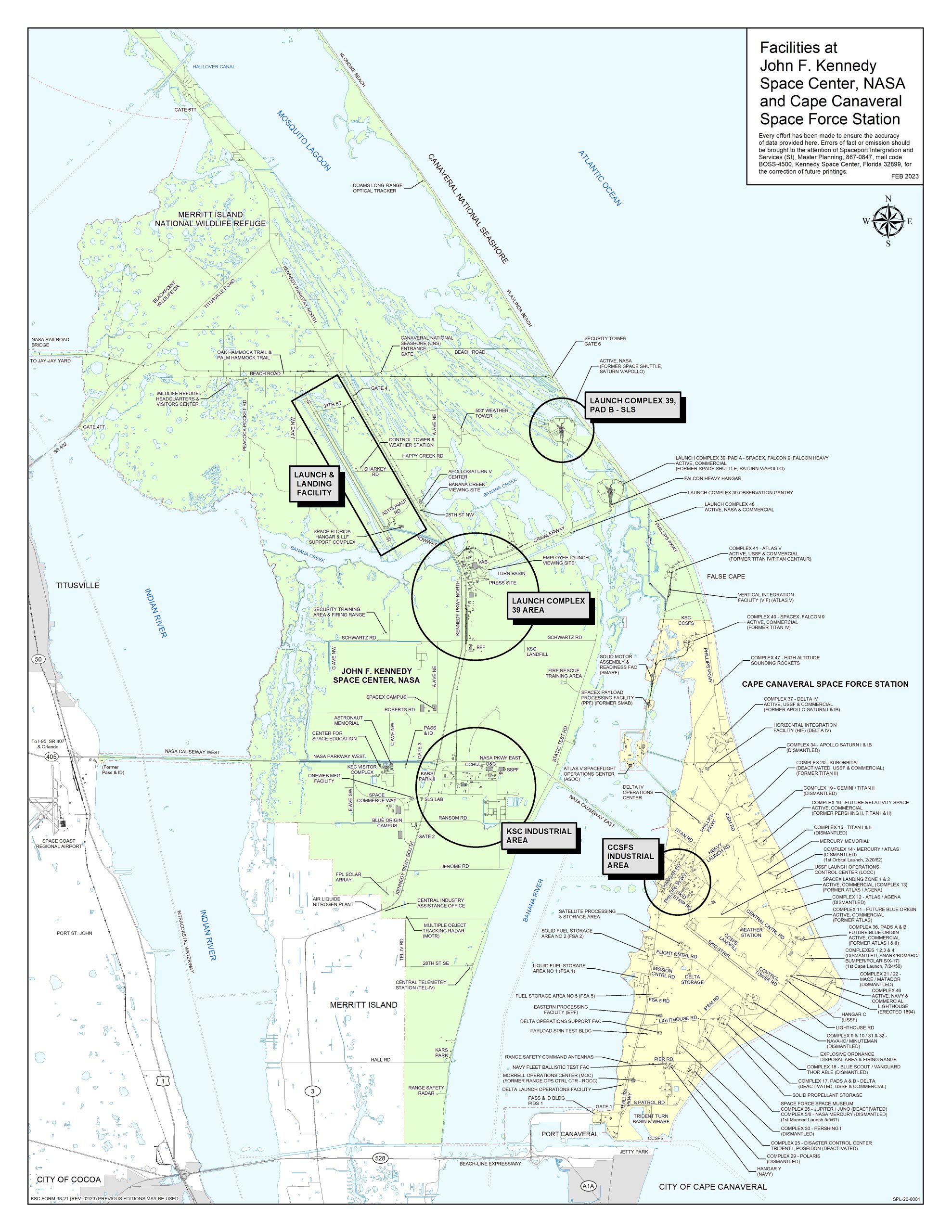
The general location of the wildfire in Merritt Island National Wildlife Refuge. Graphic: original map is from the 2021 KSC Facilities Map, NASA
12 PM EDT, Sunday: Beach Road Open, Fire Seems To Be Dwindling
From a distance and to the uneducated naked eye, the wildfire is now starting to burn itself out, especially on its northern edges. Still far away from operational KSC facilities and buildings, no flames could be seen from Beach Road or US-1 in Titusville, which is very different than twelve hours earlier.
That does not mean that the fire is no longer any danger — a change in weather conditions or wind direction and speeds could fan the flames. Stay tuned to local authorities for official status updates. We will pass them along as soon as we receive them.
1 PM Sunday, May 26: As seen from US-1 in Titusville, a perspective of the wildfire in MINWR: it is far away from any launch pad or KSC buildings, with the closest operational area of the space center being the Shuttle Landing Facility, but even that is at least two miles east. Click to enlarge Photo: Charles Boyer / Talk of Titusville12PM Sunday, May 26: a fire hotspot as seen across the Indian River from Titusville. Photo: Charles Boyer / ToT
11 PM EDT, Saturday: KSC Closes Beach Road
Around 11 PM EDT, KSC Police were emptying MINWR and were stopping people at the end of Max Brewer Bridge. KSC Police asked me to leave, and that’s exactly what I immediately did: I skedaddled.
Closeup of the fire line near Beach Road Saturday night. Photo: Charles Boyer / Talk of TitusvilleA waning moon rises over Beach Road through the smoke from wildfire in Merritt Island National Wildlife Refuge Saturday night. Photo: Charles Boyer / Talk of TitusvilleCloseup of the blaze. Photo: Charles Boyer / ToT
7 PM EDT, Saturday: Fire Is Spreading
Late afternoon wildfire scene in Merritt Island Wildlife Refuge. Photo: Charles Boyer / Talk of TitusvillePhoto: Charles Boyer / Talk of TitusvillePhoto: Charles Boyer / Talk of Titusville


You must be logged in to post a comment.