SpaceX Falcon 9 carrying Northrup Grumman NG-20 Cygnus launches from Pad SLC-40 at Cape Canaveral on January 30, 2024 Photo: Charles Boyer / Talk of Titusville
SpaceX launched a Falcon 9 carrying the Northrup Grumman NG-20 mission towards ISS this afternoon. The launch was at 12:07 PM EST from the company’s launch pad at SLC-40 at Cape Canaveral Space Force Station, and once it had completed its part of the mission, Booster 1077 completed its tenth flight when it safely touched down at Landing Zone 1, about 5.6 miles to the south of where it launched a little more than eight minutes earlier.
A previous Cygnus space craft in the grasp of ISS’s Canadarm2. Photo: NASA
Today’s launch was the first of three that Northrup Grumman has contracted with SpaceX, and is the twentieth ISS resupply mission that the company has flown. According to NASA, the Cygnus cargo spacecraft is carrying 3,017 pounds of experiments, 2,493 pounds of hardware, 2,490 pounds of crew supplies, 149 pounds of computer resources and 35 pounds of spacewalk equipment.
SpaceX Performs Late-Load For First Time
Some of that cargo was loaded in the past 24 hours — foodstuffs (ice cream for the astronauts is rumored to be that portion of the payload) as well as some of the materials for science experiments required a “late-load,” which is a new capability for SpaceX that necessitated a one-delay from the initial planned launch date of January 29.
“We’re going to do a late-load activity into the Cygnus vehicle [so] we modified the fairing that’s the covering that goes on the outside of the Falcon rocket to include a 5-foot by 4-foot wide door. It essentially allows us to enter into the fairing area and put late-load car cargo in,” William Gerstenmaier, SpaceX’s vice president ofBuild and Flight Reliability, said in a news conference on January 26th.
Booster B1077 descending towards its landing on Tuesday January 30, 2024 Photo: Charles Boyer / Talk of Titusville
Cygnus is expected to arrive at the International Space Station, where it will be docked to the orbiting facility’s Unity module by astronaut Jasmin Moghbeli.
Arrival At Space Station Will Be On Thursday
Now in orbit, the Cygnus cargo spacecraft will arrive at the International astronaut Jasmin Moghbeli will grapple it using ISS’s Canadarm 2 robotic arm, and the crew will then dock Cygnus to the Unity module. Following some normal checkouts, later, astronauts will then open the hatch to Cygnus and will begin to unload the cargo within the spacecraft.
The Cygus spacecraft is expected to stay at the International Space Station for up to six months. The spacecraft may perform additional services such as reboosting the station’s orbit to counteract atmospheric drag. Northrop Grumman’s Cygnus provides the only U.S. spacecraft reboost capability for the International Space Station.
More Photos
Liftoff As Seen Around The Space Coast
Click on the photo to see it full size on your device.
Falcon 9 in flight as it approaches the speed of sound. Photo: Richard Gallagher / Florida Media NowFalcon 9 lifting off from SLC-40 in Cape Canaveral. Photo: Charles Boyer / Talk of TitusvilleA vapor cone at the top of Falcon 9 caused by adiabatic cooling. Photo: Richard Gallagher / Florida Media NowLiftoff of Falcon 9 as seen from the NASA Press Site. Photo: Richard Gallagher, Florida Media NowA “light-saber” timelapse of Falcon 9’s liftoff. Photo: Chris Leymarie, Florida Media NowFalcon 9 touching down at Landing Zone 1. Photo: Ed Cordero, Florida Media NowFalcon 9 lifts off, as seen from the NASA Press Site. Photo: Charles Boyer, Talk of TitusvilleBooster 1077 descending towards landing, as seen from NASA Press Site. Photo: Charles Boyer, Talk of TitusvilleFalcon 9 lifts off. As seen from SLC-40, Charles Boyer, Talk of TitusvilleFalcon 9 lifts off. As seen from KARS Park. Photo: Ed Cordero, Florida Media NowBooster 1077 descending in freefall. Photo: Ed Cordero, Florida Media NowBooster 1077’s landing burn at LZ-1. Photo: Ed Cordero, Florida Media Now
The US Space Force’s 45th Weather Squadron has released their Mission Execution Forecast for tomorrow’s planned launch of a SpaceX Falcon 9 carrying NG’s Cygnus cargo craft towards the International Space Station. They are predicting nearly ideal conditions, with only a 5% chance of a Probability of Violation, meaning they expect a 95% chance of acceptable weather conditions.
The 01/29/2024 forecast from the 45th Weather Squadron. Courtesy US Space Force
Launch Time & Location
The NG-20 mission will launch from SpaceX’s launch pad at SLC-40 at Cape Canaveral Space Force Station. The launch time is an instantaneous window 12:07 PM EST. If for some reason the launch is delayed, there is a backup launch opportunity available on Thursday, February 1 at 11:18 a.m. ET.
Launch Trajectory
Falcon 9 will travel to the northeast, on a 51.2281˚inclination.
Sonic Boom Alert!
NG-20 is an RTLS mission, meaning the booster will return to Cape Canaveral 8.25 minutes after liftoff. As with all RTLS launches, a loud sonic boom will be heard across the Space Coast.
Graphic: Wave pressure at a distance of 5 miles (8.05 km). Via Acoustical Society of America.
Launch Viewing
Banana River Bridge
For unobstructed views of the liftoff and landing, the Banana River Bridge on FL 528 (aka The Beachline, and sometimes erroneously called A1A) is your best bet.
Basic Overview
Launch View
View from the Banana River Bridge. Photo: Charles Boyer
Landing View
View of Booster Landing From Banana River Bridge Photo: Charles Boyer / Talk of Titusville
Jetty Park
Jetty Park offers a closer view of the returning booster and landing, but it has an occluded view of the launch.
Jetty Park is located at 100 Jetty Park Rd, Port Canaveral, FL 32920.
Others
Playalinda Beach in the Cape Canaveral National Seashore will likely be open for this launch. It is quite far from the launch and landing, but you should still get some great views.
Parks along US1 In Titusville are further away from the action as well, but especially in the southern end of town, for example at Kennedy Point Park, good views are available.
Cocoa Beach also will have some good views of the rocket flight, but you are not going to see the liftoff and perhaps the landing burns. You will definitely feel the sonic boom, however!
Partial timelapse of Falcon 9’s flight path from Pad LC-39A at Kennedy Space Center on January 28, 2024 as seen from Rotary Park in Titusville. Photo: Charles Boyer / Talk of Titusville
SpaceX launched 23 Starlink satellites for their orbital-based Internet service tonight from Cape Canaveral aboard a Falcon 9 booster. Liftoff was at 8:10 PM EST from Pad LC-39A at Kennedy Space Center. Roughly eight-and-a -half minutes after liftoff, Booster B1062 touched down safely near the Bahamas completed its work for the evening. Simultaneously, the second stage continued to carry the company’s payload to orbit, which it achieved successfully at about the same time the first stage booster was touching down.
Booster B1062 late in its 18th flight. Photo: Ed Cordero / Florida Media Now
Mission Trajectory
Tonight’s launch was to the southeast, as has been customary with other launches of the Group 6 batch of Starlink satellites.
18th Flight for Booster B1062
Tonight’s flight was the16th flight for the first stage booster B1062.
It previously launched CRS-22, Crew-3, Turksat 5B, Crew-4, CRS-25, Eutelsat HOTBIRD 13G, mPOWER-a, PSN SATRIA, and seven Starlink missions. Following stage separation, the first stage landed on the autonomous spaceport drone ship (ASDS) A Shortfall of Gravitas droneship, stationed in the Atlantic Ocean northeast of the Bahamas.
The booster will be returned to Port Canaveral and then transferred to SpaceX’s Hangar X facility at Kennedy Space Center for inspect and ostensibly re-use on a future mission.
Next Launch
On Tuesday, January 30th SpaceX will launch Northrup-Grumman’s Cygnus CRS-2 towards the International Space Station aboard a Falcon 9. This launch will be the 20th resupply mission carried out as part of NG’s Commercial Resupply contract with NASA, and will ferry supplies for the station’s crew, equipment, as well as new scientific experiments to the orbiting outpost.
The launch of Northrup-Grumman’s Cygnus NG-20 has been delayed until Tuesday, January 30th at 12:07 PM EST.
William Gerstenmaier, SpaceX’s vice president ofBuild and Flight Reliability, said in a news conference on January 26th that, “it’s taken a lot of modifications on our part to get this hardware ready to go fly, and we want to make sure it goes right. We think it is good to delay a little bit and make sure we get all this activity right and we’re ready to get this cargo inserted into Cygnus and get ready to fly on Tuesday.”
The launch is scheduled for 12:07 PM EST with an instantaneous window from Cape Canaveral’s SLC-40. Approximately eight minutes after launching, the booster used for this mission will return to the Cape to land at LZ-1, SpaceX’s landing facility located about 5.6 miles to the south of the launch pad. For more information about Cygnus and its cargo, see our original article regarding the launch here.
The Northrop Grumman Cygnus spacecraft’s pressurized cargo module (PCM) for the company’s 20th commercial resupply mission is lifted and moved by crane inside the high bay in the Space Station Processing Facility at NASA’s Kennedy Space Center in Florida on Monday, Sept. 18, 2023. The next step is vehicle processing for the mission to the International Space Station. Liftoff, aboard a SpaceX Falcon 9 rocket, will be from Cape Canaveral Space Force Station’s Space Launch Complex 40. Photo: NASA
Northrup-Grumman’s Cygnus CRS-2 will will be the 20th resupply mission carried out as part of NG’s Commercial Resupply contract with NASA, and will ferry supplies for the station’s crew, equipment, as well as new scientific experiments to the orbiting outpost.
After having flown on Atlas V and their Antares booster, Northrup Grumman is launching on a SpaceX rocket for the first time, and to launch the voluminous Cygnus spacecraft, SpaceX has been required to make some changes to Falcon 9 fairings and launch equipment. In order to be sure that those changes were completed correctly, the company delayed the launch by at least one day.
SpaceX Modifications To Launch Cygnus
“We’re completing some modifications to the launchpad to to get it ready to to go fly. We still have quite a bit of work in front of us,” Gerstenmaier said on Friday.
After having flown on Atlas V and their Antares booster, Northrup Grumman is launching on a SpaceX rocket for the first time, and to launch the voluminous Cygnus spacecraft, SpaceX has been required to make some changes to Falcon 9 fairings and launch equipment. In order to be sure that those changes were completed correctly, SpaceX delayed the launch by at least one day.
“We’re going to do a late-load activity into the Cygnus vehicle [so] we modified the fairing that’s the covering that goes on the outside of the Falcon rocket to include a 5-foot by 4-foot wide door. It essentially allows us to enter into the fairing area and put late-load car cargo in,” Gerstenmaier said.
He then continued, “Some of [the payload’s components] are going to be delivered in this late-load cargo that goes through this new hatch we put in place. It’s it’s more than just a hatch, actually, we have an environmentally controlled area so we don’t bring any kind of debris or contamination in.”
SpaceX has added clean-room facilities to accommodate those requirements, in addition to the fairing modifications that Gerstenmaier mentions above. That said, it is understandable why the company wants to ensure that it completes every item remaining on its checklist for releasing those modifications to an actual flight without the pressure of a looming launch deadline.
“The front part of Cygnus is very sensitive as it bursts to station,” Gerstenmaier said. “There’s some rings that seal it to [the] space station. We cannot contaminate those rings, we have to make sure that the cargo is delivered safely through this door into the fairing and then carefully placed inside Cygnus for launch, so that’s a pretty intense activity this will be the first time we’ve done that.”
“It’s taken a lot of modifications on our part to get this hardware ready to go fly we want to make sure it’s right, so we think it’s it’s good to delay a little bit and make sure that we get all this activity right, and we’re ready to get this cargo safely inserted into Cygnus and get it ready to fly on Tuesday,” Gerstenmaier concluded.
Northrup-Grumman’s Booster Issues
Initially, the Commercial Resupply Services contract that NG is fulfilling was by Orbital Sciences, then Orbital-ATK after a merger, and finally Northrup Grumman when it acquired Orbital-ATK. With the CRS contract, Northrup Grumman inherited the Antares series of boosters, with the last flight of Antares being on August 1, 2023.
An Orbital Sciences Corporation Antares rocket is seen on launch Pad-0A at NASA’s Wallops Flight Facility, Monday, January 6, 2014 in advance of the launch on Thursday, January 9th. Photo: NASA
After retiring the Antares series due to supply issues — the first stage was manufactured by Ukrainian companies Yuzhnoye and Yuzhmash, and Russian firm NPO Energomash manufactured the booster’s two RD-181 engines — Northrop announced that it would develop a new first stage and engines for the Antares launch vehicle in a collaboration with Cedar Park, Texas-based Firefly Aerospace. The new rocket has been dubbed Antares-330 and is now expected to first fly in 2025.
The Tuesday launch will be the first of three contracted with SpaceX to launch Cygnus.
Falcon 9 carrying Starlink satellites lifts off from KSC Pad LC-39A on June 17, 2022. This was the view from Playalinda Beach. Photo: Charles Boyer / Talk of Titusville
SpaceX will send another batch of Starlink satellites to orbit this Sunday evening when it launches a Falcon 9 from Pad LC-39A at Kennedy Space Center to orbit on a mission designated as Starlink-6-38. After completing the initial boost of the payload, the booster used for this flight will touch down on the company’s automated automated spaceport drone-ship (ASDS) “A Shortfall of Gravitas.” The launch window opens at 6:15 PM EST and lasts until 9:55 EST.
Jellyfish Possible?
A small jellyfish with an anticrepuscular shadow from a launch in 2023. Photo: Charles Boyer / Talk of Titusville
The sun will set at 5:53 PM EST on Sunday, giving this launch the potential for a “jellyfish” over the skies after staging if it launches at or near the opening of the launch window at 6:15 PM.
The general weather forecast for the Space Coast on Sunday calls for rain showers early with some sunshine later in the day. Should skies clear in time over the launch corridor, a vivid view of staging may be visible.
Launch Viewing
This launch is from the north end of the Eastern Range, specifically from Pad LC-39A at Kennedy Space Center. The best views of the launch for the general public will be from one of Titusville’s parks on US-1, or from the Max Brewer Bridge off of US-1 on SR 406.
Currently, Playalinda Beach is open from 6am – 6pm EST, and with the launch window being just outside those hours, it is unlikely that they will be open to visitors for the launch. Interested persons can call the Canaveral National Seashore offices at 386-428-3384 x0 for the latest information.
Trajectory
As is customary for Starlink Group 6 launches, a trajectory to the southeast is planned. The booster will touch down offshore in the Atlantic Ocean northeast of the Bahamas.
Booster
SpaceX has not announced which booster will be used for this flight as of yet (Friday, January 6, 2024). We will add that information here when it is made available.
Launch Coverage
SpaceX will begin live-streaming the launch on their X account about five minutes before liftoff.
Spaceflight Now usually begins their live coverage about one hour prior to liftoff on their YouTube channel.
HAM Radio
For those with the right equipment, launch updates and live coverage can be found on the following frequencies via the N1KSC 70cm repeater
444.925 MHz Rx (standard +5 MHz Tx offset)
Analog FM 131.8 tone (in/out) / Digital P25 NAC:A55
Atlas V carrying Boeing’s CST-100 Starliner lifts off on the uncrewed OFT-2 mission on May 19, 2023 Photo: Charles Boyer / Talk of Titusville
NASA and Boeing are working to perform final analysis of recent test data from fixes identified during the CST-100 Starliner commercial crew vehicle certification process, and the agency and company are on track to complete overall system certification ahead of Starliner’s first crewed flight planned for no earlier than April 2024.
The Crew Flight Test will carry NASA astronauts Butch Wilmore and Suni Williams to ISS for a 7-14 day stay, after which Starliner will detach from the orbiting laboratory in order to return to Earth in New Mexico at the White Sands Space Harbor, near the U.S. Army’s White Sands Missile Range.
Starliner Crew Suni Williams and Butch Williams at KSC in 2022. photo: NASA
Updates To Parachutes and Risky Tape Used Inside Starliner
Recent modifications to Starliner’s parachute system were validated in a drop-test conducted at the U.S. Army’s Yuma Proving Ground on January 9, 2024.
A NASA C-130 cargo aircraft releases a dart-shaped test vehicle above the U.S. Army’s Yuma Proving Ground on Jan. 9 to begin the testing sequence for a Boeing Starliner parachute system. Photo Credit: U.S. Army Yuma Proving Ground
Boeing has also addressed concerns about the flammability of P-213 glass cloth tape that is wrapped around wiring harnesses throughout the vehicle inside the Starliner capsule and removed about 4,300 feet of the material in order to reduce a fire hazard inside the capsule.
P-213 tape. Under certain conditions, this material may have presented a fire hazard inside Starliner.
NASA also stated that it has worked to “clarify the properties and safe usage guidance relative to P213 tape in the NASA Materials Usage Agreements database to prevent a similar misapplication from occurring across industry in the future.
Other Tests Underway
According to NASA, “major integrated flight operations exercises are underway. Mission support teams recently completed a two-day undock to landing mission dress rehearsal with recovery personnel on the ground at White Sands Missile Range in New Mexico. Teams simulated Crew Flight Test procedures and spacecraft sequences starting with pre-undock powerup and continuing through undock, entry, landing, and crew recovery. The exercise provided an additional training opportunity for NASA and Boeing to practice Starliner’s return to Earth in a high-fidelity environment before the flight.”
Remaining Work To Complete Before Starliner Launch
Boeing is planning to complete Starliner’s assembly by the end of January, or about one week away. Following the completion of that work, United Launch Alliance and Boeing can work to integrate the completed vehicle to its ride in space, an Atlas V N22.
NASA released a list of activities remaining to be completed successfully prior to the Crewed Flight Test of Starliner on January 24, 2024:
work to complete overall Crew Flight Test certification (6-8 weeks)
put the finishing touches on the Starliner spacecraft, which is already joined to its service module;
run simulations of operational conditions to rehearse every phase of the mission with the crew, flight controllers, and ground operations teams;
fuel the spacecraft with propellants for its onboard thrusters for in-space maneuvering;
stack the ULA Atlas V rocket and Starliner spacecraft before rolling them to the pad at Space Launch Complex-41 at Cape Canaveral Space Force Station in Florida;
and work through detailed systems reviews, culminating with a flight readiness review in the days before launch to verify the system and teams are ready.
A Northrup Grumman Cygnus at the International Space Station Photo courtesy of Northrup Grumman
On Monday, January 29th, update: Tuesday, January 30th SpaceX will launch Northrup-Grumman’s Cygnus CRS-2 towards the International Space Station aboard a Falcon 9. This launch will be the 20th resupply mission carried out as part of NG’s Commercial Resupply contract with NASA, and will ferry supplies for the station’s crew, equipment, as well as new scientific experiments to the orbiting outpost.
The launch is scheduled for 12:07 PM EST with an instantaneous window from Cape Canaveral’s SLC-40. Approximately eight minutes after launching, the booster used for this mission will return to the Cape to land at LZ-1, SpaceX’s landing facility located about 5.6 miles to the south of the launch pad.
The Northrop Grumman Cygnus spacecraft’s pressurized cargo module (PCM) for the company’s 20th commercial resupply mission is lifted and moved by crane inside the high bay in the Space Station Processing Facility at NASA’s Kennedy Space Center in Florida on Monday, Sept. 18, 2023. Photo: NASA
With a capacity of about 5,000 kg, Cygnus is a pressurized multi-purpose logistics module with about 36 cubic meters of interior volume that can be loaded with supplies. Cygnus is compatible with multiple launch vehicles including Northrop Grumman’s Antares 330 and Medium Launch Vehicle (MLV) currently in development, and has launched on ULA’s Atlas V, Antares vehicles and SpaceX’s Falcon 9. The module is also capable of reboosting the ISS to a higher orbit, but it is not known at this time if that capability will be utilized by NG-20.
Experiments Aboard NG-20
NASA released information regarding the experiments that will be aboard Cygnus for ISS astronauts to perform:
MABL-A, Role of Mesenchymal Stem Cells in Microgravity Induced Bone Loss, Part A: This experiment aims to study the role of mesenchymal stem cells in microgravity-induced bone loss. The results could provide a better understanding of the basic molecular mechanisms of bone loss caused by spaceflight and normal aging on Earth.
APEX-10, Advanced Plant Experiment-10: This experiment will study plant-microbe interactions in space, which may support steps to optimize these beneficial interactions to increase plant productivity on Earth as well as in space.
BRIC-25, Biological Research in Canisters-25: This experiment studies how microgravity affects Staphylococcus aureus, a common and concerning bacterium. The knowledge gained from this experiment could not only safeguard astronauts’ health but also improve our understanding of bacterial adaptations on Earth.
Flight Trajectory
The flight trajectory for the NG-20 mission is to the northeast. The booster will travel southwest to return to the landing zone at Cape Canaveral.
Booster 1077 History
Booster B1077 will fly its tenth mission for this flight. B1077 has successfully completed nine previous launches and landings, and was first used for the Crew-5 mission.
“[NASA] currently [does] not have any activities underway at LC-49.”
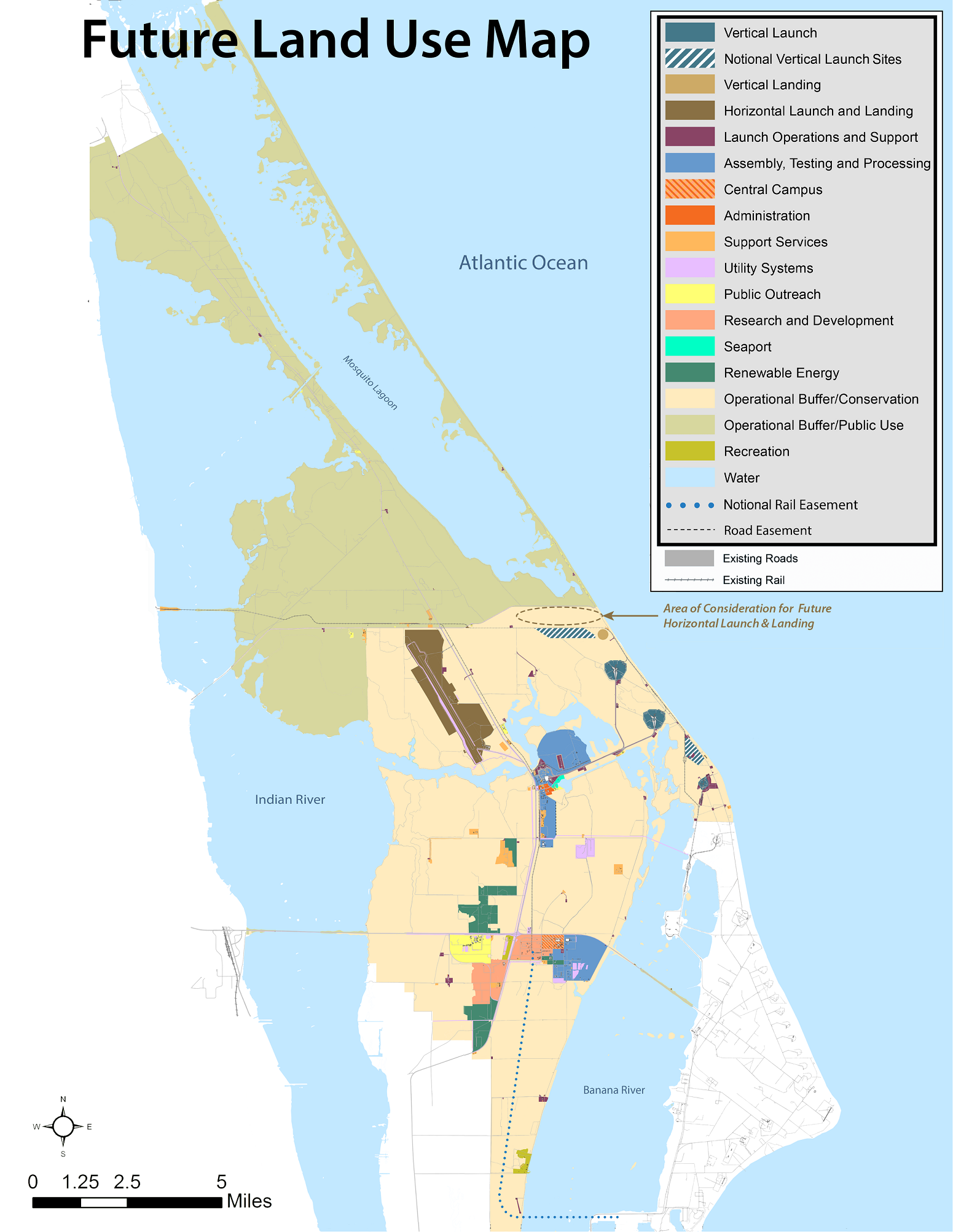
For many years, NASA has had a potential new launch pad on its Master Plan for Kennedy Space Center: LC-49 is projected to be built on the northern end of KSC property near its border with the Merritt Island National Wildlife Refuge.
There is also an LC-48 on the slate, located between the current LC-39A (Falcon 9, Falcon Heavy) and SLC-41 (Atlas/Vulcan) but it has not received the same amount of mention in the space community, nor the same amount of concern among some local residents as the potential LC-49.
Kennedy’s Master Plan
“One potential new vertical launch area, Launch Pad 49, could be sited to the north of Pad 39B. This location avoids overflight issues with Pad 39B and minimizes conflict with the Canaveral National Seashore, giving potential non-NASA entities a flexible set of operational options. In addition, Pad 49 could use Beach Road as an access road, allowing for more autonomous operations and the option to operate outside of KSC’s secured area.”
Annotated map from Kennedy Space Center’s Master Plan. Talk of Titusville added location names in order to clarify the geographical locations shown on this map. Map: NASA Future Land Use Map (FLUM) Retrieved 08/21/22
This has been on the site’s master plan in one form or another, dating back to the 1960s, and speculation of the potential of a new pad being built has risen lately due to SpaceX’s Starship due to come online in the near term.
1967 Plans for Pads LC-39C and LC-39D Drawing 68-DE-FAC-11 / NASA
“[Kennedy Space Center] announced last week that it was starting the process of an environmental review of the proposed Launch Complex (LC) 49 in response to an inquiry from SpaceX. The center did not disclose a timeline for conducting the review but said it would precede any agreement with SpaceX to develop the site.
“Launch Complex 49 is located to the northwest of Launch Complex 39B, the former Apollo and shuttle launch pad that will be used by the Space Launch System. The site was originally reserved in the 1960s for Launch Complex 39C but never developed.”
SpaceX Starship Facility at LC-39A
In 2021, SpaceX began building a launch tower for its future Starship operations at the Cape, but it appears that the company has taken a pause in constructing that launch tower, ostensibly to focus on completing Starship development, which will almost certainly inform the final design and construction of the new tower.
SpaceX Starship tower under construction in August 2022. At the time, construction cranes and other equipment were present at the site. LC-39A’s main tower is the the right, the VAB in the background left. Photo: Charles Boyer, Talk of Titusville
Given SpaceX’s iterative development method that makes a lot of sense and should not necessarily be considered a sign that they are abandoning any plans to complete the new pad next to LC-39A. The company has not made any public statement regarding the half-finished pad, and while work has apparently slowed on the structure, there is no sign of it being dismantled either.
SpaceX has made extensive changes to a similar launch pad at their Boca Chica orbital launch pad in recent months, so it makes sense to expect they will want to do the same to the pad at the Cape — when they are ready to bring Starship operations here to the Space Coast and the Eastern Range. That is speculation, however, and should be considered as such until concrete evidence of its accuracy is confirmed or disproven.
But What About LC-49?
Vicinity of LC-49 in 2021. NASA’s official caption for the photo reads “A view of a proposed new launch site, Launch Complex 49, on Dec. 20, 2021, at NASA’s Kennedy Space Center in Florida. In response to an inquiry from SpaceX, NASA is preparing to conduct environmental assessments to develop the proposed launch site. The 175-acre site, located north of Launch Complex 39B within the center’s security perimeter, would support the launch and landing of SpaceX’s Starship and Super Heavy launch vehicle. NASA and SpaceX are moving forward with the initial environmental assessment before concluding a potential agreement to develop the property.” Photo NASA, KSC-20211220-PH-KLS01_0002
At the same time, that apparent pause at LC-39A does not fully address LC-49. Talk of Titusville reached out to NASA to find out what progress is being made towards LC-49 actually being built in the relatively near future. Given that previous reports indicated that an environmental study was underway in 2021, it seems sensible that those studies would be complete or nearly so in 2024. They replied to us on January 18, 2024 and said that “[NASA] currently [does] not have any activities underway at LC-49.”
NASA added that, “all previous activities there have been suspended, including anything involving any commercial companies. We’re not currently working any NEPA or environmental actions. KSC did complete an environmental assessment in 2018-19 for the development and operations of the site, which included the construction of the existing launch pad.”
That “existing launch pad” they are referring to is almost certainly the new Starship launch pad referred to above, and that pad will not be completed for some time.
Good News For Titusville Residents and Visitors
This is likely going to be welcome news for Titusville residents. Were LC-49 built in the area planned for in the NASA Future Land Use Map (FLUM), once operational, it would likely cause repeated closings of Beach Road leading to Playalinda Beach, meaning that local beachgoers would have no route to the undeveloped beach areas located there. That is because at some points on Beach Road, an LC-49 could be as little as one mile away.
Beach Road and an LC-49 are relatively close together.
Those closures would come during fueling tests, static fires and launch activities due to Beach Road’s proximity to the LC-49 complex. Playalinda Beach is already often closed by KSC Police and the National Park Service for many launches from LC-39A and LC-39B, due to safety and security concerns during launch operations. LC-49 would result in much the same, and given SpaceX’s plans for a high cadence of Starship launches for Artemis and other commercial activities, those closures may have become a major inconvenience for residents and tourists alike.
With an estimated 1.5 – 2.0 million visitors a year, the Cape Canaveral National Seashore incorporates Playalinda Beach in its southern section as well as others (Apollo Beach) to the north. It is a major source of tourism dollars for Titusville, and it is the only beach available to local residents between Cape Canaveral’s Jetty Park and Apollo Beach in New Smyrna. In 1962, Titusville Beach was absorbed into Kennedy Space Center, leaving Playalinda, in the Merritt Island National Wildlife Refuge.
According to NASA’s statement that no activities are ongoing to build the new pad, there is little reason to worry about this happening any time in the near future.
Artist’s rendering of Astrobotics’ Peregrine Lander of the lunar surface. Courtesy of Astrobotics
Astrobotic’s Peregrine Mission One splashed down in the South Pacific yesterday around 4:04 pm local time on January 18th, completing its trip to space after launching from Cape Canaveral on January 8, 2024.
Peregrine Mission One has concluded. We look to the future and our next mission to the Moon, Griffin Mission One. All of the hard-earned experience from the past 10 days in space along with the preceding years of designing, building, and testing Peregrine will directly inform Griffin and our future missions.
Peregrine and its payload teams have made a meaningful contribution to our lunar future, and we thank everyone who supported this mission. Courtesy of United Launch Alliance, this video was captured from their Vulcan rocket’s payload fairing.
Peregrine has flown so Griffin may land.
Astrobotic: Final Update for Peregrine Mission
Great Start
Peregrine enjoyed a perfect ride to space on board United Launch Alliance’s Vulcan rocket making its maiden voyage on January 8th. That launch was deemed a success after what ULA CEO Tory Bruno labeled as a “Bullseye” launch that ended nearly precisely in its intended orbital altitude, inclination and speed.
ULA graphic stating Vulcan launch of Peregrine and other payloads aboard CERT-1 were placed in their intended positions in space. Chart: United Launch Alliance
Shortly after being placed in orbit, communications with Peregrine was established by Astrobotic, and the spacecraft was sent on its course to the moon. Not long after that, Peregrine’s problems began. Those problems precluded completing the primary mission of a soft lunar landing, and instead, Astrobotics salvaged what science they could from the mission and prepared for an eventual conclusion.
Falcon 9 lifting off carrying four European astronauts to the International Space Station on January 18, 2024.
Minutes before a warm front brought heavy showers to Kennedy Space Center, SpaceX launched Crew Dragon aboard a Falcon 9 for Axiom Space on a chartered flight to the International Space Station at 4:49 PM EST this evening. The all-European crew is expected to dock at ISS in two days time, and stay aboard the station until February 3, 2024.


You must be logged in to post a comment.