JPL

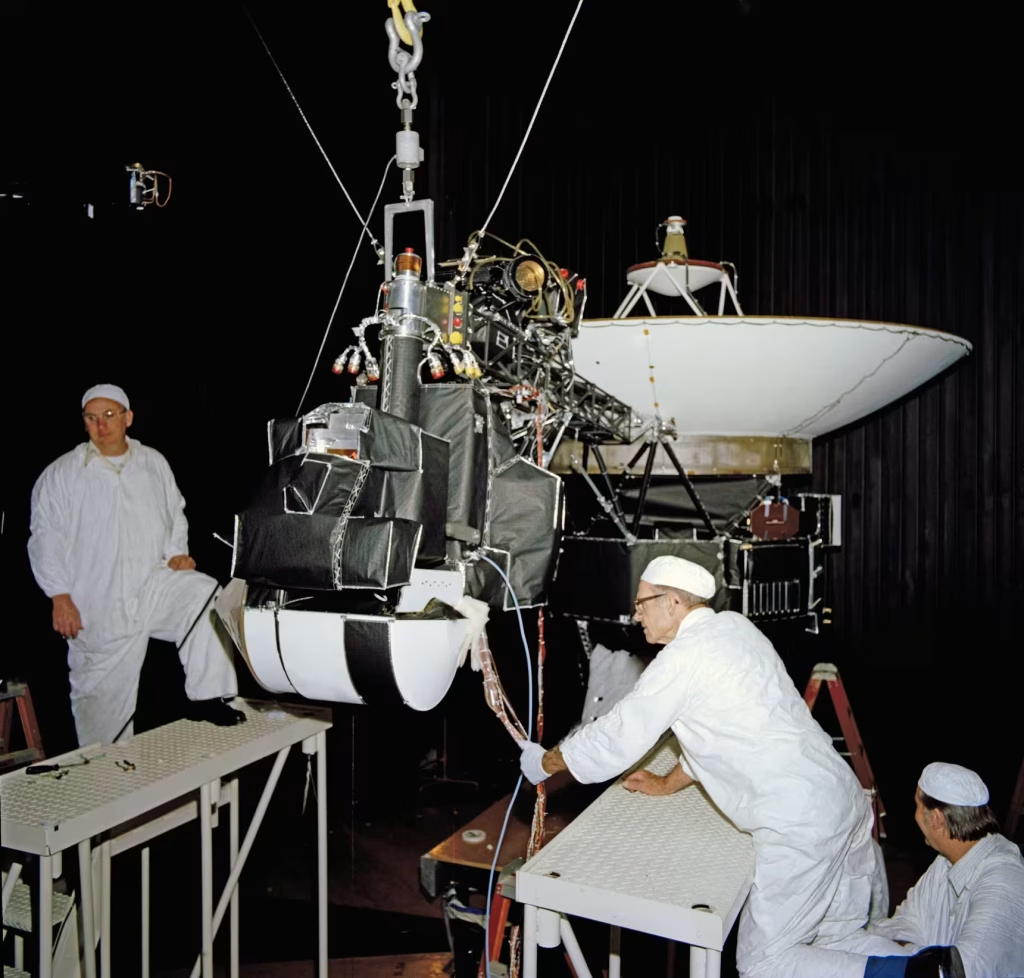
Voyager 1 undergoing testing before launch at NASA’s Jet Propulsion Laboratory in Pasadena, Calif., on April 27, 1977.
Photo: NASA / JPL

According to NASA and the Jet Propulsion Laboratory, Voyager 1, one of humanity’s two probes in interstellar space, has resumed sending engineering data back to Earth.

Last November, Voyager 1 stopped sending readable science and engineering data back to Earth, halting ongoing measurements and investigations. Mission controllers could tell the spacecraft was still receiving their commands and otherwise operating normally but could not do much else, leaving mission managers and engineers scrambling to assemble a team to fix the aging spacecraft.

According to a press release from JPL and NASA, “In March, the Voyager engineering team at NASA’s Jet Propulsion Laboratory in Southern California confirmed that the issue was tied to one of the spacecraft’s three onboard computers, called the flight data subsystem (FDS). The FDS is responsible for packaging the science and engineering data before it’s sent to Earth.”

“The team discovered that a single chip responsible for storing a portion of the FDS memory — including some of the FDS computer’s software code — isn’t working. The loss of that code rendered the science and engineering data unusable. Unable to repair the chip, the team decided to place the affected code elsewhere in the FDS memory. But no single location is large enough to hold the section of code in its entirety.”

In this illustration oriented along the ecliptic plane, NASA’s Hubble Space Telescope looks along the paths of NASA’s Voyager 1 and 2 spacecraft as they journey through the solar system and into interstellar space. Hubble is gazing at two sight lines (the twin cone-shaped features) along each spacecraft’s path. The telescope’s goal is to help astronomers map interstellar structure along each spacecraft’s star-bound route. Each sight line stretches several light-years to nearby stars.
NASA, ESA, and Z. Levay (STScI)

They continued by saying, “[T]hey devised a plan to divide affected the code into sections and store those sections in different places in the FDS. To make this plan work, they also needed to adjust those code sections to ensure, for example, that they all still function as a whole. Any references to the location of that code in other parts of the FDS memory needed to be updated as well.”

Brilliant computer science work that was, especially for a vehicle about 15.12 billion miles from Earth, traveling at 38,026 miles per hour. Currently, it takes roughly 22.5 hours for a signal to travel from Voyager 1 to Earth (and vice versa), creating a major challenge in communications.

Voyager 1 Launch on September 5, 1977

The narrow bandwidth further complicates those communications: about 40 bits per second for engineering data, or roughly five alphanumeric characters each second. By comparison, the median Internet speed in the US is 242.38 Megabits per second, or 30.2 million characters.

In the next few weeks, the Voyager 1 team plans to relocate and adjust the affected portions of the FDS software including portions that will start returning science data. Meanwhile, Voyager 1 will continue to travel away from the Earth.

Read more

A towering dust devil casts a serpentine shadow over the Martian surface in this image from NASA Mars Reconnaissance Orbiter. The scene is a late-spring afternoon in the Amazonis Planitia region of northern Mars.
Photo: NASA / JPL

NASA’s ambitious Mars Sample Return program, which plans to land on the Martian surface, collect rock and dust samples, and return them to Earth has been delayed and will be revised due to its high costs and long lead times.

Mars Sample Return is the highest priority solar system exploration goals identified by the National Academies of Sciences, Engineering and Medicine in the past three decadal surveys, but technical capability, costs and funding have stopped the mission short of execution.

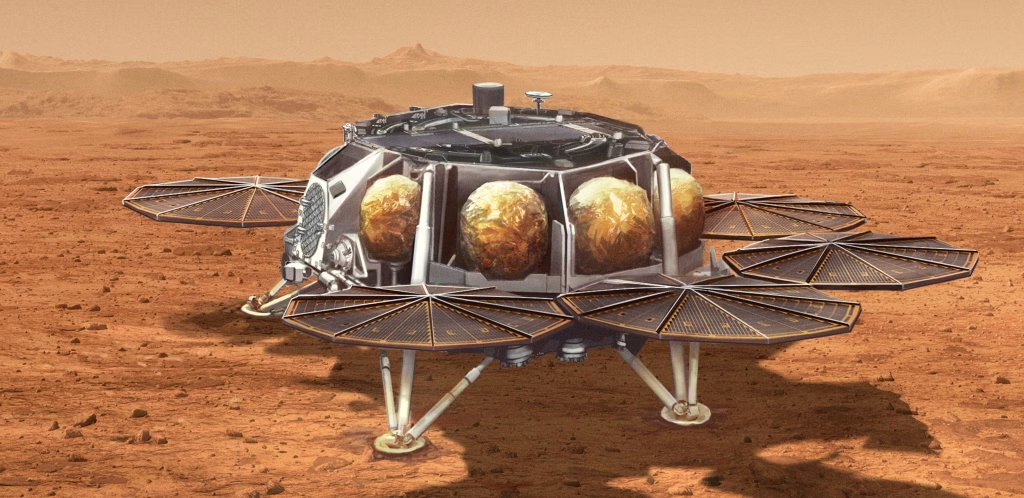
Artist’s concept of what the Mars Sample Return lander might look like.
Graphic: NASA / JPL

Changes Made, In Short

“An $11 billion budget is too expensive, and a 2040 return date is too far away,” NASA Administrator Bill Nelson said today.

NASA has asked the Jet Propulsion Laboratory to create an updated mission design that “has reduced complexity, improve resiliency and risk posture, and well as well as strong accountability and coordination,” sad Nicola “Nicky” Fox, associate administrator for NASA’s Science Mission Directorate today in a NASA press conference.

Original outline of the MSR Program
Graphic: NASA

“NASA SMD will release a competitive solicitation in the immediate future for funded industry studies to investigate either 1) innovative and alternate MSR architectures or 2) innovative and alternate architecture elements, such as a smaller Mars Ascent Vehicle, that could offer lower life cycle cost, lower annual cost, provide earlier sample return,” Fox relayed in an accompanying press release.

Nelson said that JPL and other NASA centers will have until fall to prepare the new mission profile, and that sometime after that a revised plan will be released for Congressional and public scrutiny.

MSR has been in a state of limbo since last fall, when an independent review board said that the project  “[an] unrealistic budget and schedule expectations from the beginning.” (Note: link goes to a PDF file.)

The board also pointed out other classical challenges for a Mars mission, such as launch window constraints (every other year), the potential for dust storms upon arrival, landing site certifications and so on.

Afterwards, Congressional appropriations committees recommended a budget that included a cut of $454.1 Million to NASA’s 2024 budget, specifically from the Mars Sample Return mission. That action left a lot of doubt about the program and whether it would be canceled outright, but it appears that NASA and JPL are attempting to put it back on track with the solicitation of new mission profiles and ideas.

Back To The Drawing Board

In response to the Independent Review Board, NASA filed a response and publicly released it today.

NASA’s response to the second Mars Sample Return Independent Review Board (MSR IRB-2)

In it, NASA says that their new plan is to make several changes to the program in order to balance current technology and innovation. They also plan to reduce programmatic and technical risk, and decouple launch readiness dates.

“Independent review boards like the one we commissioned for Mars Sample Return help review whether we’re on the right track to meet our mission goals within the appropriate budget,” Sandra Connelly, deputy associate administrator for NASA’s Science Mission Directorate, said in a statement the agency released today. “We thank the board for its work, and now our job is to assess the report and address if there are elements of the program that need to change.”

Read more